
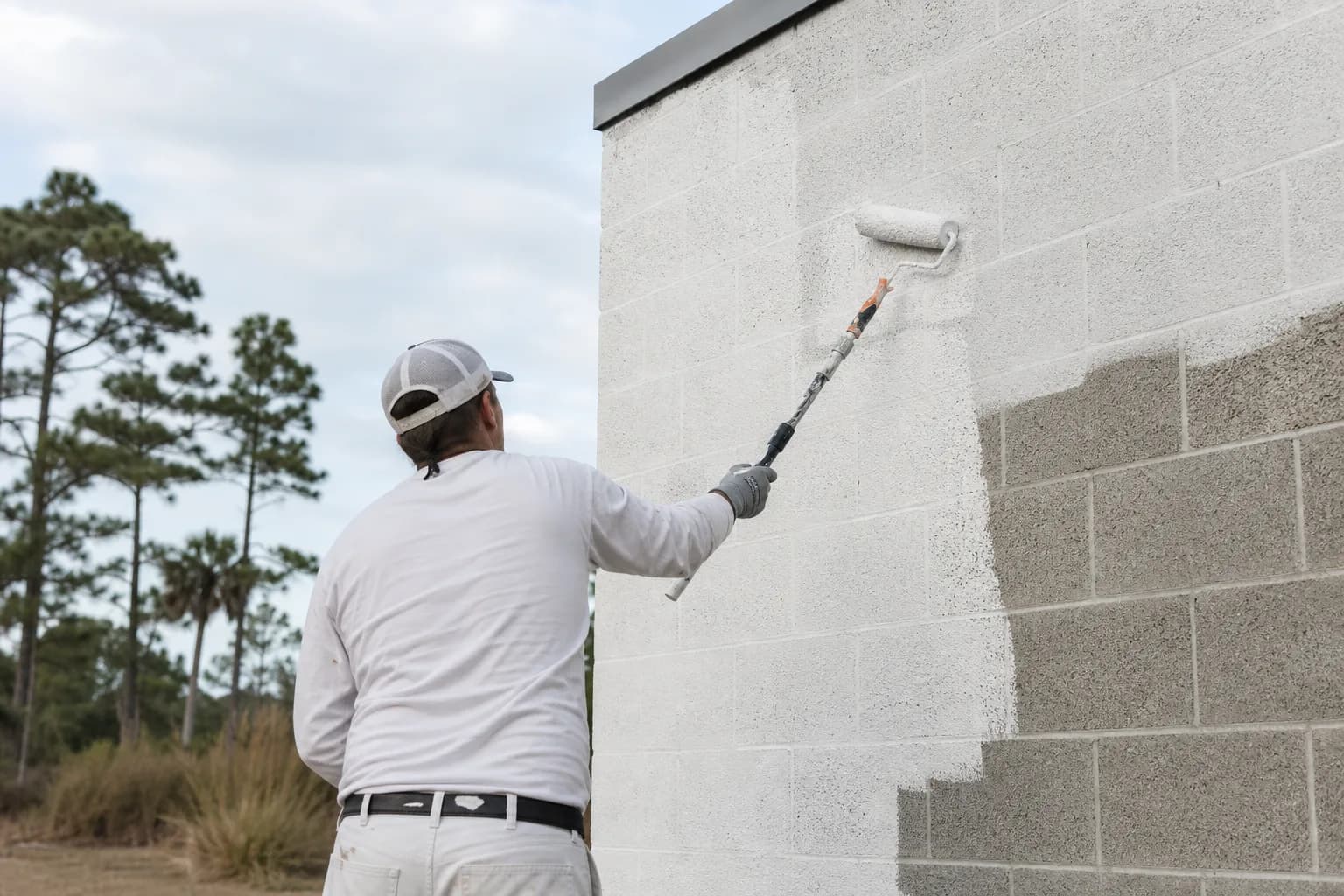
A freshly painted block wall that's flaking and streaked with white powder a year later isn't bad paint — it's bad prep on a surface that behaves nothing like drywall or wood. Cinder block, or CMU, is a sponge made of concrete. It's full of open pores, it pulls and pushes moisture, and on the humid Gulf Coast that moisture is constantly trying to move through the wall. Painting a cinder block wall that lasts means working with that reality, not painting over it.
Here's how we do it on Mobile and Baldwin County buildings — warehouses, shops, block storefronts, foundations — so the finish holds instead of peeling. (Block is mostly a commercial surface, so if you're weighing a larger building project, our commercial painting guide for Mobile and Baldwin County covers how the whole job gets scoped and run.)
This is a different animal from stucco or brick. If your project is one of those, our guides on painting brick without trapping moisture and stucco in a humid climate cover them. Bare concrete block has its own two enemies — open porosity and efflorescence — and beating both is the whole game.
Why does cinder block need block filler, not just paint?
Answer-first: bare CMU has thousands of open pores, so painting it without block filler leaves a pitted, pinholed finish that drinks paint and never seals. Block filler is the fix.
Run your hand over a bare block wall and you feel it — the surface is riddled with tiny voids, the open cells of the aggregate. Roll regular paint onto that and it sinks into the holes, leaving pinholes that show through every coat and a surface that soaks up two or three times the paint it should. Block filler is a thick, high-build masonry primer made to bridge and fill those pores. We work it into the surface with a heavy roller, pushing it into every cell, so what was a moonscape becomes a smooth, uniform base. Once it's filled, the topcoat covers evenly, looks right, and actually bonds.
Efflorescence: the white crust that wrecks the bond
The white, chalky bloom you see on block and its mortar joints is efflorescence — soluble salts inside the masonry that get carried to the surface as water moves through the wall and then left behind when that water evaporates. It's a moisture flag, and it's a bond-killer. Paint over efflorescence and you're gluing your coating to a layer of loose salt; it'll lift the paint right back off.
So we deal with it before anything else. The crust gets dry-brushed off, or lightly ground where it's heavy, then the wall gets scrubbed and rinsed and — this is the part people skip — left to dry completely. We don't wet-wash and paint the same afternoon. And because efflorescence is a symptom, we look for why the wall is wet: a leak, grade pushing water at the foundation, failed mortar joints, missing flashing. Clean the salt, fix the water, then paint.
How we paint a block wall, start to finish
The full sequence on a Gulf Coast block wall looks like this — and the order matters as much as the products.
1. Cure and dry the block
New CMU and mortar get about 28 days to cure; existing block has to be genuinely dry. We check moisture and plan around the weather before a thing goes on the wall.2. Clean off salts and grime
We brush or grind off efflorescence, scrub away dirt and any mildew, rinse, and let it dry fully so the bond isn't sitting on loose salt or chalk.3. Fill the pores
We roll high-build block filler into the open cells, working every pinhole, turning the porous block into a smooth, sealed base for topcoat.4. Spot-treat and point up
We prime stains and chalky spots, repair failed mortar joints, and confirm water isn't getting behind the wall.5. Breathable topcoat, two coats
We finish with a breathable acrylic masonry paint that sheds rain but lets vapor escape, so the wall dries instead of trapping moisture.
New block deserves a special note: fresh CMU is highly alkaline and still giving off moisture for weeks. Paint it too soon and the high pH can chew at the coating while trapped moisture pushes it off. Roughly a month of cure is the rule, and we plan the schedule around it rather than rushing a wall that isn't ready.
Breathable coatings are non-negotiable on the coast
Here's where Gulf Coast block walls go wrong most often: someone seals them up tight. A wall that can't breathe in this climate is a wall that blisters. Masonry holds and moves water vapor, and between humidity, wind-driven rain, and ground moisture, our block is always a little damp somewhere. That moisture has to be able to escape outward. If you trap it behind a film that won't let vapor through, it builds pressure under the paint and lifts it off in sheets.
So on CMU we use a breathable acrylic masonry topcoat — permeable enough to let vapor out, while still shedding liquid rain from the outside. It's a balance: water out as vapor, water off as rain. That's a different goal than a thick, sealing elastomeric membrane, which has its place on cracked stucco but can be exactly the wrong call on block that needs to dry. Picking the right system for the substrate and the exposure is the kind of thing we sort out at the estimate, the same way we choose coatings on any exterior painting job up against salt air and UV.
The bottom line on painting block the right way
A cinder block wall that holds its paint on the Gulf Coast comes down to four things done in order: let the block cure and dry, scrub off the efflorescence and fix the water feeding it, fill the open pores with block filler, and finish with a breathable masonry coating that lets the wall dry outward. Skip any one of them and you're back on a ladder in a year scraping flakes. Respect all four and a block building can look sharp and stay sealed for years.
That's how we approach every masonry job — family-owned since 2013, one accountable crew from your free estimate through the final inspection, all backed by our 1-year workmanship warranty. If you've got a block warehouse, shop, foundation, or storefront that needs paint that lasts, see our commercial painting service or reach out for a free estimate and a written quote within 24 hours. Pay by Cash, Check, or Credit Card.