
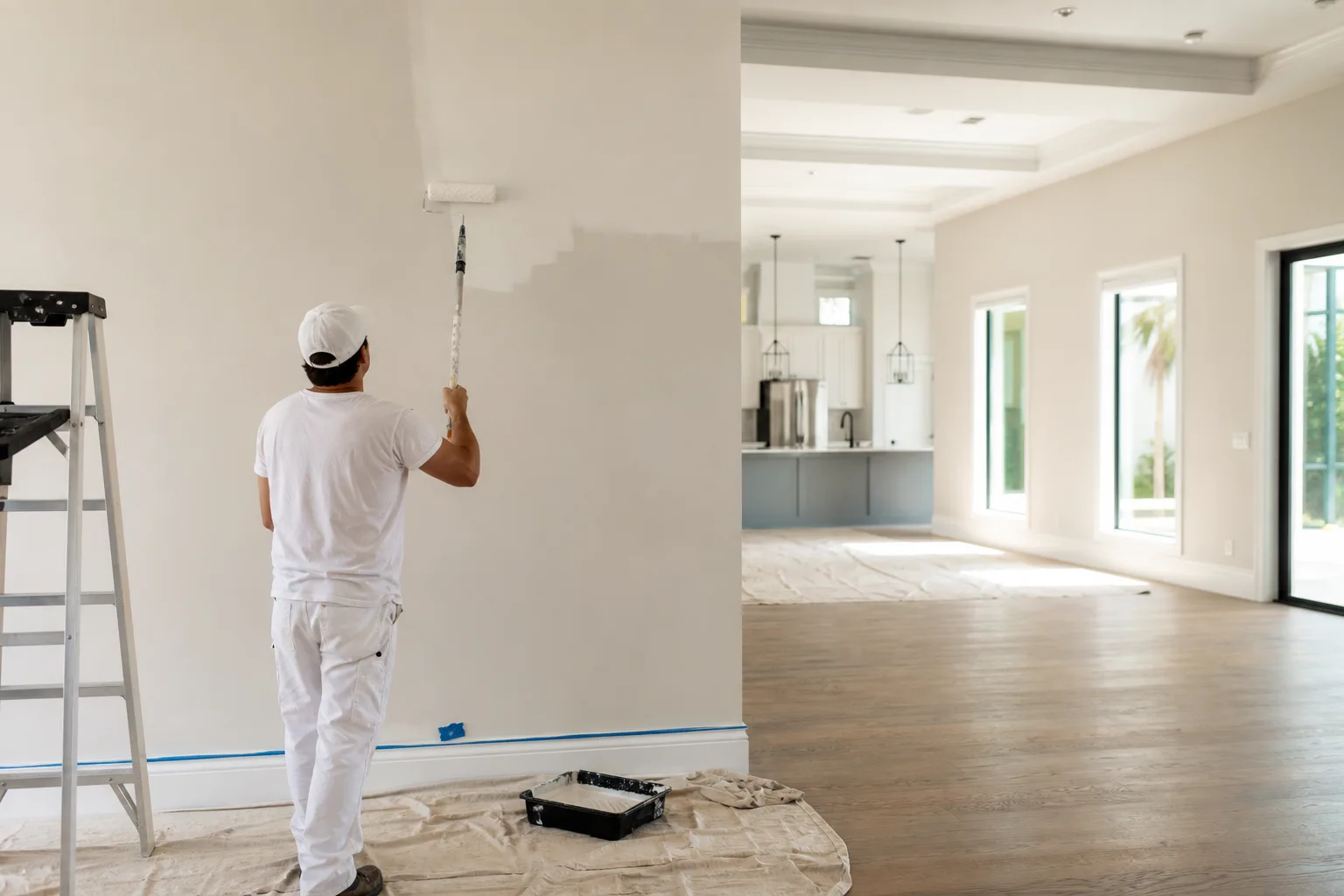
When homeowners ask us what it costs to paint a whole house inside, they want one number — and the honest answer is that no painter can give you a real one over the phone. The cost to paint a whole house interior isn't a flat rate; it's the sum of how big the home is, how many surfaces you paint, what shape the walls are in, and how much prep the job actually needs. A two-bedroom with good walls and walls-only scope is a fraction of a four-bedroom with high ceilings, full trim, and a decade of dings to patch.
What we can do is show you exactly what moves the number, so when you get a written quote it makes sense and you know which levers are yours to pull. This guide breaks down what drives the cost of a full interior repaint and how to budget one without nasty surprises on the invoice.
What actually drives the cost of a whole-house repaint?
The price comes down to a handful of factors, and once you see them, the range stops feeling random. Here's what every honest interior quote is really pricing.
| Cost factor | How it moves the price | Why |
|---|---|---|
| Square footage | Biggest single driver | More wall and ceiling area means more material and more labor hours — it scales with size |
| Ceiling height | Adds noticeably | Tall and vaulted ceilings need extra setup, ladders or scaffolding, and slower, careful work |
| Surfaces included | Major swing | Walls only is fast; adding ceilings, trim, doors, and closets adds a lot of detailed labor |
| Wall & surface condition | Adds with age | Patching, sanding, and priming damaged or older walls is real prep time before any color goes on |
| Number of coats | Adds per coat | Two coats give even color and durability; dark-to-light color changes can need more |
| Paint quality & sheen | Modest but real | Better paint and washable sheens cost more per gallon and last longer — usually worth it |
Two of these are levers you control directly: how many surfaces you paint and the condition you hand us. Everything else is mostly fixed by the house itself.
Square footage is the foundation
Bigger home, bigger number — that part's intuitive. Interior painting scales with the area of wall and ceiling, so the size of your home sets the baseline before anything else. If you want to understand how painters think about it per-square-foot, our interior painting cost per square foot explained post digs into that math. Just know that floor area alone undersells it: a home with lots of hallways, stairwells, and tall rooms has far more paintable surface than its listed square footage suggests.
Surfaces included is the lever you control
This is where two quotes for the "same" house end up hundreds or thousands apart. Walls are fast. Ceilings, trim, doors, baseboards, and closets are slow, detailed, time-consuming work — and that labor is most of the bill on a full repaint.
Prep is invisible until you skip it
On an older Gulf Coast home, prep is the bulk of the labor and the reason a good job costs more than a cheap one. Patching nail holes and cracks, sanding, caulking gaps, and priming bare or stained spots all happen before a drop of color goes on. It doesn't show up as a glamorous line item, but it's exactly what separates a repaint that still looks sharp in five years from one that's peeling and showing flaws by next summer. A suspiciously low quote has almost always cut the prep.
How to budget a whole-house interior paint job
Budgeting a full repaint is less about guessing a number and more about pinning down the scope so the number you get is real. Here's the order we'd walk a homeowner through.
Measure the real scope, not just floor area
Count the rooms and note which surfaces you actually want painted — walls, ceilings, trim, doors, closets — because the surface list drives the price far more than the home's listed square footage.Decide walls-only versus everything
Choose how far the repaint goes. Walls go fast and cost less; ceilings, trim, and doors are slow detailed work, so trimming the surface list is the easiest way to fit a budget.Account for prep and wall condition
Older or damaged walls need patching, sanding, and sometimes priming before paint, and that prep time is a real line item — budget for it instead of being surprised by it.Get a written, itemized quote
Have the painter put the surfaces, coats, prep, paint, and timeline in writing so you're comparing the same job from quote to quote, not a lump number with hidden gaps.
A couple of moves stretch the budget without cutting corners. Paint before you move in if you can — an empty house paints faster and cleaner, with no furniture to move and full access to every wall, which can lower the cost. And time the whole house together rather than one room a year; doing it in one mobilization is usually more efficient than repeated trips.
The details that quietly add to the total
Beyond size and surfaces, a few specifics on your particular home nudge the number — and knowing them ahead of time keeps a quote from feeling like a surprise. The big one is how dramatic your color change is. Going from a light wall to another light wall usually covers in two coats. Going dark-to-light, covering a bold accent wall, or painting over a deep red or navy can take an extra coat or a tinted primer to cover evenly, and that's more material and more time. If you're rethinking your palette during the repaint, our free AI Color Visualizer lets you preview real colors on a photo of your own room before you commit — which also helps you avoid a "we hate it, repaint it" round that doubles the cost of a space.
Room type matters too. Kitchens and bathrooms involve more cutting in around cabinets, tile, and fixtures, and they often call for a more moisture-tolerant paint — both of which run a little higher per room than a simple bedroom. Stairwells and two-story foyers are slow because of the height and the setup. None of this is a reason to skip those spaces; it's just why a flat "per room" average rarely matches a real home.
Finally, be wary of the one-coat shortcut. A single coat can look fine on the wall the day it's painted, but it usually lacks the film thickness for even color and long-term durability, and it shows wear faster. Two coats is the standard we quote for a repaint that holds up. When a competing number comes in surprisingly low, a single coat is one of the first places that corner gets cut — which loops right back to comparing scope, not just price.
Getting an accurate quote — and comparing quotes fairly
The only number that means anything is one based on your actual rooms. That's why our interior painting estimates start with a free in-home visit: we walk the house, talk through which surfaces you want done and what color and sheen, note the prep, and put it all in writing. You get an itemized quote within 24 hours — and because it lists what's painted and what isn't, you can compare it apples-to-apples against anyone else's.
When you do compare, look past the bottom line. Two quotes are only comparable if they cover the same surfaces, the same number of coats, and the same prep. The cheapest number is frequently the one quoting walls-only, one coat, minimal prep — a different, smaller job dressed up as the same one. For the bigger picture on local pricing across services, our cost to paint a house in Mobile and Baldwin County guide is the pillar that ties it all together, and our Gulf Coast interior cost breakdown goes deeper on regional factors. Painting one space instead of the whole place? Our cost to paint a room guide covers that.
Two free tools can help you plan before you ever call: the project timeline calculator gives you a sense of how long a whole-home repaint takes, and if cabinets are part of your refresh, the cabinet painting cost estimator ballparks that piece separately.
When you're ready for a real number, call us for a free in-home estimate. One accountable crew runs your repaint from that first visit through the final inspection, a manager signs off before final payment, and every job is backed by our 3-year workmanship warranty. You can pay by cash, check, or credit card.