
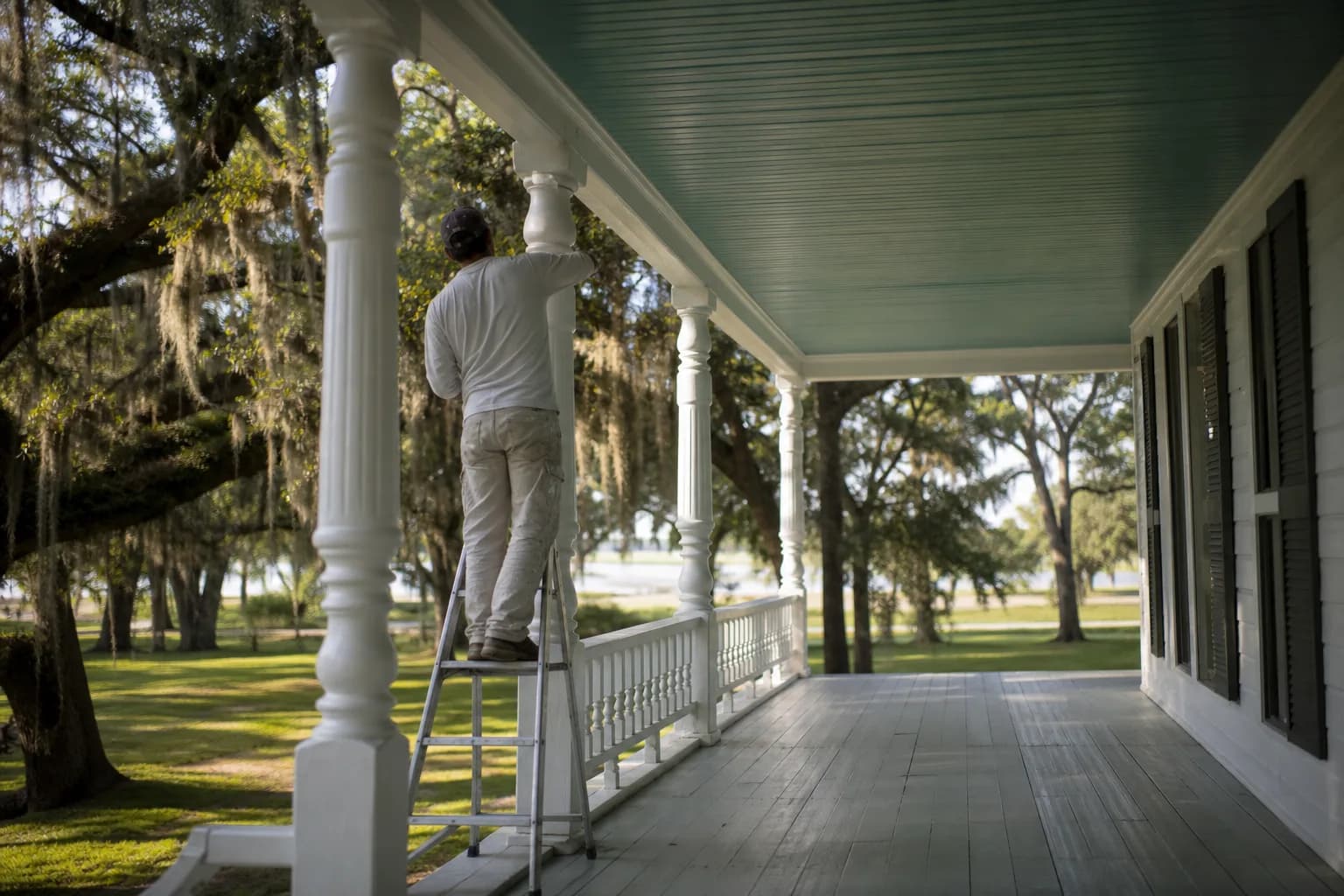
A deep front porch is the best room in an old Mobile house, and it's the one that takes the most weather without a wall to hide behind. Spend an evening on a porch off Government Street or in the Oakleigh district and you'll see all of it at once — a soft blue ceiling overhead, turned columns that have been painted a dozen times, and floorboards that have carried a century of footsteps through hot, wet summers. Painting one of these porches well isn't a deck job. It's a handful of very different surfaces, each with its own rules.
This post is about exactly that: porch painting in Mobile on the older homes, where the porch is a true outdoor room with a tongue-and-groove ceiling, columns, and a hard-working floor. It's not the paint-or-stain decision for a backyard deck — that's its own guide. This is the front porch, the part of the house everyone sees, and how to paint it so it holds up to our climate and honors a home with some age on it.
Why are Mobile's older porches their own job?
Mobile is an old city with old housing, and the porches show it. The median home here was built back in the early 1970s, and the historic districts — Oakleigh Garden, De Tonti Square, Old Dauphin Way — run far older than that, with deep porches built in an era when the porch was where you lived in summer. That means real materials: solid-wood tongue-and-groove ceilings, turned or boxed columns, wood floors and rails, layered with decades of paint. None of it behaves like a modern composite deck.
It also means weather has had a long time to work. Mobile sees more than 50 inches of rain a year and summer highs near 94 degrees, and a porch lives out in all of it. The roof shelters the ceiling and columns, but wind-driven rain still reaches them, and the floor takes both the foot traffic and whatever weather blows in. So an older porch is usually part prep, part repair, and part knowing which finish belongs on which surface. For where these homes sit and how their neighborhoods read, our guide to painters in Mobile by neighborhood maps the territory, and the Mobile service area page covers the city as a whole.
The haint-blue ceiling
If there's one Mobile porch tradition, it's the pale blue ceiling. Haint blue — a soft blue-green that turns up on porch ceilings all through the older South — is the color people ask us for most on a front porch here. The folklore is that it keeps "haints," or spirits, from settling in; the everyday reason it stuck is simpler. It reads like a patch of sky, it makes a deep porch feel cool and calm, and it ages gracefully under a roof that keeps the hard sun off it.
You don't have to go blue — we paint porch ceilings whatever suits the house. But if you want the traditional look, the AI Color Visualizer lets you see a porch-ceiling blue on your own porch before you commit, which beats guessing from a tiny chip. The work itself is mostly in the prep: an old tongue-and-groove ceiling has been painted many times, so it's about getting a sound, clean surface and then cutting paint cleanly into every groove so the lines stay crisp. Done right on a sheltered ceiling, a quality finish lasts a long time.
The columns, rails, and the hard-working floor
Below the ceiling, the surfaces get tougher. Columns and rails take some wind-driven rain and sun but no foot traffic, so a quality exterior finish, brushed carefully on the turned and detailed parts, holds up well. The floor is the one that earns its keep. It carries every footstep and takes whatever weather reaches it, so it needs a porch-and-floor enamel built for traffic — or, on a more open or exposed floor, a stain that wears down gradually instead of peeling. Which one fits depends on how covered your porch is and the look you're after; we read the boards and tell you straight.
Before any of that, the wood has to be sound. On porches this old, that's not a given — column bases wick moisture up from the masonry, floor edges drink standing water, and a long-shaded ceiling board can hide rot. Soft spots, popped fasteners, and rot get repaired before paint, because a coat over soft wood peels no matter how good the product is. That's where our carpentry and wood repair comes in alongside the painting, and the common spots wood rot starts on a house checklist names the porch trouble areas to check first.
How we paint an older Mobile porch
Here's the order we work, ceiling to floor, so each surface gets what it needs and the working floor cures last and clean.
Repair the wood before any paint
We check the floor, column bases, and ceiling boards for soft wood, popped fasteners, and rot, and repair or replace what we find first. Paint over soft wood peels within a season, so on an older porch this step comes before everything else.Clean and prep every surface
We wash off the chalk, mildew, and grime our humidity grows, scrape and sand failing paint, and set and fill nail holes in the tongue-and-groove. Then the wood dries fully — a porch can look dry on top and still hold moisture after our frequent rain.Spot-prime bare wood and stains
Bare wood, repaired areas, and any water or tannin stains get primed so the finish bonds evenly and old stains don't bleed through the new color, especially on a ceiling that's been recoated many times.Paint the ceiling, working the grooves
We brush paint into every groove of the tongue-and-groove first, then roll or spray the faces. That keeps the lines crisp and gets full coverage in the recesses a roller alone skips — the detail that makes an old ceiling look right.Coat the columns, rails, and trim
Columns, balusters, rails, and trim get a quality exterior finish, with the turned and detailed parts brushed so the profile stays clean. These take weather but no traffic, so a good finish here holds for years.Finish the porch floor for traffic
Last, the floor — a porch-and-floor enamel built for foot traffic, or a stain on a more exposed floor. Doing it last means the hardest-working surface cures undisturbed after the rest of the porch is done.
Worth doing right
An old Mobile porch is worth the extra care. Get the prep and the repairs right, match the finish to each surface, and that porch reads crisp and cared-for from the street and holds up through our summers — backed by our 3-year workmanship warranty. We've been family-owned and working Mobile and Baldwin County since 2013, with a 4.8-star rating across hundreds of Google reviews, and one accountable crew runs your job from the free estimate through the final inspection.
For more on painting the older homes these porches belong to, see our guide to painters in Mobile by neighborhood and our exterior painting service. If you're weighing finishes for a separate backyard deck, paint or stain your deck in coastal Alabama covers that decision in full.
Ready to bring your front porch back? Book a free in-home estimate and we'll look at the ceiling, columns, and floor, handle any carpentry the right way, and email you a written quote within 24 hours.