
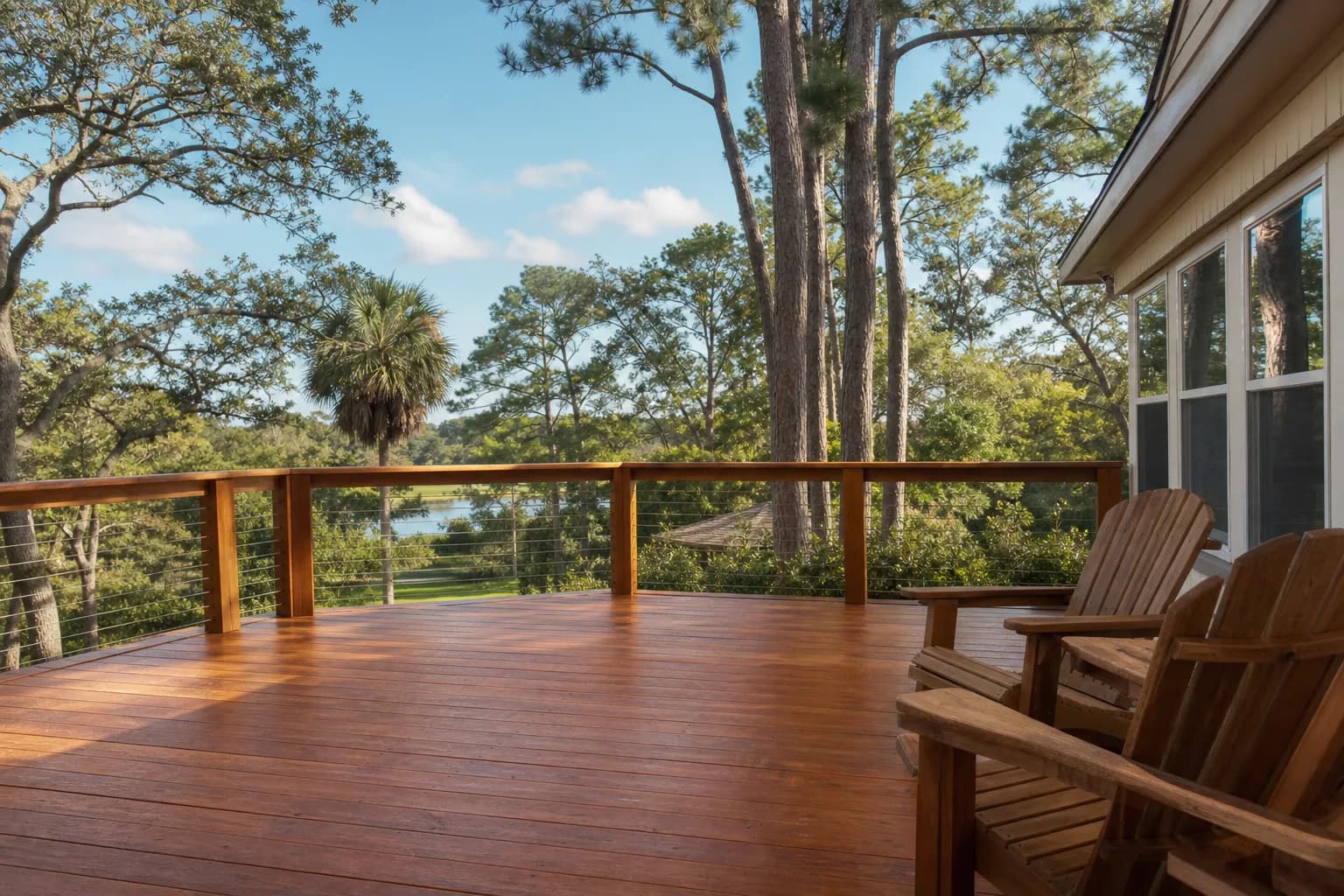
Few things take a beating like a deck in coastal Alabama. It sits out in full sun, soaks up more than 50 inches of rain a year, swells and shrinks with the humidity, and gets walked on barefoot all summer. So when a deck starts looking gray and tired, the real question isn't just "what color" — it's paint or stain. Pick wrong for our climate and you'll be redoing it far sooner than you should. Here's how each finish actually holds up to Gulf-Coast sun, humidity, and foot traffic, what upkeep each one needs, and how to decide which is right for your deck.
Paint vs stain: how each finish handles a deck
The core difference is simple. Paint forms a film that sits on top of the wood. Stain soaks into the wood and colors it from within. That single distinction drives almost everything about how the two perform on a deck down here.
A film on top can look great and give you a solid, uniform color — but on a flat walking surface, that film takes the full beating of UV, standing water after a storm, and foot traffic. When moisture works underneath it, it lifts and peels in sheets, and a peeling deck is both ugly and slippery. Stain wears differently: because it's in the wood rather than on it, it fades and thins gradually instead of peeling, so a worn stained deck still looks like wood, not a flaking floor.
| Factor | Deck paint | Deck stain |
|---|---|---|
| How it works | Forms a film on top of the wood | Soaks into and colors the wood |
| Look | Solid, uniform color; hides grain | Shows the wood grain; natural look |
| On the walking surface | Prone to peeling under sun, water, and traffic | Wears down gradually, rarely peels |
| Recoat effort | Often needs scraping or sanding first | Usually clean and recoat |
| Hides flaws | Good at hiding old, weathered wood | Shows more of the wood's condition |
| Best fit | Older or previously painted decks; solid color | Most sound wood decks in a humid climate |
Why the Gulf-Coast climate changes the answer
Down here, the climate does the deciding as much as your taste does. Our intense sun breaks down any finish on the surface, humidity and 50-plus inches of annual rain drive moisture into and out of the wood constantly, and on a deck the flat boards never get a break from either. That combination is brutal on a paint film and merely tiring on a stain.
There's a moisture trap, too. Coastal decks rarely dry out completely between rains, and sealing a film of paint over wood that's holding moisture is a recipe for peeling and even rot underneath. Stain's breathability — its ability to let the wood release moisture — is a real advantage in a climate this wet. If your deck is on a truly coastal lot near Gulf Shores or Orange Beach, add salt air to the list of stresses, which is one more reason a finish that wears gradually beats one that fails all at once. The same coastal-weather logic drives every exterior surface on your home, which we cover in our coastal exterior painting guide for Mobile and Baldwin County.
The wood under your feet matters too. A lot of Gulf-Coast decks are pressure-treated pine, which arrives wet from the yard and needs to dry out before it will hold any finish — rush it and the coat won't bond. Older decks may be cedar or a hardwood that takes finish differently and shows its age in different ways. We read the actual boards before we recommend anything, because the species, the age, and how the deck was built decide far more than what looks good on a color card.
Upkeep: what you're signing up for with each
Whatever you choose, plan to maintain it sooner than the can suggests — Gulf-Coast conditions shorten every finish's life. The difference is how painful that maintenance is.
With stain, upkeep is straightforward. A transparent or semi-transparent stain on the walking surface typically needs a refresh every one to three years here; rails and shaded areas last longer. Recoating usually means a good cleaning and a fresh coat — no scraping, no peeling to chase. With paint or solid stain, you can get three to five-plus years on rails and vertical surfaces, but when the flat surface does fail, the prep to fix it is heavier: scraping, sanding, and spot-priming before you can recoat.
It also helps to think of a deck as several surfaces, not one. The flat boards take the full sun and every footstep, so they wear fastest no matter what's on them. The rails, posts, and any covered or shaded sections take far less abuse and hold a finish much longer. That's why a deck rarely fails all over at once — and why a smart finish plan can lean tougher on the boards and let the protected parts ride longer between coats. Either way, staying ahead of the walking surface with a timely recoat is cheaper and easier than waiting for it to gray out and start over.
One more thing worth knowing before you choose: going from stain to paint is largely a one-way door. You can paint over a properly prepped, previously stained deck, but stripping paint back off later to return to a natural stained look is a big, expensive job. So decide deliberately rather than by default.
So which should you choose?
Here's the honest short version for most coastal Alabama decks:
Sound wood, natural look
If your deck is structurally sound wood and you like seeing the grain, stain is usually the better call here — it wears gracefully and is easy to maintain in our climate.Older or already painted
If the deck is older, weathered, or already painted, paint or a solid stain can hide a lot and give you a clean, uniform color without stripping back to bare wood.Want a specific solid color
If a particular solid color is the whole point, go with paint or solid stain on the rails and a tougher finish on the boards — just budget for more upkeep on the walking surface.Not sure
Have it looked at. The wood species, the deck's history, and its current condition decide the right finish more than any rule of thumb.
A worn deck often needs more than a finish, too — soft boards, popped fasteners, and rot have to be addressed first, which is where our carpentry and wood repair work comes in before any stain or paint goes on. Prep and repair are what make the finish last, the same as on the rest of the house. If you're weighing the same paint-or-stain question for the fence out back, the trade-offs shift a little — a fence stands in wet soil and has no flat boards taking foot traffic — and we cover that in paint vs stain for a wood fence on the Gulf Coast.
If you're weighing paint or stain for your deck, book a free in-home estimate. We'll look at the wood, tell you honestly which finish will hold up best for your deck and your climate, and put a written quote in your hands within 24 hours. You can also see the full scope of our outdoor work on our exterior painting service page.