
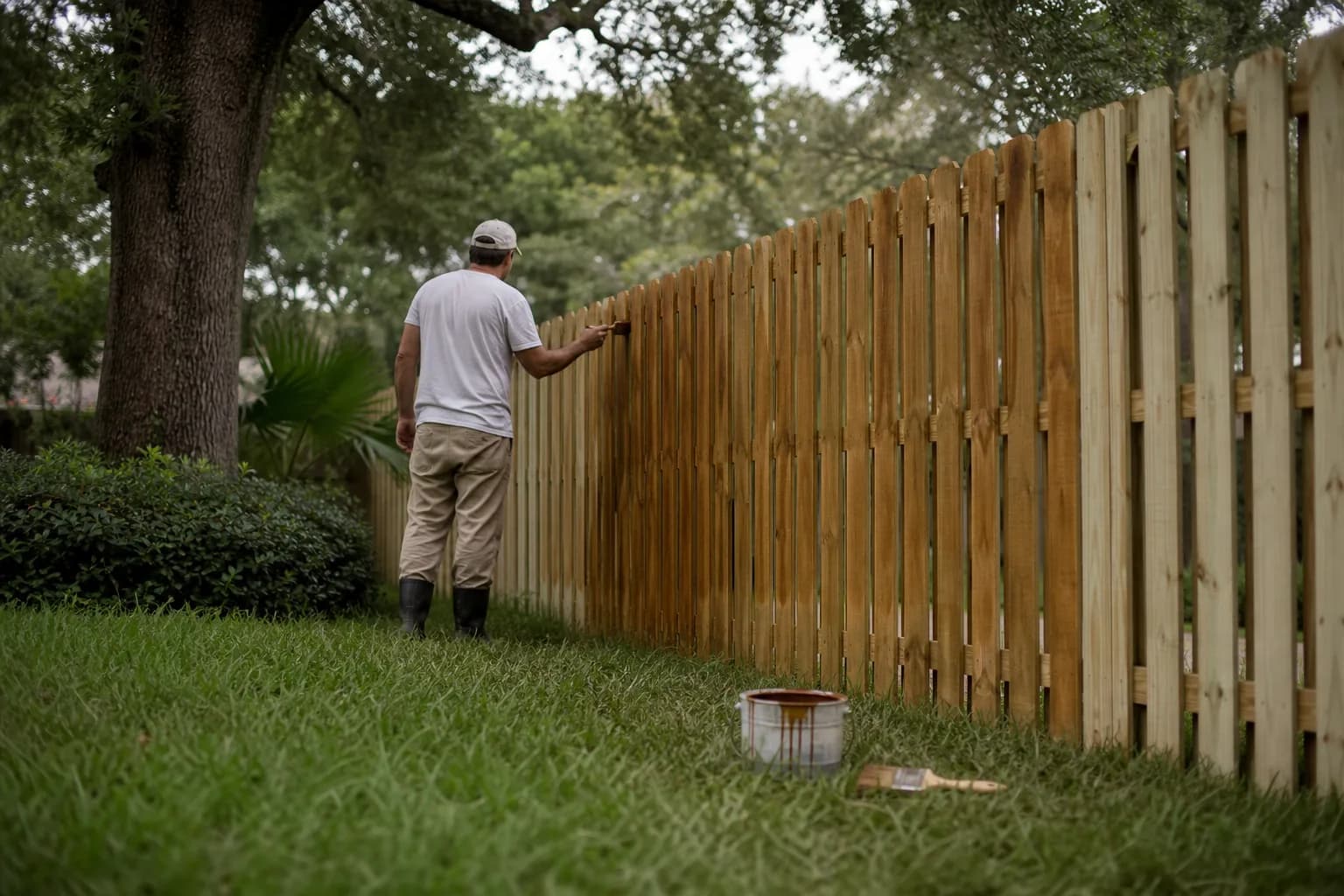
A new fence goes up looking sharp, and a year later the street-facing side is graying while the boards near the ground start to cup. On the Gulf Coast, a wood fence stands in wet soil, bakes in the sun, and catches weather on both faces at once — so when it's time to finish it, paint or stain is a real question. The honest answer depends less on what looks good on a sample and more on how your fence is built and how it lives in our climate. Here's how each finish holds up, what upkeep you're signing up for, and how to choose.
Why a fence is harder on a finish than a wall
A fence stands in the ground and gets wet from both sides — and that changes everything about how a finish behaves on it. Ground moisture wicks up through the posts and lower pickets constantly in our humid soil, while sun and our 50-plus inches of annual rain work the faces from outside. A house wall sits on a foundation and only weathers on one side; a fence has no such break.
That ground contact is why paint peels on fences far more than on siding. A paint film seals the surface, and when moisture drives up from the soil it gets trapped against the wood and blisters the coating from underneath. Stain's breathability — its ability to let the wood release that moisture — is a genuine advantage on a fence in a climate this wet.
If your fence is on a truly coastal lot near Gulf Shores or Orange Beach, add salt air to the list of stresses — one more reason a finish that wears gradually beats one that fails all at once. The same coastal-weather logic runs through every exterior surface on your home, which we cover in our coastal exterior painting guide for Mobile and Baldwin County.
Paint vs stain on a fence: the honest comparison
Both finishes can work on a Gulf Coast fence. They just trade off differently than they do on a deck — a fence is all vertical surface and ground contact, with no flat boards taking foot traffic. Here's how they stack up.
| Solid stain / paint | Transparent / semi-transparent stain | |
|---|---|---|
| Look | Solid color, hides grain and mismatched boards | Shows the wood grain, natural tones |
| Ground-moisture tolerance | Lower — film can trap wicking moisture | Higher — breathes, lets wood release moisture |
| How it fails | Peeling and blistering, needs scraping | Fades gradually, no peeling to chase |
| Recoat prep | Heavier — scrape, sand, spot-prime | Lighter — clean and recoat |
| Best for | Older or mismatched fences, bold color | Sound newer pine, low-fuss upkeep |
The pattern: a solid stain or paint gives you a clean, uniform color and hides an aging fence, but it asks for heavier prep when it fails. A penetrating stain wears gracefully and is easy to keep up, but it won't deliver a bold solid color or fully hide a fence that's already mismatched. There's also a one-way-door rule worth knowing — going from stain to paint is easy, but stripping paint back off to return to a natural stained look is a big, expensive job. Decide deliberately. If color is the real question, our color consultation helps you land on a fence tone that works with your house and won't read dated in a couple of years.
Upkeep and the right way to finish a fence
Whatever you choose, plan to maintain it sooner than the label suggests — Gulf Coast sun and ground moisture shorten every finish's life. The difference is how painful that upkeep is. A transparent or semi-transparent stain typically needs a refresh every couple of years on the weather-facing pickets, with shaded runs lasting longer, and recoating is just a wash and a fresh coat. Paint or solid stain can hold a few more seasons before it fails, but when it does, the prep to fix it is heavier.
Two things make or break a fence finish no matter which you pick:
Read the fence and the wood
Check whether it's newer pressure-treated pine still drying out, or older cedar or weathered wood, and look at how it's built. Species, age, and condition decide the right finish far more than a color card does.Clean and let it dry
Wash off dirt, mildew, and any failing old finish, then let the fence dry through — both faces. Coastal wood holds moisture even when the surface looks dry, and finishing over damp wood is the fastest route to peeling.Spot-repair before you finish
Reset or replace any rotted pickets, loose rails, or leaning posts before a finish goes on. There's no point coating a board that needs to come out, and ground-level rot only spreads if you paint over it.Apply the right finish to both sides
Coat both faces of the fence evenly with the chosen paint or stain so moisture can't drive in through an unfinished back and cup the boards. Even coverage front and back is what makes it last.
That repair step is where a finish job sometimes becomes a carpentry job. Posts that have rotted at the ground line, rails pulling loose, or pickets gone soft need to be reset or replaced before any finish goes on — coating bad wood just hides the problem until it gets worse. We handle the wood repair and the finish together so you're not chasing two trades.
So which should you choose for your fence?
Here's the honest short version for most Gulf Coast wood fences:
- Sound, newer pine and a natural look — a penetrating stain is usually the easier call. It breathes with the wood, shrugs off ground moisture better, and refreshes without peeling.
- Older, weathered, or mismatched fence — paint or a solid stain hides a lot and gives you a clean, uniform color, as long as you budget for heavier upkeep when it eventually fails.
- A specific bold color is the whole point — go paint or solid stain, finish both sides, and stay ahead of the recoat.
- Not sure — have it looked at. The wood, the build, and the ground contact decide far more than any rule of thumb.
If you're also weighing the same question for the deck out back, the trade-offs shift because a deck adds flat boards and foot traffic — we cover that in paint or stain your deck in coastal Alabama, and the seasonal side in the best time of year to stain a deck on the Gulf Coast. For the fence itself, our exterior painting crew reads the wood, handles any repairs, and finishes both sides properly. Book a free estimate and we'll tell you straight whether your fence wants paint, stain, or a little wood repair first.