
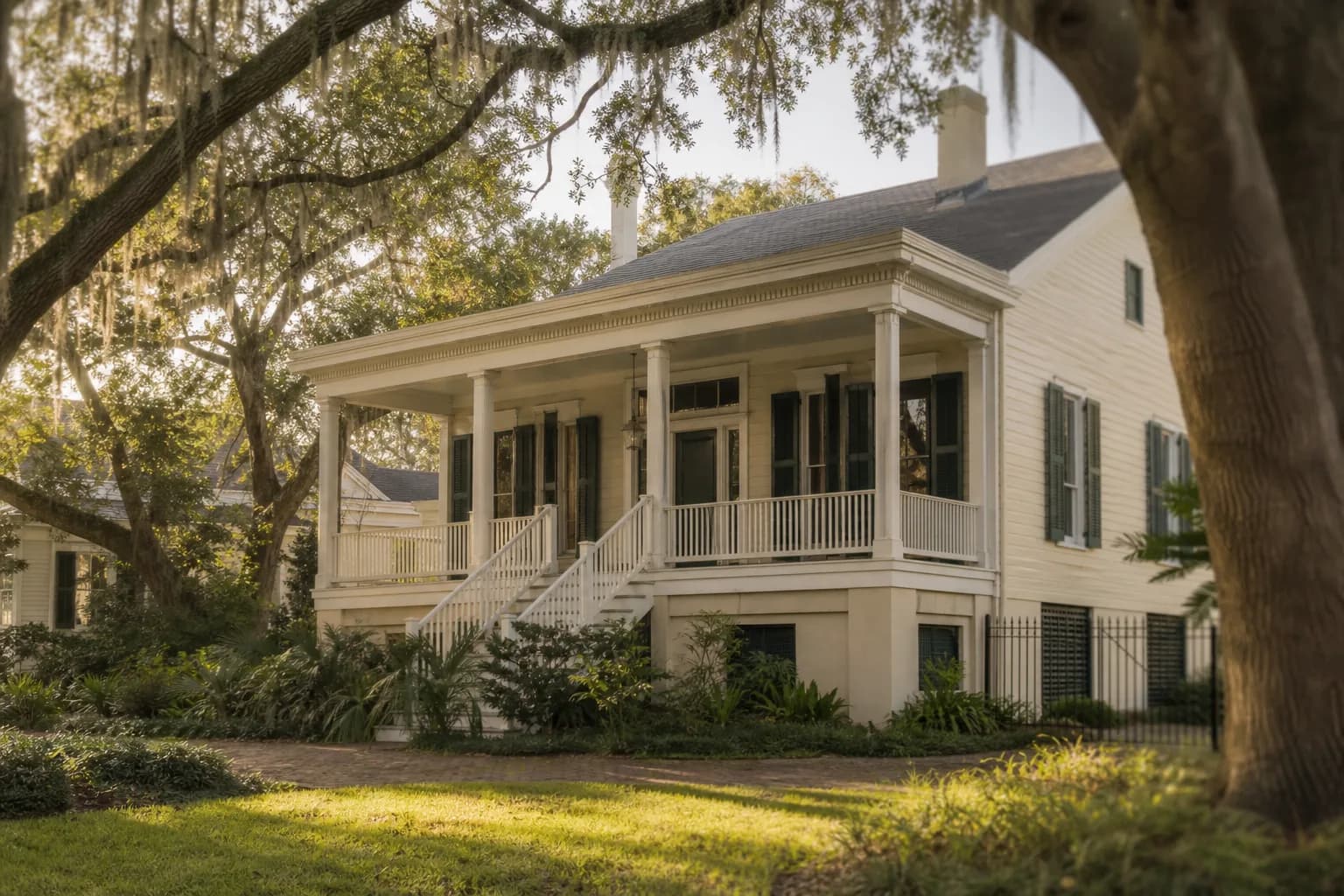
Walk the brick sidewalks of Oakleigh Garden and you're looking at some of the oldest houses in Mobile — raised cottages and columned townhouses that went up in the 1830s, '40s, and '50s, decades before the gingerbread Victorians a few neighborhoods over. These homes were built for a quieter kind of color. Paint one like a Queen Anne and it reads as a costume; paint it within its own era and the columns, the deep porch, and the proportions all snap back into focus.
Choosing Oakleigh Garden paint colors starts with one fact: this is antebellum and Greek Revival ground, not Victorian streetcar-suburb ground. Here's how to land a scheme that fits the house, clears the district's expectations, and stands up to the Gulf-Coast climate.
Start with the era: 1830s–1850s, not the 1890s
The single biggest mistake on a house this old is borrowing a palette from the wrong century. Oakleigh Garden's character was set in the antebellum decades, when the fashionable look was restrained and classical — a soft, light body, brilliant white columns and trim, and dark, sober shutters. The loud, layered three- and four-color schemes people associate with "historic homes" came later, with the Victorians. They look wrong on a Greek Revival.
Get specific about what you actually own. A raised Creole cottage wears color differently than a center-hall Greek Revival townhouse, and both differ from the simpler Federal-influenced houses scattered through the district.
| Home type in Oakleigh Garden | Palette that fits the era |
|---|---|
| Greek Revival (columned) | Light, near-white or pale stone body to read as 'stone,' brilliant white columns and entablature, dark green or black shutters |
| Raised Creole cottage | Soft buff, putty, or pale ochre body, white porch posts and trim, louvered shutters in deep green |
| Antebellum townhouse | Warm white or pale gray body, crisp white trim, a restrained dark front door — minimal accent colors |
| Federal-into-Greek Revival | Quiet warm neutrals, white trim, shutters as the one dark element |
Notice what these have in common: low contrast, light bodies, and the shutters doing almost all the dark work. That restraint is the period look. Greek Revival in particular was meant to evoke classical stone temples, which is why so many of these homes read best in a soft white or the palest gray — the body color is imitating marble, not showing off.
Why doesn't the Victorian playbook transfer here?
It's worth saying plainly, because the advice you'll find online is mostly written for later houses. The polychrome "painted lady" approach — a saturated body, two or three contrasting trim colors, and a bright accent picking out every bracket — was a Victorian invention. Oakleigh Garden's homes were a generation old by then.
On a Greek Revival or a raised cottage, that busy scheme fights the architecture. These houses get their drama from form: tall columns, deep shaded porches, simple strong lines. Color's job here is to stay out of the way and let the proportions speak. One light body, clean white trim, and dark shutters will almost always look more correct — and more expensive — than a six-color job ever could.
Fixed elements set your limits
Before you fall for a swatch, look at what isn't changing. The roof, any exposed brick on the foundation or chimney, the brick of the sidewalk and steps, and the masonry of a raised cottage's ground floor all have to live with your color. A warm red-brick base, common on these older homes, pulls you toward warm whites, buffs, and putties — and away from the cool blue-grays that have been trendy on new builds, which would clash badly here.
The shutters are the one place to commit. Historic dark greens (think a deep, slightly grayed bottle green) and near-blacks are the safest, most period-correct choice, and they give a light-bodied house all the contrast it needs.
Respect the district's review
Oakleigh Garden is a locally designated historic district, and that's a big part of why it still looks like itself — the same protection that shapes color in nearby Mobile districts like De Tonti Square and Church Street East just off Government Street. Exterior changes — including color — can be subject to review, so check with the City of Mobile's Architectural Review Board about what applies to your block and your scope before you settle on a scheme. Confirming up front beats repainting after the fact. Keep documentation of any approved colors with your house records; it helps at resale and the next time the house needs paint.
Color is only as good as the prep underneath it
The most period-correct palette fails fast if the surface isn't ready — and on a house pushing 150 or even 190 years old, prep is most of the job. Prep is 80% of a paint job that lasts. On original cypress and heart-pine siding we wash off chalk and grime, scrape failing paint back to a sound edge, treat any soft or rotted wood, and prime every bare spot before a drop of finish goes on. Old-growth wood rewards that patience; it'll hold a finish beautifully when it's prepped right.
The climate makes it non-negotiable. Just blocks from Mobile Bay, Oakleigh Garden sees roughly 52 inches of rain a year, July highs near 94°F, and the salt-tinged humidity off the water that barely lets up — conditions that are hard on exterior paint and quick to find any corner that got skipped. The soft white you chose so carefully should still look right in year five, and that comes down to the work under the finish, not the brand on the can. Our exterior painting service is built around that prep-first approach, and Mobile's median home is nearly 50 years old, so we spend most of our days on houses that need exactly this kind of care.
Putting your Oakleigh Garden palette together
Match the antebellum era, keep the contrast low and the body light, let the shutters carry the dark, confirm the district's rules, and insist on real prep. Do those things and your home will look like the best version of what it has always been. For the wider district context and approval process, see our guide to painting Mobile's National Register historic homes, and for a neighboring district with a later, more Victorian palette, compare our Old Dauphin Way color guide. For the city at large, here's our Mobile exterior painting overview.
Pro 1 Painters is family-owned since 2013 with a 4.8-star Google rating, a Mobile office about 15 minutes from the district, and a 3-year workmanship warranty on our work. Ready to choose your colors? Call us for a free on-site estimate and a written quote within 24 hours. Pay by Cash, Check, or Credit Card.