
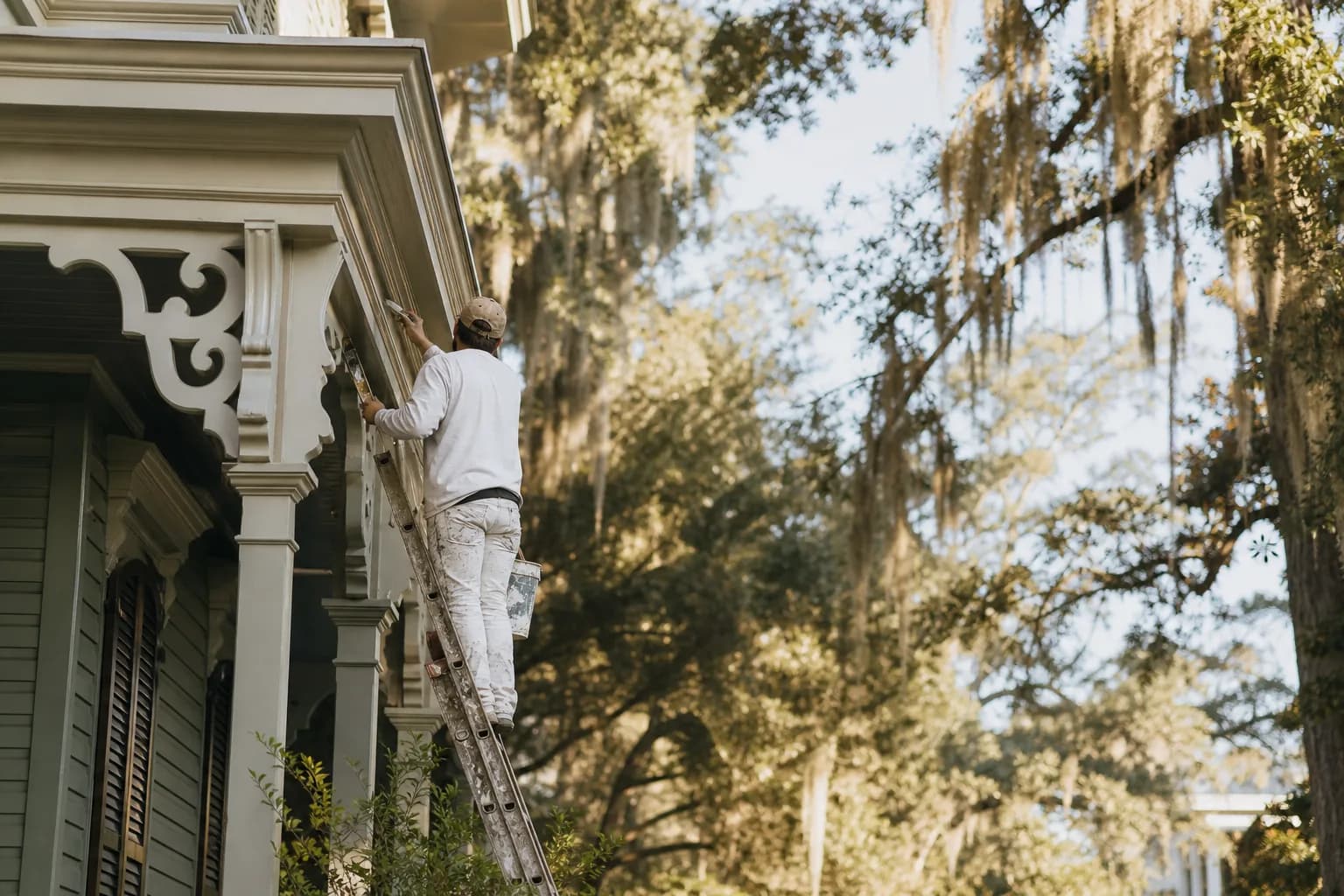
Stand on a quiet block off Government Street and you're looking at homes that have weathered more storm seasons than anyone alive. Greek Revival columns, Italianate brackets, Queen Anne spindlework, deep Craftsman porches — Mobile's old neighborhoods carry it all. Painting one of these houses isn't the same as painting a 1990s build out in the county. The wood is older, the layers are deeper, the colors have history, and in some districts there are people whose job is to care what color you choose.
That's not a reason to put it off. It's a reason to do it right. Here's how we approach painting a historic home in Mobile, district by district, so the finish lasts and the house still looks like itself.
Why does the era matter in Mobile's historic districts?
Mobile has one of the richest collections of old architecture on the Gulf Coast, and several of its neighborhoods are listed on the National Register of Historic Places. Each one has a personality, and that personality should drive the palette.
| District | Era & character | Palette that tends to fit |
|---|---|---|
| Old Dauphin Way | Mid-1800s to early 1900s; the largest district, Greek Revival through Craftsman | Ranges widely by block — soft historic neutrals, deeper earth tones on the later bungalows |
| Oakleigh Garden | Centered on the 1833 Oakleigh mansion; Greek Revival, Italianate, Queen Anne | Antebellum lights and creams; richer Victorian schemes on the later homes |
| De Tonti Square | Antebellum; Late Federal and Greek Revival brick townhouses | Restrained, masonry-friendly trim colors; crisp whites and soft greens |
| Church Street East | Downtown; a mix of 19th-century styles, residential and civic | Period-appropriate to each building's style and date |
| Leinkauf | Early-1900s streetcar suburb; Queen Anne to Craftsman | Multi-color Victorian schemes; warm Craftsman earth tones |
| Lower Dauphin Street | Mobile's oldest intact business district | Commercial-historic palettes; storefront and cornice accents |
The point isn't to memorize this. It's that a color that's perfect three blocks over can look wrong on your house if the architecture is from a different decade. A 1908 Leinkauf foursquare wears a multi-color Victorian scheme beautifully. A De Tonti Square Federal townhouse usually wants something quieter that lets the brick lead.
Color and the architectural review question
Here's the part people worry about most, so let's be straight about it. Some of Mobile's historic neighborhoods are locally designated, and exterior changes in those areas — including paint color — can fall under architectural review by the city. The original Oakleigh Garden nomination itself notes that homes in the district were restored "with approval of the Architectural Review Board." Rules differ by district, and they differ by what you're actually changing.
We're painters, not the city, so we won't tell you what your specific block requires. What we will tell you is the smart order of operations.
Find out if your home is in a regulated district
Locally designated historic districts can have review requirements that the broader National Register listing does not. A quick check with the City of Mobile tells you which rules apply to your address before you fall in love with a color.Choose period-appropriate colors early
If review applies, period-correct palettes move faster than something off-trend. We'll bring color help to your free estimate so you're choosing from schemes that suit your home's era — and that you won't regret in two years.Document before you paint
Photos of the existing exterior and the proposed colors make any approval conversation easier. It's also just good record-keeping for a house worth protecting.Schedule the work around the answer
Once you know what your district allows, we build the project around it. No surprises, no repainting because a color didn't clear.
Period palettes also read very differently at full scale than on a fan deck, especially in Mobile's bright Gulf light. Before you settle on a historic scheme, snap a photo of your house and test period-appropriate colors on your own home with our free AI Color Visualizer — it's an easy way to see how a body-and-trim combination sits on the architecture before you take it to review.
Lead-safe prep on pre-1978 homes
Almost every original home in these districts predates the 1978 ban on lead-based house paint. Across Mobile as a whole, the median home was built around 1973, and entire historic blocks go back to the 1800s — so in the old neighborhoods, lead in the existing paint isn't an edge case. It's the baseline assumption until testing proves otherwise.
That changes how the prep gets done. Dry-scraping or sanding old paint without containment throws lead dust into your yard, your soil, and your home. The careful way is to test, contain the work area, capture the debris, and clean up to a verifiable standard. We follow lead-safe work practices on older homes for exactly this reason — it protects your family and your neighbors, not just the paint job.
This is also where breathable systems earn their keep, which we'll get to — but first, the wood.
Wood rot, period trim, and why prep is most of the job
Mobile is a wet place. The city averages around 52 inches of rain a year, and the Gulf humidity rarely lets wood fully dry out between storms. That's hard on any house, and it's brutal on hundred-year-old trim. The decorative pieces that make these homes special — Italianate eave brackets, Queen Anne spindles, deep Craftsman rafter tails, tall window sills and casings — are exactly the spots where water collects and the old paint film finally gives up.
Paint can't fix rotted wood. It just hides it for a season, then peels off and takes your money with it. So on a historic exterior, the real work happens before the finish coat.
Our prep on an older Mobile home runs like this:
Wash and assess
We clean off the chalk, mildew, and salt-laden grime that build up in this climate, then look hard at every elevation for soft wood, open joints, and failing caulk.Repair or replace damaged wood
Rotted trim, sills, brackets, and fascia get repaired or replaced with sound material. Our carpentry crew can rebuild period profiles so the detail matches what was there.Scrape to a sound edge and feather
Failing paint comes off to a stable surface, edges get feathered smooth, and bare wood gets spot-primed so the new system bonds instead of peeling at the seams.Prime the bare and the repaired
Fresh wood and patches get the right primer before topcoat. On an old house this is non-negotiable — it's what keeps the color from lifting a year later.Caulk, then finish
We seal the gaps that let Gulf water in, then apply the finish coats. Good prep is most of why a paint job lasts down here — the brand on the can is a distant second.
That sequence is why we say prep is roughly 80% of a paint job that actually holds up in this climate. On a historic home it's even more true, because the surfaces are older and the stakes are higher. If you want the deeper version of how we handle Gulf-Coast exteriors generally, we walk through it in our exterior house painting guide for Mobile and Baldwin County.
Breathable systems for old walls
There's one more thing that separates a historic-home paint job from a new-construction one: how the wall handles moisture.
Older Mobile homes — especially wood-sided ones and some of the masonry stock in De Tonti Square and Lower Dauphin Street — were built to let water vapor move through the wall and escape. Seal an old wall under the wrong modern coating and you can trap that moisture inside, where it pushes the new paint right back off and can feed rot underneath. It's a common reason "I just painted this two years ago" turns into peeling.
The fix is matching the system to the substrate: more permeable, breathable products on the surfaces that need to release moisture, rather than locking everything under a tight film. On historic wood and masonry, that breathability is often the difference between a finish that lasts and one that fails from the inside out.
Doing it once, doing it right
A historic home in Mobile is worth the extra care. Get the era-appropriate color, clear any review your district requires, prep with lead-safety on pre-1978 surfaces, fix the rot before the finish goes on, and let an old wall breathe — and you get a paint job that honors the house and stands up to the Gulf for years, not seasons.
Pro 1 Painters has been a family-owned Mobile-area crew since 2013, and we treat these old homes like the landmarks they are. One accountable crew runs your project from the free estimate to the final inspection, a manager signs off before you make final payment, and it's all backed by our 3-year workmanship warranty.
If you're in one of the old neighborhoods — or anywhere in Mobile — and you're thinking about repainting, take a look at our exterior painting work, get a feel for the local color landscape in our Mobile neighborhood guide, and then call us for a free in-home estimate. We'll bring the color help, walk your home with you, and put a written quote in your hands within 24 hours.