
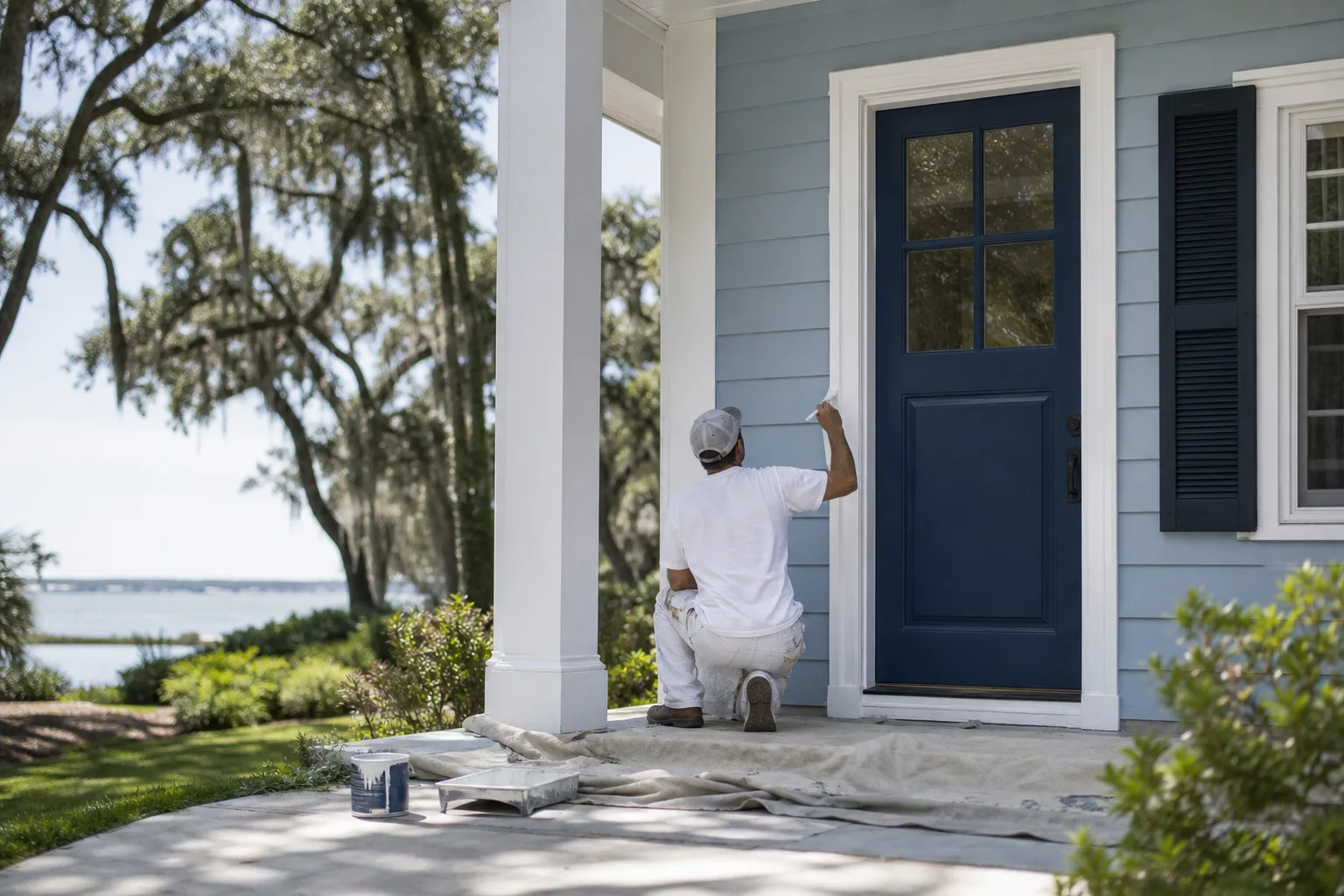
You picked the color. You're standing in the paint aisle, and now there's a second decision you didn't expect: flat, matte, satin, or semi-gloss. It feels like a small thing. It isn't. On a coastal home, the wrong sheen can make a nice color look cheap, or turn a long wall into a billboard for every ripple and seam in the siding.
The trick is that there's no single right answer for the whole house. The smart move is to pick a different exterior paint sheen for each surface — one for the broad runs of siding, another for the trim, doors, and shutters that frame everything. Get that split right and the house reads sharp and holds up to our heat, salt, and humidity. Here's how we sort it out.
What sheen actually does (and why it matters here)
Sheen is just how much light a finish reflects. Flat scatters light and disappears; semi-gloss bounces it back and pops. That one property drives two things you care about: how well the paint hides flaws, and how well it sheds dirt and takes a wash.
Those two pull in opposite directions, which is the whole game. The flatter the finish, the better it buries imperfections — but the more it grabs and holds grime. The glossier the finish, the easier it cleans and the longer it lasts against weather and scrubbing — but the more it advertises every dent and seam underneath. On the Gulf Coast, where mildew and black streaks are a fact of life, washability isn't a luxury — and that tension is exactly why we don't paint a whole house one sheen.
Sheen by surface: the coastal cheat sheet
Here's how the choices shake out once you map each sheen to the job it's good at. The short version: flat or matte for hiding flaws on big walls, satin as the everyday workhorse for most siding, and semi-gloss for the trim and accents that need to be tough and crisp.
| Sheen | Best for | Trade-off on the coast |
|---|---|---|
| Flat / matte | Hiding flaws on old, wavy, or stucco walls; a soft, modern body look | More porous — holds dirt and mildew, harder to wash clean |
| Satin | Most siding — the coastal workhorse: sheds dirt and mildew, takes a gentle wash | Shows a little more surface texture than flat, but far less than gloss |
| Semi-gloss | Trim, doors, shutters — durability, scrubbability, and a crisp pop | Highlights every imperfection, so it's wrong for big siding runs |
That satin-body, semi-gloss-trim combo is the one we reach for most often on homes across Mobile and Baldwin County, because it threads the needle: the siding hides its age and rinses clean, and the trim and door earn their contrast.
Why is satin the workhorse for siding?
If we had to paint a Gulf Coast house's body one sheen sight unseen, it'd be satin almost every time. It carries just enough sheen to fight back against our climate without crossing into glare.
A satin surface is slick enough that pollen, dirt, and mildew spores have a harder time taking hold, and it stands up to a gentle wash, so when the north side grows the black streaks our humidity is famous for, you can rinse them off instead of watching them stain in. If those streaks are already a problem on your home, our breakdown of black streaks on the north side of a house and how to fix them walks through what's really going on. At the same time, satin doesn't reflect light hard enough to turn a 40-foot run of lap siding into a ripple show. We pair it with a quality acrylic like Sherwin-Williams Duration or Emerald — both carry satin formulas built to flex through coastal heat and shed moisture — and we color-match any brand in-house if you're matching an existing scheme.
Flat and matte still have their place. On stucco, on older siding that's seen a few repaints, or when you genuinely want that soft, no-shine modern look, a flat body hides imperfections better than anything else. You just trade away some washability for it, which on the coast is a real trade — so we make sure you know what you're choosing.
Why trim and doors step up to semi-gloss
Trim, doors, and shutters live a harder life than the siding does. Hands push the door. Storms drive rain straight at the fascia. You'll scrub these spots far more than you'll ever scrub a wall. That's exactly why they want a higher sheen.
Semi-gloss is the toughest, most scrubbable finish in the normal exterior lineup, and the extra reflection is the point on trim: it draws a crisp line against the body and makes white trim read sharp instead of chalky. The same logic carries to a front door or shutters, where a punch of sheen is what makes the accent color pop. For the door and shutters specifically, we like Sherwin-Williams Emerald Urethane Trim Enamel — it lays out smooth and holds a hard, wipeable surface. If a bold door color is part of your plan, test-drive shades on your own house with our free color visualizer, and our guide to a front door and shutter repaint covers what goes into doing it right. Going in, know this: because semi-gloss reflects so much light, it shows every flaw beneath it, so the sanding on trim has to be clean — which is the whole reason it's wrong for big siding.
How brand and prep fit into the sheen call
A sheen is only as good as the line it comes in. The same product carries flat, satin, and semi-gloss versions, so once you've chosen your sheens by surface, the next question is which paint line delivers them best for our climate — our rundown of the best paint brands for Gulf Coast homes gets into that. For homes right on the water taking the full salt-and-sun beating, the demands climb again, and our guide to the best exterior paint for Gulf-front beach homes covers what changes.
None of it matters without prep, though. Sheen decides how light hits the surface; prep decides whether the paint stays on it. We wash off the salt and mildew film, scrape and sand to a sound edge, and prime bare spots before any sheen goes up — because a flawless semi-gloss over a flaking wall fails just as fast as a bargain flat.
Bottom line
There's no one perfect exterior sheen — there's a right sheen for each surface. Flat or matte to hide flaws on big or weathered walls, satin as the coastal workhorse on most siding because it sheds dirt and mildew and washes clean, and semi-gloss on trim, doors, and shutters for durability and a crisp pop. Map the sheen to the surface and your color reads sharp and lasts through the Gulf Coast seasons.
We're a family-owned crew that's painted coastal Alabama exteriors since 2013, and we'll walk you through the right sheen for every surface on your home and back the work with a 3-year workmanship warranty. Reach out for a free in-home estimate and you'll have a written quote within 24 hours.