
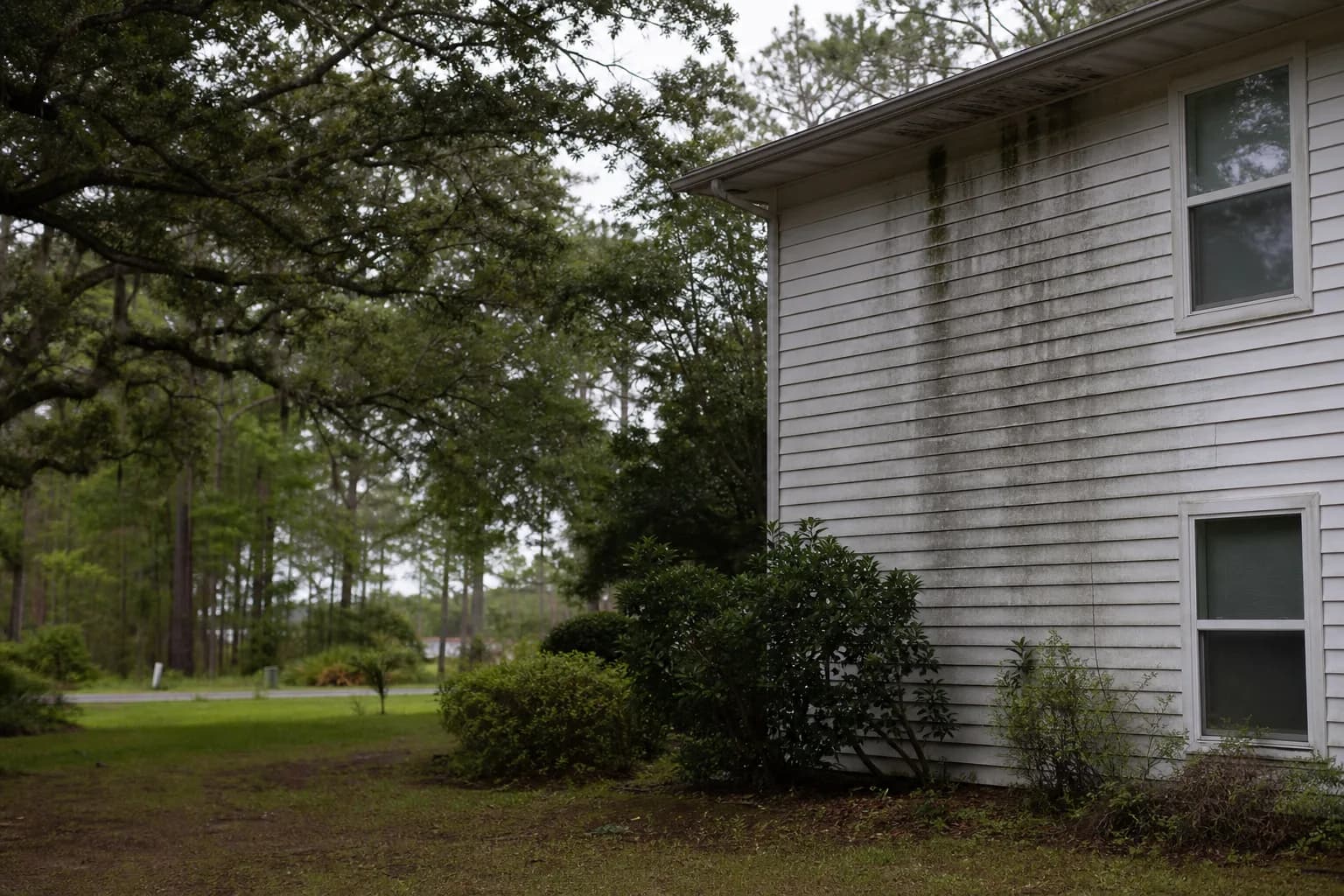
You finally notice them on a gray afternoon: dark, dirty-looking streaks creeping down the north wall, or running in vertical lines from the roof toward the ground. You wipe at one and nothing comes off. It's not dirt, and pressure washing it last spring clearly didn't stick. Those black streaks are alive — a tough little algae that loves exactly the conditions a Gulf Coast home hands it: shade, humidity, and a wall that never quite dries out.
Here's what those black streaks on your house exterior actually are, why they hit the north side and the area below your roofline first, and how to get rid of them in a way that lasts longer than one season.
What the black streaks on your house exterior really are
The dark streaking on shaded walls is almost always a hardy algae called Gloeocapsa magma. It's not dirt and it's not quite the same as the speckled mildew you might see elsewhere. This algae wraps itself in a dark, sun-resistant sheath to survive — and that protective coating is exactly what you're seeing as black.
It sets up where moisture lingers, which on any house means the north and east walls: the sides that get the least direct sun, dry the slowest, and stay damp longest after rain or a humid night. On the coast, with long humid stretches and shade from live oaks and pines, those walls can stay damp enough to feed algae for most of the year.
Why do the streaks run down from the roof?
If your streaks start at the roofline and run straight down the wall, the roof is feeding them. The same algae colonizes asphalt shingles, and every rain rinses spores and dark staining off the roof and carries them down the siding. That's why the marks line up under the eaves and get worse below roof valleys and downspouts — anywhere the runoff is concentrated into a narrow path.
So you can be looking at two sources at once: algae growing on the shaded wall itself, and algae washing down onto that wall from the roof above. Cleaning the siding handles what's on the wall, but if the roof is the source, expect the streaks to creep back faster until the runoff pattern is dealt with.
How to remove black streaks from your siding
The method is the same one that works on any biological growth: kill it first, then rinse — never the other way around. This is the short version aimed at the streaks; for the complete method that applies to algae and mildew alike, see how to remove mildew and algae from your house exterior before painting.
Pick a shaded or overcast time
Work when the wall is shaded or the sky is overcast so the solution doesn't dry before it works. Wet down nearby plants, cover delicate landscaping, and put on eye protection and gloves.Apply an algae-killing solution
Apply diluted bleach or a dedicated exterior algaecide to the streaked siding, working bottom-up so it doesn't run down dry areas and streak. Cover the whole stained section, not just the darkest lines.Let it dwell
Give it several minutes to kill the algae at the root, not just loosen the surface stain. Keep the siding wet the whole time so the solution stays active — if it dries, reapply.Rinse from the top down
Rinse clean from the top down with low to moderate pressure, washing off the dead algae and solution. The pressure washer is the rinse step, not a blasting tool.Let it dry completely
Let the siding dry thoroughly, usually a day or more depending on material, shade, and humidity, before any priming or painting so you don't trap moisture under the finish.
Go easy on the pressure. Too much force gouges wood and fiber-cement siding and drives water behind it, trading a cosmetic problem for a real one. The chemistry does the killing; the water just carries off what's already dead.
How to keep the black streaks from coming back
Cleaning only removes the growth. The shade and damp that grew it are still there, so unless you change the conditions, the streaks return — often within a season on the shadiest walls. Keeping them gone is about drying the wall out and denying the algae its hold:
- Let in sun and air. Trim back the trees, branches, and shrubs shading and crowding the north and east walls. More light and airflow means siding that dries faster and stays inhospitable to algae.
- Manage the roof runoff. Keep gutters clean and draining away from the wall so roof water isn't sheeting down the siding. If the streaks trace to the roof itself, that's the source to address.
- Repaint with the right product. When it's time to repaint, a quality exterior paint formulated for humid coastal conditions resists regrowth far better than a bargain can. Here's how to choose a mold-resistant exterior paint for the humid Gulf Coast.
One more reason washing comes first: you can't paint over algae and expect it to hold. That's why pressure washing is the first step on an exterior paint job — paint won't bond to a wall that's still got living growth on it, and the streaks bleed right back through.
The bottom line
Black streaks on your north-facing walls are algae, fed by the shade, humidity, and roof runoff that come standard on the Gulf Coast. Wash them off the right way — kill the algae with a real solution, let it dwell, then rinse gently from the top down — and then change the conditions: more sun and airflow, cleaner gutters, and a coastal-grade exterior paint when you repaint. Skip the prevention and they'll be back by next spring.
Tired of the streaks coming back every year? Let us handle it for good. Book a free in-home estimate and we'll wash the walls, prep them right, and repaint with a finish built for our climate — with a written quote in your inbox within 24 hours. See what's covered under exterior painting.