
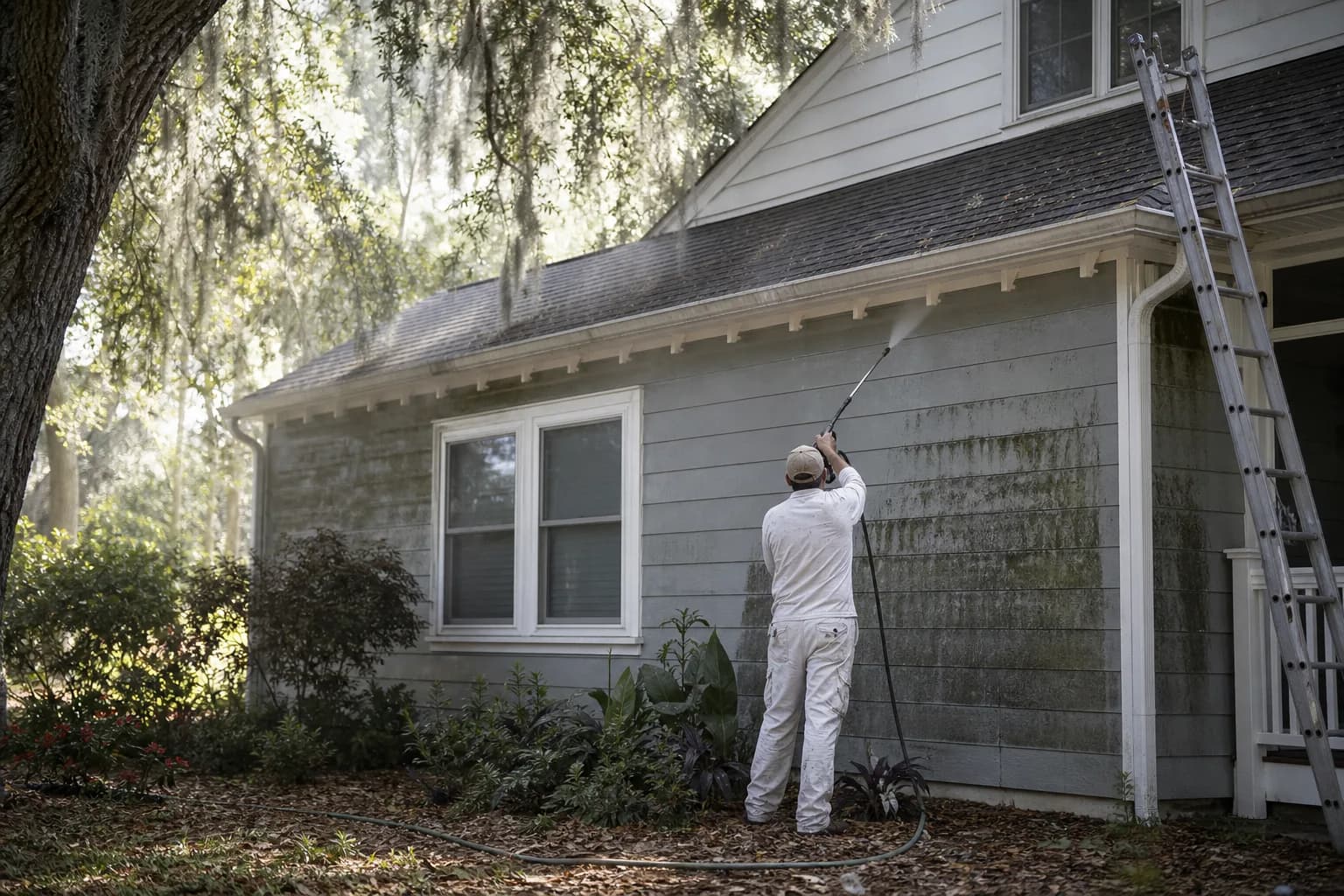
Walk around the north side of almost any Gulf Coast house and you'll find it: a gray-green haze creeping up the siding where the sun never reaches, a wall that looks dirty no matter how recently it was painted. Our humidity, shade, and long warm seasons feed mildew outside a home as hard as inside one. So the can labeled mold-resistant exterior paint looks like the answer. It's a real tool — but it solves one part of the problem, and fails when asked to do the rest. Here's what it does on siding, which walls it helps most, and the prep that decides whether it lasts.
What does mold-resistant exterior paint actually do?
Mold-resistant exterior paint is ordinary exterior paint with a mildewcide built into the dried film — an additive that makes the painted surface inhospitable to mold and mildew. On a shaded, humid wall, that additive genuinely slows the gray speckling that would otherwise bloom on a basic paint. It's worth having where you need it.
But be clear about what that isn't:
- It does not kill mildew already growing on the siding.
- It is not a barrier against water getting behind the siding.
- It does not fix shade, trapped moisture, or dead air against a wall.
The mildewcide protects the paint film. It does nothing for a wall that stays damp because the sun never hits it. Think of mold-resistant paint as the topcoat that holds the line after you've dealt with why that wall grows mildew in the first place. This is the exterior cousin of a problem we also see indoors — for the bathroom-and-laundry side of it, see our guide to anti-mildew and mold-resistant paint for interior rooms. Outside, the surfaces, the products, and the prep are a different game.
Why north and shaded walls grow mildew worst
Mildew needs three things: moisture, something to feed on, and still air. A Gulf Coast home hands it all three on the shaded elevations. The north side and any wall tucked under live oaks, behind dense shrubs, or in a tight side-yard gets the least direct sun to dry the surface after our humid nights and frequent rain. So the siding stays damp longer, and mildew gets the foothold a sun-baked south wall never gives it.
That's why mildew rarely shows up evenly. The bright, breezy walls can look great while the shaded ones go gray — same paint, same house, completely different exposure. A mildew-resistant exterior paint earns its place precisely on those dim, damp elevations, and it's wasted effort to specify it where there's no humidity problem to begin with.
| Exterior surface | Mildew risk | What helps most |
|---|---|---|
| North & deep-shade walls | High — little sun, slow to dry | Mildew-resistant paint + airflow |
| Walls under oaks / behind shrubs | High — shade, trapped moisture | Trim back growth, mildew-resistant paint |
| Soffits, eaves & porch ceilings | Moderate — shaded, still air | Mildew-resistant paint, satin sheen |
| Tight side-yards with no airflow | Moderate — dead air holds damp | Open up airflow, mildew-resistant paint |
| Sunny south & west walls | Low — dry fast after rain | Quality exterior paint is plenty |
One detail matters as much as the can: where you can, help the wall dry. Trimming shrubs back off the siding, limbing up a tree that keeps a wall in permanent shadow, and clearing a gutter that drips down one elevation all do more for mildew than any additive. The same coastal-weather logic runs through every surface on your home, which we lay out in our coastal exterior painting guide for Mobile and Baldwin County.
Prep beats the can's promises — every time
Here's the part the label won't tell you: prep does more for exterior mildew than any product on the shelf. A mid-grade exterior paint over siding that's been washed, treated, dried, and primed will outlast a premium mold-resistant coat sprayed over dirty, damp wood. The order of operations is the whole game on a humid wall.
Pressure-wash the siding
Wash the exterior to strip dirt, chalk, and loose mildew off the surface, paying extra attention to the shaded north and side walls where growth concentrates. Fresh paint only bonds to a clean surface.Treat and kill the mildew
Apply a mildew-killing exterior cleaner to any siding that showed gray or green growth, let it dwell, scrub the stubborn spots, and rinse. Mildewcide in the paint slows new growth; it won't smother living spores you coat over.Let the wall dry completely
Give the siding real time to dry through after washing — coastal walls hold moisture even when they look dry on top. Sealing paint over damp wood is the fastest route to peeling and rot underneath.Prime bare and stained spots
Spot-prime any bare wood, repairs, and remaining stains with an exterior stain-blocking primer so old discoloration can't bleed through and the topcoat bonds evenly across the wall.Topcoat with a mildew-resistant exterior paint
Apply two coats of a quality mildew-resistant exterior paint built for humid climates, focusing the durability where shade and moisture concentrate. Two full coats beat one heavy one for film integrity.
That removal-first step is its own job when the growth is heavy. We've walked through it for siding in how to remove mildew and algae before painting your house, and for the dark vertical streaks specifically in what causes black streaks on the north side of a house and how to fix them. Get that right and a mildew-resistant topcoat has a clean surface to protect.
It's also where a paint job can turn into a repair. If a wall has stayed damp long enough, the siding or trim behind the mildew can be soft or rotten — at which point cleaning and repainting won't cut it and the material needs to come out. That's normal coastal work, and it's why we read the actual wall before we recommend a product.
The honest bottom line on mold-resistant exterior paint
Mold-resistant exterior paint is real, and on a humid Gulf Coast home it's a smart choice for the shaded, damp walls that grow mildew. But it's a helper, not a hero. It protects the paint film; it can't out-argue a wall that never sees sun, and it can't undo siding you coated without washing first. Choosing the right product also starts with the right exterior paint for the climate, which we cover in the best exterior paint for salt air and humidity around Mobile.
Put a mildew-resistant exterior paint where shade and moisture concentrate, over siding that's been washed, killed, dried, and primed, and help the wall breathe where you can — and it'll hold the line for years. When you're ready, our exterior painting crew handles the shaded-wall problem start to finish: diagnosis, wash and prep, the right product, and a manager sign-off before final payment. Book a free estimate and we'll figure out whether your wall needs a better paint, more airflow, a real repair, or all three.