
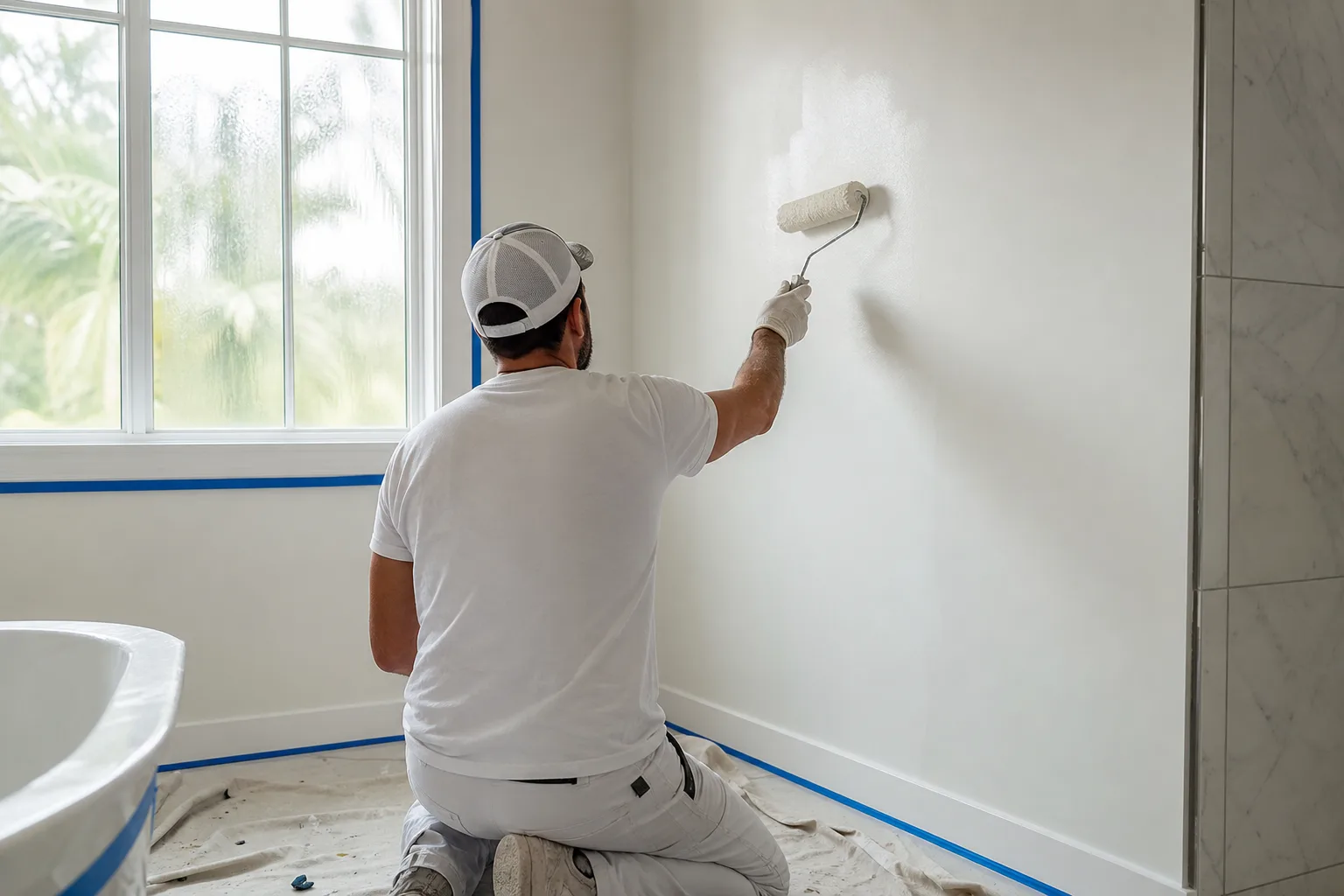
If you live on the Gulf Coast, you've seen it: a faint gray speckle creeping up the bathroom wall, a dark bloom in a north-facing closet. Our humidity feeds mildew, and the most tempting fix on the shelf is a can labeled mold-resistant. So does anti-mildew paint actually work — or is it marketing? The honest answer: it's a real, useful tool that solves exactly one part of the problem, and it fails every time people ask it to do the other parts. Below is what mildew-resistant paint does, where it earns its place in a humid home, and the order of operations that makes it last.
What anti-mildew paint actually is
Anti-mildew paint is ordinary paint with a mildewcide baked into the dried film — an additive that makes the paint surface inhospitable to mold and mildew. That's the whole trick, and it's a worthwhile one. On a coating in a steamy bathroom, that additive measurably slows the speckling that would otherwise show up on a basic flat paint.
But it's important to be clear about what that isn't:
- It does not kill mold that's already living in or on the wall.
- It is not a waterproofer or a sealant against a leak.
- It does not fix humidity, condensation, or bad airflow.
The mildewcide protects the paint film. It doesn't protect a wall that has a moisture source behind it. Think of mold-resistant paint as the last line of defense — the topcoat that holds the line after you've solved why the wall was damp in the first place.
Why are humid Gulf Coast homes the right use case?
Mildew needs three things: moisture, something to feed on, and still air. Gulf Coast homes hand it the first and third for free most of the year. Long humid stretches, mild winters that never really dry things out, and rooms that hold steam are a standing invitation. That's why a paint that fights surface mildew is more than a gimmick here — it does real work in the rooms where humidity concentrates.
It also won't help much where there's no humidity problem to begin with. A dry, well-ventilated living room doesn't need a specialty coating; a quality paint and a working HVAC system already keep mildew away. The skill is putting the mildew-resistant product where it pays off and not wasting it where it doesn't.
Where to use mildew-resistant paint (and where to skip it)
After years painting interiors across Mobile and Baldwin County, these are the rooms where we reach for a bathroom-and-kitchen or mildew-resistant line every time — and the ones where standard paint is plenty.
| Room / surface | Mildew risk | What we use |
|---|---|---|
| Bathrooms & showers | High — steam, poor airflow | Mildew-resistant, satin/semi-gloss |
| Laundry & utility rooms | High — moisture, warmth | Mildew-resistant, satin |
| Kitchens | Moderate — steam, grease | Bathroom-and-kitchen line, satin |
| North-facing & exterior-wall closets | Moderate — cool, shady, still air | Mildew-resistant, eggshell/satin |
| Dry living rooms & bedrooms | Low | Quality interior paint, matte/eggshell |
The pattern is simple: the wetter and stiller the air, the more a mildew-resistant product is worth it. And one detail that matters as much as the can you pick — sheen. In a humid room, a satin or semi-gloss has a tighter, less porous film that sheds moisture and wipes clean far better than flat. We use the glossier finishes in wet rooms not just for looks but because they give mildew less to grab and make cleanup easy.
Prep beats the can's promises — every time
Here's the part the label won't tell you: prep does more for mildew than any product on the shelf. A mediocre paint over a properly fixed, cleaned, and primed wall will outlast a premium mold-resistant coat slapped over living mildew. The order of operations is the whole game.
Fix the moisture source first
Find why the surface stays damp — a leak, a weak bathroom exhaust, condensation on a cold exterior wall — and solve it. Anti-mildew paint can't out-argue standing moisture, so this comes before anything else.Kill and clean any existing growth
Wipe the area with a mildew-killing cleaner or a diluted bleach solution, scrub gently, rinse, and let it dry completely. The mildewcide in the paint discourages new growth; it won't smother living spores you painted over.Stain-block the leftover staining
Seal any remaining mildew or water staining with a stain-blocking primer so it can't bleed back through the topcoat. Bare or patched drywall gets primed too, so the finish bonds evenly.Topcoat with a mildew-resistant paint in the right sheen
Apply two coats of a quality bathroom-and-kitchen or mildew-resistant paint in satin or semi-gloss, which sheds moisture and wipes clean better than flat in a humid room.
This is also where the line between a paint job and a real repair shows up. If mildew has been feeding on the same wall long enough, the drywall behind it can be soft, swollen, or musty — at that point cleaning and repainting won't cut it and the material needs to come out. That's where our drywall repair and painting work comes in: cut out the failed board, address what was keeping it wet, and rebuild the surface before a drop of finish goes on.
The honest bottom line on mold-resistant paint
Anti-mildew paint is real, and in a humid Gulf Coast home it's a smart choice for the rooms that stay wet. But it's a helper, not a hero. It protects the paint film; it can't fix a moisture problem, and it can't undo a wall you painted over without cleaning. Use it where humidity concentrates, in the right sheen, over a surface that's been fixed, killed, cleaned, and primed — and it'll do its job for years.
If you're already seeing growth, start with removal before you ever open a fresh can. We've broken that down step by step for interiors in how to remove mold and mildew from walls before painting, and for siding in how to remove mildew and algae before painting your house. And if you'd rather hand the whole thing off, our interior painting crew handles the moisture-prone rooms start to finish — diagnosis, prep, the right product, and a manager sign-off before final payment.
For more on the specialty products that step in when standard paint isn't enough, see our guide to specialty coatings and when a surface needs more. When you're ready, book a free estimate and we'll figure out whether your wall needs a better paint, a real repair, or both.