
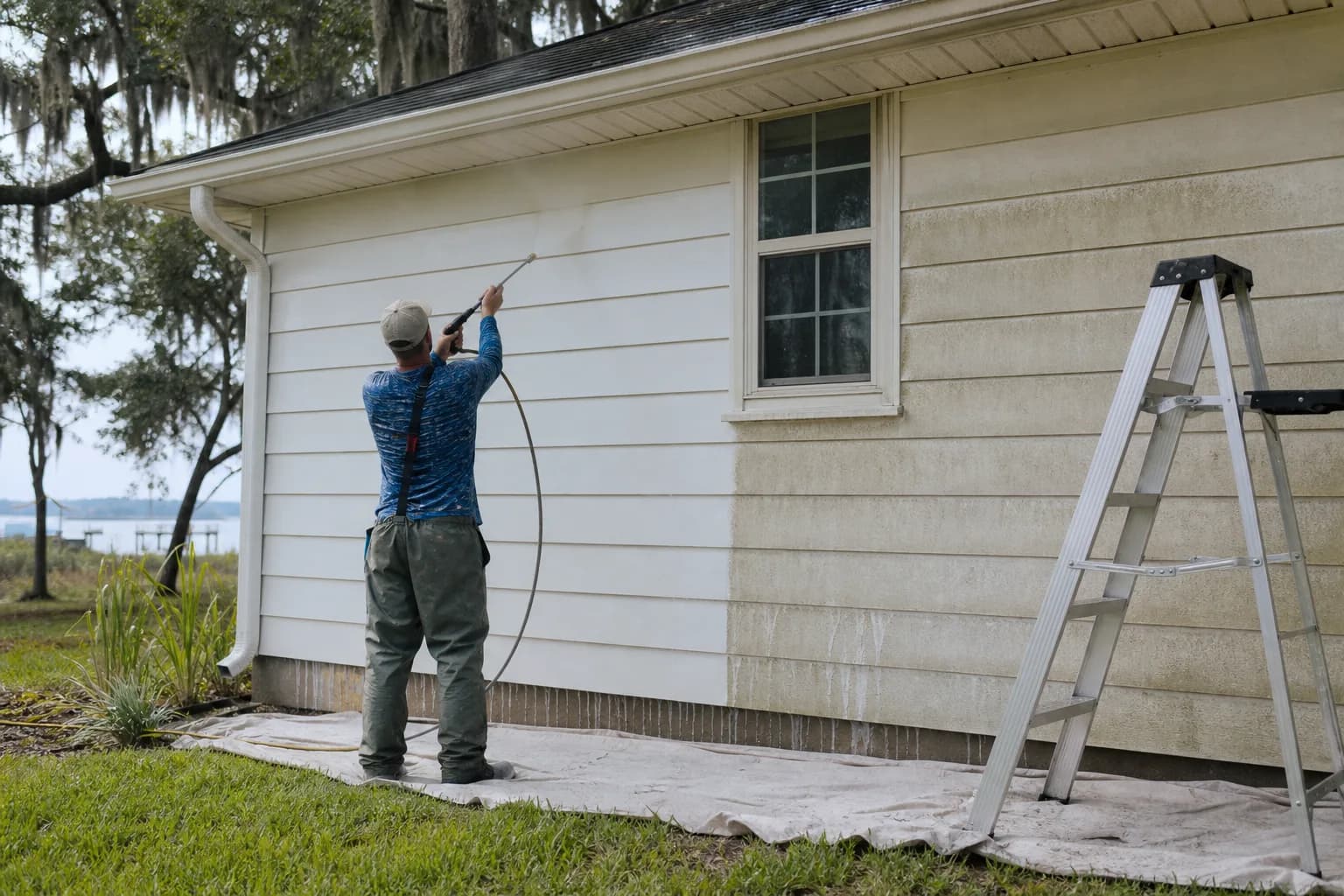
You can buy the best exterior paint made, hire a careful crew, and still watch the job start peeling in a year — if the house wasn't washed first. It happens all the time on the Gulf Coast. The siding looked clean, somebody opened a bucket, and the new coat went down over a layer of salt film, chalk, and dust that no eye could see. Within a season or two, it lets go. That's why pressure washing isn't a nice-to-have first step on an exterior job. It's the step the whole job is built on.
Here's the simple truth that explains it: paint bonds to the surface it touches, and only that surface. If what it touches is grime, it bonds to grime, and grime doesn't hold. Washing the house removes that layer so the new finish grips the siding itself. This is why pressure washing before painting comes first, every time — and why a crew that skips it, or rushes it, is the one whose work fails early. Let's walk through what washing actually removes, how it's done right, and the part most people get wrong.
Why pressure washing has to come first
A house exterior is dirtier than it looks. Even a home that seems clean from the curb is carrying a film of contaminants that quietly destroy paint adhesion: airborne dirt and pollen, chalk from an old finish breaking down in the sun, mildew and algae spores, and — this is the Gulf Coast killer — a layer of salt the humid coastal air leaves on every surface. None of that shows up in a glance. All of it keeps paint from bonding.
Pressure washing before painting is how you strip that layer off so the new coat meets clean, sound material. Get it off and the paint forms a real mechanical bond with the siding. Leave it on and you've built your finish on a foundation that's already letting go. That's the entire reason washing is non-negotiable as step one: it's not about the house looking nice for the painters — it's about whether the coat you're paying for can actually stick. It's the same principle that makes surface prep the most important step before painting on any surface, inside or out.
Soft wash vs. pressure wash: matching the method to the siding
"Pressure washing" is the common name, but the right approach depends on what your house is made of — and using the wrong one does real damage. There are two methods, and a good crew picks based on the material.
| Method | Best for | Why |
|---|---|---|
| Pressure wash (high pressure) | Brick, masonry, concrete, hardscape | Hard, durable surfaces take the force, and high pressure clears heavy buildup fast without harm |
| Soft wash (low pressure + solution) | Wood siding, vinyl, stucco, older finishes | Low pressure with a cleaning solution lifts dirt and growth gently, so it won't gouge wood, crack stucco, or drive water behind siding |
The mistake we see most is somebody renting a high-pressure unit and blasting wood siding or stucco with it. High pressure on the wrong surface gouges soft wood, forces water up behind lap siding and under trim, and can crack a stucco finish — creating the exact moisture problem the wash was supposed to prevent. On most Gulf Coast homes with wood, vinyl, or stucco, the safer and more effective route is a soft wash: low pressure, the right cleaning solution, and technique. The goal is a clean surface, not a powerful spray. For where the washing step fits in the full sequence — scrape, sand, repair, caulk, prime, paint — see our exterior paint prep steps guide.
How we wash a house before painting
Done right, the wash is a sequence of its own. Here's the approach we follow before any exterior project, whether it's a soft wash or a pressure wash.
Inspect and pick the right method
We look over the siding and match the wash to the material — high pressure for brick and masonry, low-pressure soft washing for wood, vinyl, stucco, and older finishes that hard pressure could damage.Protect plants, fixtures, and openings
Before any water goes on, we wet down and cover landscaping, shut windows and doors, and move or cover anything near the walls so the wash doesn't do collateral damage.Wash off the buildup
Working top to bottom, we remove dirt, chalk, pollen, mildew, and the salt film Gulf air leaves behind — so the new paint bonds to clean material instead of grime.Rinse thoroughly
We rinse the whole surface clean from the top down, so no cleaning residue, dead growth, or loosened chalk is left behind to interfere with the bond.Let the surface dry completely
Then we wait. The siding has to dry fully — often a day or more in our humidity — before any scraping, priming, or painting, so no trapped moisture sits under the finish.
Notice that washing isn't the only prep — it's the first prep. Once the surface is clean and fully dry, a proper exterior job still scrapes loose paint, sands the edges, repairs soft wood, caulks the gaps, and primes bare spots before a drop of finish goes on. The wash sets all of that up by giving you a sound, clean surface to build on.
What mistake undoes a good wash?
Here's where well-meaning jobs fall apart: somebody washes the house correctly, then paints it the same afternoon. On the Gulf Coast, that's a guaranteed failure.
Washing puts water on — and into — the surface, and wood especially holds moisture you can't see on the surface. In our humidity, "dry to the touch" isn't the same as "ready to paint." Coat a wall that's still damp underneath and you seal that moisture in behind the finish, and trapped moisture is one of the surest ways to get peeling, blistering, and fresh mildew. So the wash has a non-negotiable partner: dry time. Depending on the material, the sun, and the dew point, that's often a full day or more before anything else happens. A crew that washes and paints back-to-back is rushing the one step that can't be rushed. If you're hiring out the job, our guide on the questions to ask before hiring a painter covers how to make sure prep like this is actually in the plan.
Wash first, and the rest of the job has a chance
Pressure washing is step one of every exterior paint job for one reason: paint can only bond to a clean, sound, dry surface, and a Gulf Coast house is covered in the dirt, chalk, mildew, and salt that keep it from bonding. Strip that off — with the right method for your siding — let it dry completely, and the finish coat finally has something to grip. Skip it, and the best paint in the world peels anyway.
If you want an exterior job that starts with the wash done right and the prep done in order, that's how we work. Start with a free in-home estimate and we'll tell you which wash your siding needs, how the prep will run, and what the finished result will hold up to. You can book that estimate here and we'll come read your siding in person. We've washed and painted Gulf Coast homes since 2013 — one accountable crew from your free estimate through the final inspection, backed by our 3-year workmanship warranty. The wash is invisible once the paint's on. It's also the reason the paint stays on.