
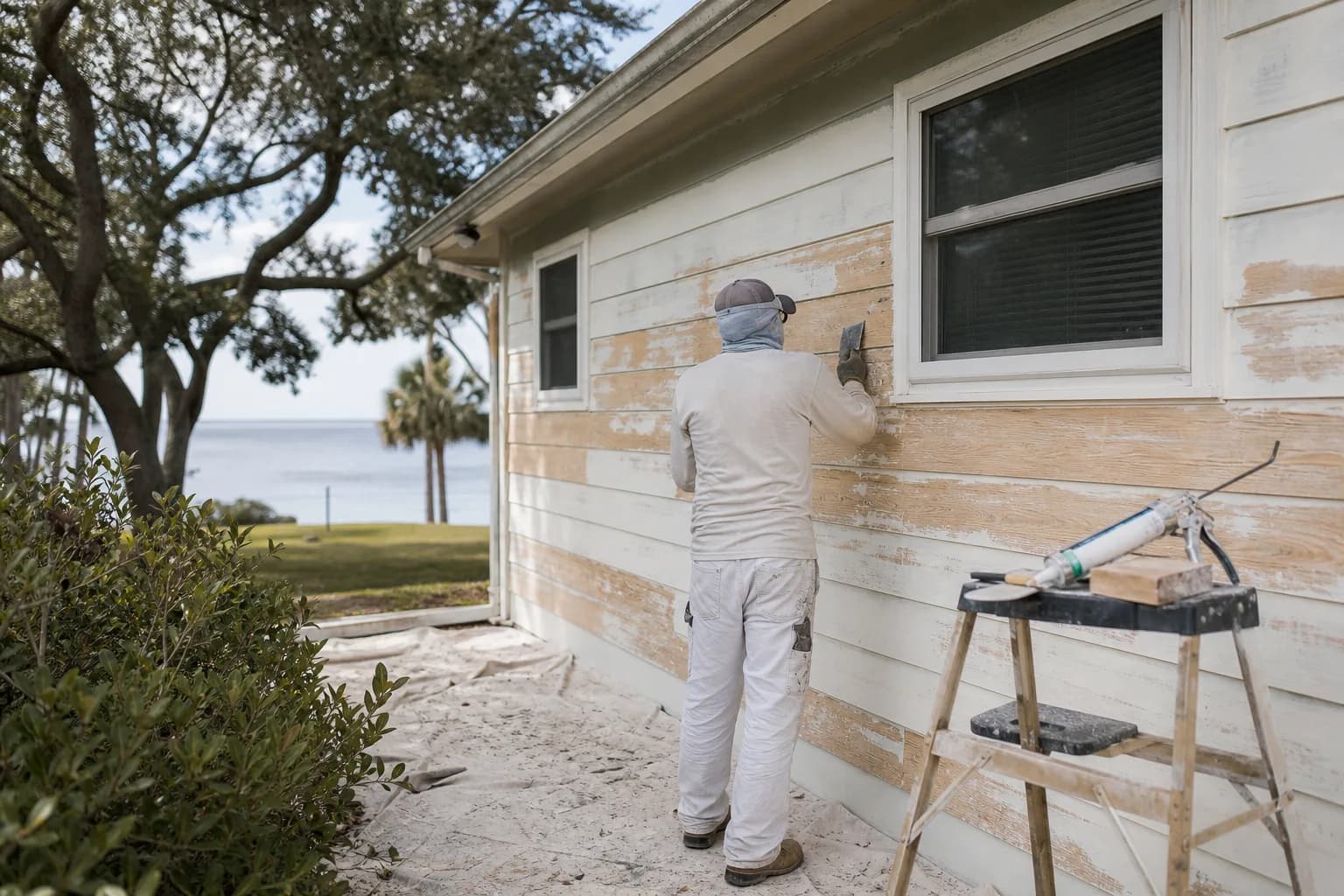
The Gulf Coast is brutal on exterior paint. Salt air, summer humidity, hard UV, and storm-season rain gang up on every painted surface outside your home — and a job that skipped prep starts peeling in a couple of seasons. The paint on the can isn't what makes the color last out here. The prep underneath it is.
So before you or anyone you hire opens a five-gallon bucket, here are the exterior paint prep steps that actually matter, in order: wash, scrape, sand, repair, caulk, prime, then paint. We'll walk through why each one counts and, just as important, where our climate changes the playbook. Get the prep right and the finish coat almost takes care of itself.
Why does exterior paint prep matter more on the Gulf Coast?
Here's the simplest truth in painting: paint can only stick to what's underneath it. Coat over dirt, salt film, mildew, chalk, or peeling paint and you've guaranteed the new finish lets go early — you just paid to peel. Prep is the work that bonds paint to a sound, clean surface, and it's the single biggest reason one exterior job lasts a decade and another fails in a year.
That's true anywhere, but the Gulf Coast turns it up. Salt in the air leaves an invisible film that wrecks adhesion if it isn't washed off. Humidity stretches drying times, so anything painted before the surface is truly dry traps moisture and fails. And our sun chalks and degrades old finishes fast, leaving a powdery layer that fresh paint can't grip. Prep is how you beat all three.
The exterior paint prep steps, in order
Each step sets up the next. Skip one and the rest can't do their job. Here's the sequence we follow on every exterior project, and what each step is really for.
Pressure-wash the surface
Blast off dirt, chalk, mildew, and the salt film Gulf air leaves behind — then let it dry fully. Paint bonds to clean material, not to grime.Scrape loose and peeling paint
Take every loose, peeling, or flaking edge down to a tight, sound surface. New paint takes a failing layer down with it, so this can't be skipped.Sand the edges smooth
Feather the scraped edges so the line between bare and painted areas disappears under the finish instead of telegraphing through it.Repair soft or rotted wood
Replace or repair any soft, rotted, or damaged wood now. Paint never fixes failing wood, and our climate is hard on it.Caulk the gaps
Seal joints, seams, and gaps around trim and penetrations with a quality exterior caulk to keep water out — then let it cure before paint.Prime bare and patched spots
Spot-prime all bare wood, repairs, and stains. Primer seals the surface, blocks stains, and gives the finish coat something to grip.Apply the finish coats
Only once everything is clean, sound, dry, sealed, and primed do the finish coats go on — while respecting dew point and drying times.
Notice the order isn't arbitrary. You wash before you scrape so you're not grinding grime into the wood. You repair and caulk before you prime so the primer seals your repairs. And you prime before you paint so the finish has a sealed, uniform surface to bond to. Jump around and you undo your own work.
Where Gulf Coast humidity changes the playbook
This is where a lot of well-meaning DIY exterior jobs go wrong. The steps are right, but the timing ignores our weather. Two rules matter more here than almost anywhere.
First, respect drying times. A washed wall, fresh caulk, and primer all need to be fully dry before the next step. In our humidity, "dry to the touch" isn't the same as "ready" — rushing it traps moisture under the finish, and trapped moisture is a guaranteed failure. The cure is patience, not a faster product.
Second, watch the dew point. Painting late in the day when humidity climbs and surfaces are cooling toward dew point means moisture forms right as your finish is trying to set. That's how you get a coat that won't bond or that flashes and fails. Knowing when not to paint is as much a skill as the painting itself, which is part of why timing the job to the season matters — we cover that in the exterior house painting coastal guide.
There's a third habit worth naming, because it trips up even careful homeowners here: don't trust a forecast that only looks at rain. A dry afternoon can still sit at 85 percent humidity, and a pop-up storm two hours after you finish can wash uncured paint right off the siding. We plan exterior work around the whole weather picture — humidity, dew point, wind, and the radar — not just whether it's "supposed to rain." That's the difference between a finish that cures hard and one that never quite sets. On the Gulf Coast, the calendar and the sky decide as much about a paint job as the brush does, and respecting that is most of what separates a coat that lasts a decade from one you're redoing in two summers.
Two prep steps carry extra weight in this climate and are worth a closer look: where and how to caulk for our weather, in best exterior caulk for the Gulf Coast, and exactly when bare wood needs primer, in when to prime bare wood siding. And because it's the foundation of everything above, here's why pressure-washing is the first step.
The bottom line on exterior prep
Good exterior paint isn't poured out of a better can — it's built on a clean, sound, dry, sealed, and primed surface. Wash, scrape, sand, repair, caulk, prime, then paint, with our humidity respected at every step, and the color holds for years on the Gulf Coast. Cut the prep and you'll be back on a ladder long before you should be.
If you'd rather not spend your weekends scraping in the heat, that's what we're for. Pro 1 Painters has prepped and painted exteriors across Mobile and Baldwin County since 2013, with a 4.8-star Google rating, obsessive prep, and a 3-year workmanship warranty backing the work. Book a free in-home estimate and we'll put a written quote in your hands within 24 hours — prep spelled out, so you know exactly what you're getting.