
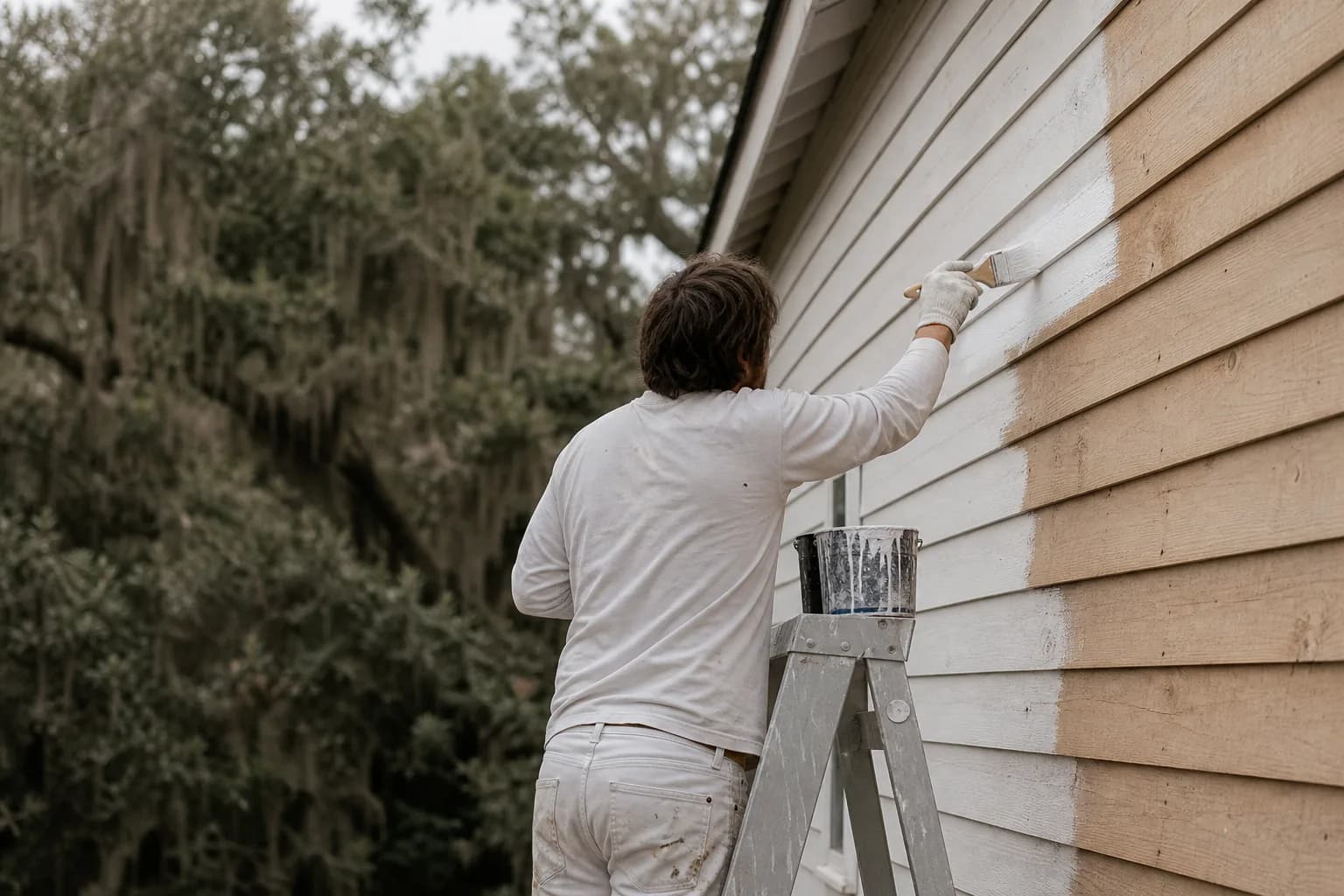
There's a stretch of bare cedar on the south wall, the old paint scraped off in sheets last weekend, and the wood is sitting there raw and tan in the sun. The temptation is to skip ahead and just get color on it. Don't. Painting straight onto bare wood siding is the fastest way to watch a fresh exterior repaint peel by next summer. Priming bare wood before painting exterior siding isn't an upcharge or an old-school habit — on the Gulf Coast it's the step that decides whether the job lasts two years or ten.
This guide is about bare wood siding specifically: when it needs primer, when you can spot-prime instead of coating the whole wall, and how to pick between oil and acrylic primer for raw wood. If your question is about interior drywall instead, that's a different call — see when interior walls need primer. And if you want the all-surface rundown on primer types, our prime-or-skip guide covers it. Here we stay outside, on the wood.
Does bare wood siding always need primer?
Short answer: yes. Bare exterior wood is porous, unprotected, and exposed to the worst of the Gulf-Coast climate — salt air, hard sun, and humidity that swings all day. Paint laid straight onto raw wood soaks in unevenly, never bonds the way it should, and lifts within a season or two. Primer seals the surface, blocks the natural tannins in the wood from bleeding through, evens out how the wood drinks the finish, and gives the topcoat a sound layer to grip. It's the foundation under the color.
That said, "bare wood always needs primer" doesn't mean you re-prime the entire house every time you repaint. The real question is how much bare wood you're dealing with — which decides whether you spot-prime or full-prime.
Spot-prime or full-prime bare wood?
Here's the rule we work by on the Eastern Shore.
| What you're looking at | Prime how? | Why |
|---|---|---|
| New, never-painted wood siding or trim | Full-prime the whole face | Every board is raw and porous and needs sealing for an even finish |
| Weathered gray, sun-degraded wood | Sand/wash to sound wood, then full-prime | The loose surface layer won't hold paint and the wood underneath is bare |
| Scattered bare patches on otherwise-sound paint | Spot-prime the bare spots only | The intact paint is still a sound base; only the raw wood needs sealing |
| Cut ends, joints, and trim ends | Always prime — twice | End grain drinks water fastest and is where rot starts |
Most exterior repaints land somewhere in the middle: a sound painted house with bare spots where the old paint failed. Spot-priming those raw areas is the right, efficient call. But once more than a third or so of a wall has failed, or the wood has weathered gray across the face, you're better off priming the whole surface — chasing dozens of little patches costs more than just coating the wall once and getting a uniform base.
Oil-based or acrylic primer on bare wood?
Both belong on bare wood; the wood and the conditions pick the winner.
- Penetrating oil-based exterior primer is the traditional choice for raw, tannin-rich woods — cedar, redwood, and old-growth fir. It soaks deep into the grain and does the best job blocking the brown tannin bleed those woods push out, which otherwise stains right through a light topcoat.
- Quality 100% acrylic exterior primer bonds well, stays flexible as the wood moves with our humidity, breathes so trapped moisture can escape, and recoats faster — a real advantage when an afternoon storm is always on the radar.
We don't pick one and use it on everything. Raw cedar shakes and a stained-grade door get oil; a stretch of new primed-grade trim or a previously painted wall with bare patches usually gets acrylic. Matching the primer to the wood is part of the prep, not an afterthought.
Don't skip the gray wood — or the end grain
Two mistakes peel more Gulf-Coast repaints than anything else, and both happen at the primer stage.
Weathered gray wood. When wood sits unpainted in the sun, the top fibers break down into a loose, powdery gray layer. Paint — even primer — can't grip that; it bonds to the dead surface, and the whole coat sheets off with it. You have to sand or wash back to firm, clean wood, let it dry completely, then prime. There's no shortcut around it.
End grain. The cut ends of boards drink water and primer many times faster than the face. They're also exactly where rot starts on fascia, trim, and siding butt-joints. Seal every cut end, and hit the end grain a second time — that's not overkill, it's cheap insurance against rot. This ties straight into the rest of your exterior prep, which we walk through in our guide to scrape, caulk, and prime before exterior paint. It also matters on lap siding specifically, covered in how to paint wood lap siding on the Gulf Coast.
The step-by-step on priming bare wood siding
Get the wood sound and clean
Scrape and sand off loose paint and the gray surface layer down to firm wood, wash off dirt and chalk, and let it dry fully — primer can't seal a damp or powdery surface.Decide spot-prime vs full-prime
Prime just the bare patches on sound paint; full-prime new, gray, or mostly-failed siding so the finish goes on even.Choose the right primer
Oil-based on raw tannin-rich woods like cedar to block bleed; quality acrylic where humidity, breathability, and recoat speed matter.Hit the end grain twice
Brush primer into every cut end and joint, then give the end grain a second pass — it soaks up water fastest and rots first.Let it cure, then finish
Let the primer dry per the can, then apply two coats of quality exterior paint over the sealed, uniform surface.
The bottom line on priming bare wood siding
Priming bare wood before painting exterior siding is the non-negotiable part of a coastal repaint. Seal new wood, sand weathered gray wood back to sound and seal it, double-seal the end grain, and pick oil or acrylic primer to fit the wood — and the color you put on top has a real foundation to hold for years instead of months.
If you'd rather not judge bare-wood prep board by board yourself, that's exactly what our exterior painting crew does on every job. Book a free in-home estimate and you'll get a written quote within 24 hours, with the prep and priming laid out before any paint goes on the wood.