
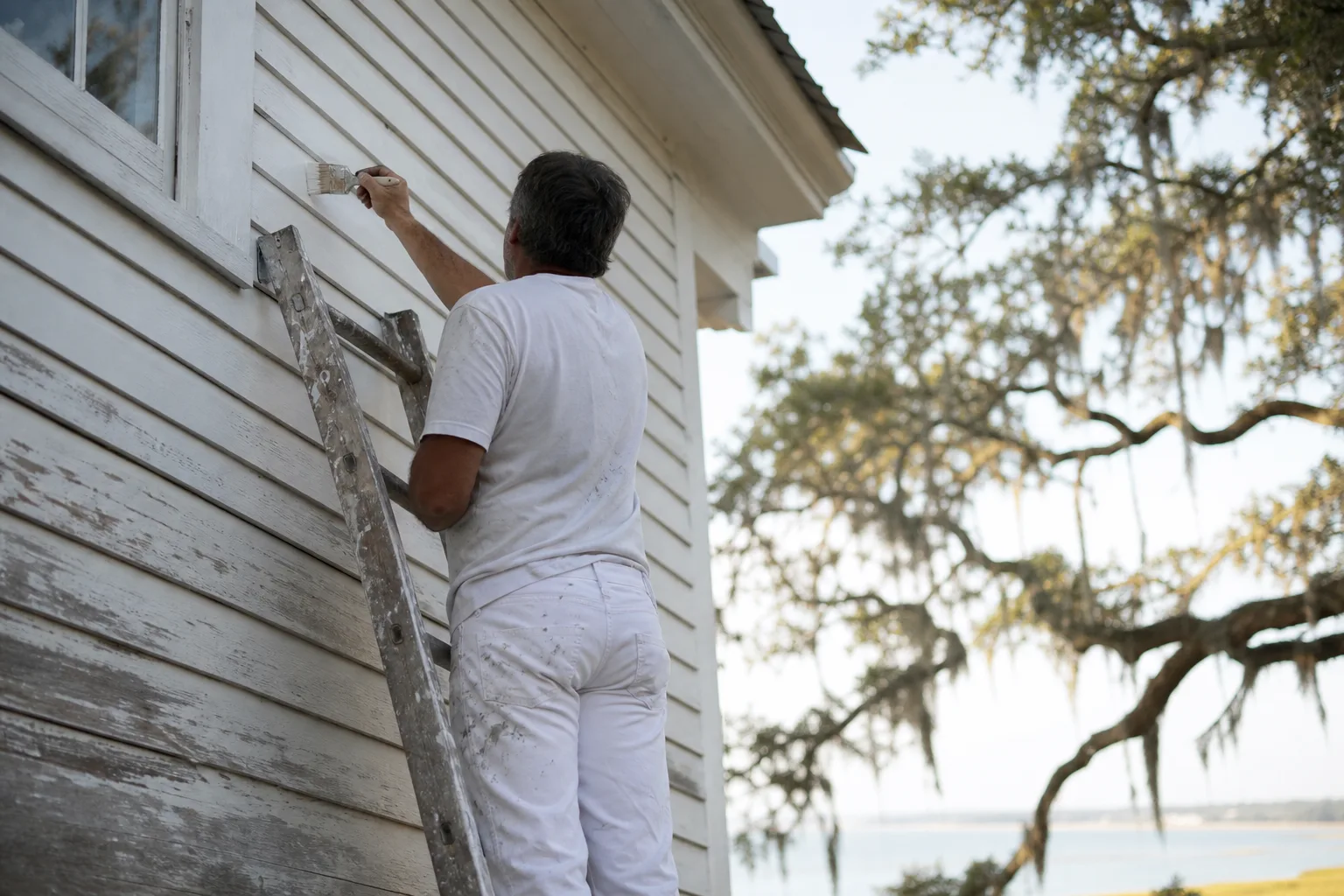
A wood-sided house has character that no manufactured board quite matches — and a list of demands that no manufactured board makes. Real wood swells when it's wet and shrinks when it dries, and on the Gulf Coast it's doing both constantly, all year. That movement is exactly why a wood-siding paint job that skipped the prep starts cracking and peeling in a couple of seasons, while one done right rides out a decade of our weather. If you've got traditional wood lap siding — clapboard, bevel, whatever the old-timers called it — painting it well comes down to respecting how wood moves and where water gets in.
Here's how to paint wood lap siding on the Gulf Coast the way it's meant to be done: the scraping, the spot-priming, the nail spots, and the one caulking mistake that quietly ruins wood-siding repaints down here.
How to paint wood lap siding: the short version
You can get a long-lasting finish on wood lap siding even in this climate, but wood is less forgiving than fiber cement or engineered board, so the prep carries the whole job. The sequence is: wash it and let the wood genuinely dry, scrape all the loose paint back to a sound edge, fix the nail spots and any rot, spot-prime every patch of bare wood, caulk the joints that should be caulked while leaving the laps open, then put on two coats of a quality acrylic.
The thing that trips people up is treating wood like it's a stable surface. It isn't. It moves with the weather, it has knots and end-grain that bleed and drink water, and it was nailed up board by board, which means dozens of fasteners and joints that all need attention. Wood lap siding is its own animal, different from the milled-sheet world of T1-11 plywood and from the fiber cement of Hardie board — and it wants a process built around real wood.
Prep is the whole job: wash, dry, scrape
Prep is 80% of a paint job that lasts, and on solid wood it's the difference between five years and five months. Wash the siding first to strip off dirt, chalk, and the mildew this climate grows. Then wait — and wait longer than you think. Solid wood holds moisture deep in the board, and in Gulf Coast humidity it can need two or three dry days before it's ready, not an afternoon in the sun. Paint over a damp board and you seal moisture in; that trapped moisture is the number-one cause of peeling on wood siding.
Then comes the scraping, which on an older wood home is most of the labor. Scrape every bit of loose, cracked, or peeling paint back to a tight, sound edge — a spot where the old paint is bonded firmly and won't keep lifting. Feather-sand the transitions so the edges of the old paint don't show as ridges, and sand any glossy or gray, weathered wood so the new coat has something to grip. You're not trying to get back to bare wood everywhere; you're trying to leave only paint that's actually holding, plus clean, sanded wood where it isn't.
What's the caulking mistake that ruins wood-siding repaints?
Wood lap siding was put up one board at a time with a lot of nails, and those fasteners are a story of their own. Over the years nails pop proud of the surface, and steel nail heads rust and bleed an ugly brown stain right through the paint. So before you prime, set any proud nails back below the surface, and treat rusty heads — sand them and hit them with a stain-blocking primer — so they don't bleed through your fresh coat. Fill the cracks, gouges, and old nail holes with an exterior-grade wood filler and sand the repairs flush.
Knots and board ends need the same respect. Knots ooze resin and bleed through ordinary paint, and the cut ends of boards are thirsty end-grain that wicks water. Both want a quality primer — a stain-blocking one over knots and on cedar or redwood, whose natural tannins will otherwise bleed orange-brown through a light topcoat.
Now the caulking, and this is where good intentions wreck a wood-siding job. Caulk the butt joints where two boards meet end to end, the seams against corner boards and trim, and around every window and door. Do not caulk the horizontal lap lines — the spots where each board overlaps the one below it. Those laps are supposed to stay open. They let the wall drain and breathe, and any water that does get behind the siding can weep out. Run a bead of caulk along every lap line, as some well-meaning homeowners do, and you seal moisture inside the wall, which leads straight to peeling and rot. Our guide to where to caulk a coastal exterior maps the joints that should be sealed and the ones that shouldn't.
The right paint, and putting it on
Once the wood is clean, dry, scraped, repaired, and the bare spots are primed, it's two coats of a quality 100% acrylic exterior paint. Acrylic is the right call on wood because it stays flexible — it moves with the board as it swells and shrinks through our heat and humidity instead of cracking — and it breathes enough to let the wood release moisture rather than trapping it. Oil and cheap paints go brittle on wood, and brittle paint cracks and lets water past the film, which on real wood is where the rot starts. For the products that hold up in salt air and humidity, see our best exterior paint for the Gulf Coast.
Putting it on, brush and roll work better than a bare spray pass on lap siding. We back-brush so the paint is worked into the grain and pushed up under the lap edges, where a roller or sprayer alone leaves a thin, hungry line — and a thin lap edge is the first place wood siding fails. Here's the full sequence we follow.
Wash and let the wood dry
Wash off dirt, chalk, and mildew, then give solid wood two to three full dry days. Real wood holds moisture deep, coastal humidity slows drying, and painting a damp board traps moisture and peels.Scrape to a sound edge and sand
Scrape all loose and peeling paint back to a tight, sound edge, feather-sand the transitions, and sand glossy or weathered wood so the new coat grips clean wood and firm paint.Fix nail spots and repairs
Set proud nails, treat rusty heads with a stain-blocking primer so they don't bleed, and fill cracks, gouges, and old nail holes with an exterior wood filler, sanding the repairs flush.Spot-prime bare wood, knots, and ends
Prime every patch of bare wood, knots, and exposed board ends with a quality exterior primer — a stain-blocking primer on cedar or redwood so tannins don't bleed through.Caulk the right joints, then two coats
Caulk butt joints, trim, and openings but leave the horizontal lap lines open to drain and breathe, then brush and roll two coats of a quality acrylic, back-brushing into the grain and under the lap edges.
The full picture for painting any surface in our climate lives in our coastal exterior painting guide for Mobile and Baldwin County, and the broader prep playbook is in our exterior paint prep guide.
When to call a pro
Homeowners do paint their own wood siding, and on a small one-story house with paint in decent shape it's a doable project. But wood is where exterior painting gets demanding fast. The scraping alone on an older home is a huge job, lead-safe practices matter on pre-1978 paint, the spot-priming has to be thorough, and the back-brushing and lap work are what actually make it last. Get the dry time, the priming, or the lap caulking wrong and you'll be scraping it all off again far sooner than you'd like.
If your wood siding is cracking, peeling, or showing bare gray boards, the smart first step is a free, honest look. We'll tell you straight what's sound, what needs to come back to bare wood, and whether any boards need replacing first — and you'll get a written quote within 24 hours. Our exterior painting crew handles the wash, the scraping, the carpentry, the priming, and two coats, all backed by our 3-year workmanship warranty. Book a free estimate and we'll get your wood siding set up to last.