
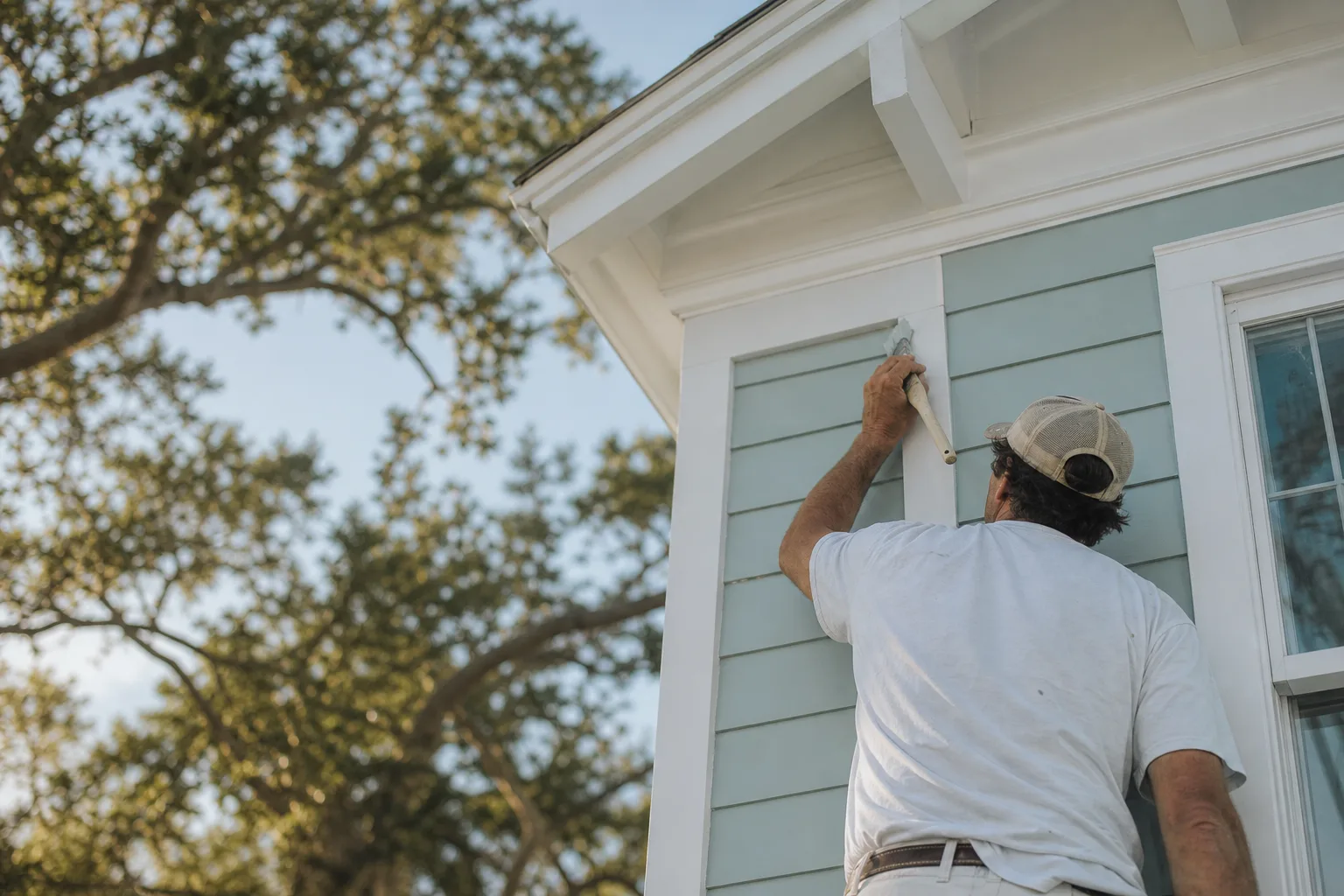
Drive any street on the Eastern Shore and you'll notice the houses that look sharp share one thing: their trim is doing real work. The siding gets all the attention when people talk color, but trim is the frame around the picture. It outlines the windows, runs the eaves, caps the corners, and crisps up the roofline. Get the trim color right and an ordinary house reads finished. Get it wrong and even a beautiful body color falls flat.
These are the exterior trim color ideas we reach for most on Gulf Coast homes — the whites that frame almost anything, plus the handful of accent moves that give trim a little more personality without making the house busy.
Exterior trim color ideas start with the right white
Answer first: a soft or warm white is the most reliable exterior trim color on the coast, because it frames nearly any siding and stays clean-looking in hard Gulf sun. Before you chase anything fancier, know the whites that earn their keep here.
| Trim white | How it reads | Pairs well with |
|---|---|---|
| Pure White (SW 7005) | Crisp, bright, barely-there undertone | Almost any siding — the safe high-contrast choice |
| Alabaster (SW 7008) | Warm, soft, slightly creamy | Greige, sage, and warm-white bodies |
| Snowbound (SW 7004) | Clean white with a whisper of warmth | Cool grays and blue-grays that need softening |
| Greek Villa (SW 7551) | Gentle creamy white | Earthy, warm, and cottage-style exteriors |
| Dover White (SW 6385) | Soft antique white | Historic and traditional homes that want a vintage frame |
The move here is matching undertone to your siding. A cool gray body next to a creamy trim can look muddy; a warm greige next to a stark bright white can look harsh. When the trim and body undertones agree, the whole house relaxes. That's why we always look at the trim and the siding together, not the trim by itself.
Soffits, fascia, and the porch ceiling
Trim isn't just the window casings. On a coastal home it includes the fascia along the roofline, the soffits underneath, the corner boards, and often the porch ceiling — and how you handle those decides whether the frame looks continuous or chopped up.
The simplest, cleanest approach is to carry your trim white up onto the fascia so the roofline reads as one unbroken edge. Soffits usually take the same white or a half-step softer. The one beloved exception down here is the porch ceiling: a pale sky blue overhead, sometimes called "haint blue," is a long-standing Southern tradition that still looks right on a Gulf Coast porch.
When does darker exterior trim work better than white?
White isn't the only answer. On modern and farmhouse-style exteriors especially, a darker trim can look fantastic — it just changes the effect from "framed" to "outlined." A few directions that hold up in coastal light:
- Black-ish trim on a white body. Iron Ore (SW 7069) or Tricorn Black (SW 6258) around the windows of a white or pale-gray house gives that crisp modern-farmhouse outline. High contrast, high drama, very current.
- Bronze and warm-dark trim. Urbane Bronze (SW 7048) reads softer than true black and pairs beautifully with warm whites and natural wood, which suits a lot of Eastern Shore homes tucked under live oaks.
- Tone-on-tone. Trim one or two shades off the body — a slightly deeper greige on a greige house — for a calm, layered look that's less stark than white but still defines the edges.
Accent trim: the small, high-impact touches
Beyond the main trim color, a few accent surfaces let you add personality without committing the whole house to it. Think shutters, the front door, porch posts, and brackets. This is where a stronger color earns its place — a Naval (SW 6244) door, Pewter Green (SW 6208) shutters, or a bronze porch light fixture against white trim.
The rule we follow: pick one accent and repeat it. A navy door looks intentional when the same navy shows up on the shutters or a window box. Scatter three different accent colors around and the eye doesn't know where to land. Trim is the calm frame; the accent is the one note that pops inside it. For how the body, trim, and accent split should actually balance, our guide on the body, trim, and accent three-color rule breaks down the proportions, and if you want full color schemes already built out, see our coastal cottage exterior color schemes for Mobile.
See your trim before you commit
Trim color reads completely differently at scale and in coastal light than it does on a paint chip. A white that looks warm on a card can flash cool against your siding once the sun hits it. Before you commit a whole house to a trim color, snap a photo and preview real colors on your own home with our free AI Color Visualizer — it's the fastest way to see how a trim white frames your actual siding.
And if you'd rather not guess at all, that's what our color consultation is for. We'll look at your siding, your roof, your fixed elements, and the light your house gets, then help you land a trim, body, and accent that work together the first time.
When you're ready, reach out for a free in-home estimate and we'll walk your home's exterior, talk trim and color, and get you a written quote within 24 hours. We're a family-owned crew that has painted Gulf Coast exteriors since 2013, backed by a 3-year workmanship warranty and a 4.8-star Google rating, and our coastal exterior house painting guide for Mobile and Baldwin County covers everything that goes into a finish that lasts. Pay by Cash, Check, or Credit Card.