
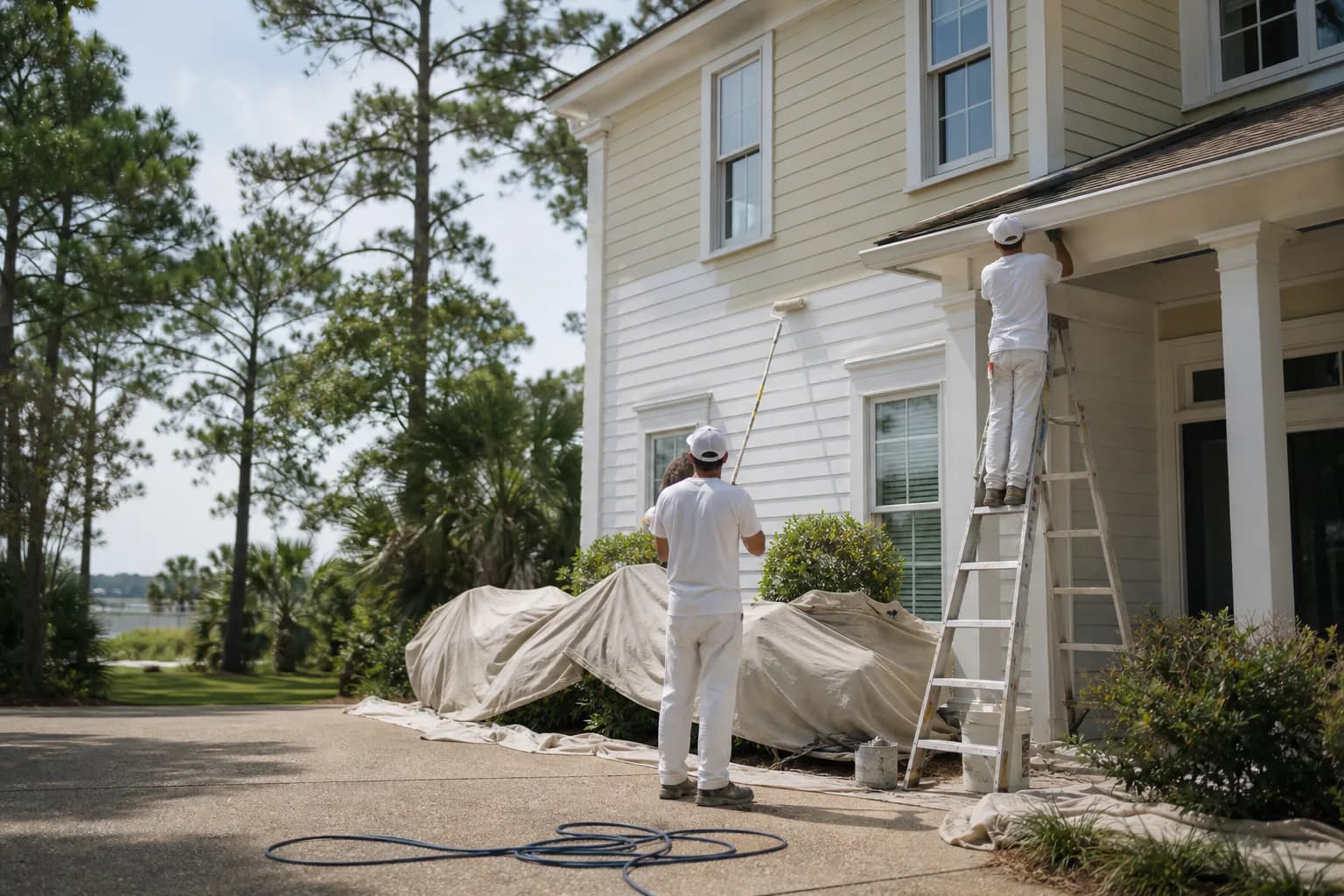
An exterior paint job is mostly weather and prep, and neither one runs on your calendar. The rolling itself is fast — it's the pressure-wash that has to dry, the scraping and wood repair the wash uncovers, and the humid Gulf-Coast air that stretches the time between coats. So how long does exterior painting take on a real house? For most homes around Mobile and Baldwin County, three to six working days from the wash to the final inspection — but "working days" is the key phrase, because an outdoor job can pause mid-stream in a way an interior one never does.
Here's a realistic look at where those days go, what makes an exterior project shorter or longer, and what can stop the work cold once it starts.
How long does an exterior paint job take by home size?
For a quick read: a small one-story in good shape often finishes in two to three working days, a typical home runs three to six, and a large two-story with lots of trim or heavy prep can stretch past a week. Size and stories set the baseline — more square footage means more washing, more surface to coat, and more setup and ladder time on a two-story.
| Home | Typical working days | What moves it |
|---|---|---|
| Small 1-story | 2–4 days | Simple lines finish fast; heavy prep or wood repair adds time |
| Average 1–2 story home | 3–6 days | Square footage, amount of trim, condition of the old paint |
| Large 2-story / detailed home | 5–8+ days | Stories, lots of trim and detail, staging and ladder time |
| Detached garage, fence, or trim-only | 1–3 days | Scope is smaller, but a separate mobilization day still counts |
These are working-day ranges, not promises — your home and the forecast decide where it lands. The most reliable way to get a real day count for your house is a free in-home estimate, where we see the actual siding and condition instead of guessing over the phone. For the full picture of what an exterior project involves, our exterior house painting guide for Mobile and Baldwin County walks through the whole coastal approach.
What the working days actually go to
Most of an exterior job isn't the visible rolling — it's the wash, the dry time, and the prep that the wash uncovers. Here's how a typical exterior project unfolds, step by step.
Free in-home estimate
We measure the exterior, check the siding and trim, and give you a written quote plus a realistic working-day timeline within 24 hours.Pressure-wash and dry
We wash the whole exterior to strip salt, chalk, and mildew, then let it dry — usually a full day — because paint won't bond to a damp surface here.Scrape, repair, and prep
We scrape to a sound edge, treat soft wood, reset failed caulk, and sand rough spots — the step most likely to add days, and the one that makes the finish last.Prime bare spots
We spot-prime bare wood, repairs, and stains so the finish coats seal evenly over a protected surface.Finish coats
We coat the body, trim, and details, letting each coat dry properly in the humidity before the next instead of rushing it.Cleanup and final inspection
We pull masking, clean up, and walk the whole exterior with you for the final inspection before final payment.
Two stages quietly set the length of every exterior job here. The first is the wash-and-dry — that's a day on its own before a drop of paint goes on, and it's not optional on the coast, because salt and chalk left on the wall keep fresh paint from bonding. The second is prep. Prep is roughly 80% of a paint job that lasts, and it's also the wild card on timing: the wash often uncovers soft wood, open joints, or peeling that wasn't obvious from the ground, and fixing those before painting is what separates a finish that holds from one that fails in a couple of seasons. When a board needs replacing, that's carpentry we handle before color, and it adds time well spent.
What can pause an exterior job mid-stream
This is the part that makes exterior timelines different from interior ones: the weather gets a vote. An interior crew can work through a rainy week without blinking. Outside, the same week can stop the job cold, and on the Gulf Coast that's a normal part of the season, not a sign anything's wrong.
- Rain. We won't paint a wet wall or put a coat on right before a storm. Rain on a soft, uncured finish causes streaking and adhesion problems, so a few wet days can stretch a calendar week even when the actual painting is quick.
- Humidity. Heavy air slows the cure, which means longer waits between coats. A muggy stretch doesn't stop the job, but it does pad the schedule.
- Summer pop-up storms. During the hottest months we start early and follow the dry weather around the house, working with the radar rather than the clock.
- Surprises the wash uncovers. Hidden soft wood, rot behind a downspout, or more peeling than expected all add prep time before paint.
None of these are wasted time — they're the difference between a finish that lasts and one you repaint early. The flip side is that timing the work for a settled, drier stretch keeps delays to a minimum, which is exactly why season matters; our guide to the best time to paint a house exterior on the Gulf Coast covers the windows where the weather works with you instead of against you.
What makes an exterior job shorter or longer
A handful of things reliably move an exterior timeline. Size and stories set the baseline — more wall and a second floor mean more wash, more coat, and more staging. Prep load is the biggest swing factor, because scraping, wood repair, and re-caulking all happen before paint. Detail — lots of trim, shutters, railings, and tight cut-in work — is slow brush work that adds up. And color or sheen changes, especially going dark over light, can mean an extra coat for clean coverage.
On the other side, you can keep an exterior job moving: clear the perimeter so the crew isn't working around patio furniture and potted plants, make sure we have water access and gate codes, and schedule the work for a drier stretch of the year. None of that touches the prep that makes the job last — it just removes the friction around it.
When you want a real schedule for your house instead of a phone guess, the move is a free in-home estimate. We'll look at your actual siding, factor in the prep your home needs and the season you're painting in, and put a written quote and a working-day timeline in your hands within 24 hours for your exterior painting project. If you're also weighing the inside of the house, our companion guide on how long an interior paint job takes breaks that timeline down too. Every Pro 1 exterior job runs with one accountable crew from that first estimate to the final inspection, a clean job-site each day, and a manager sign-off before final payment — backed by our 3-year workmanship warranty and a 4.8-star rating from homeowners across the Gulf Coast.