
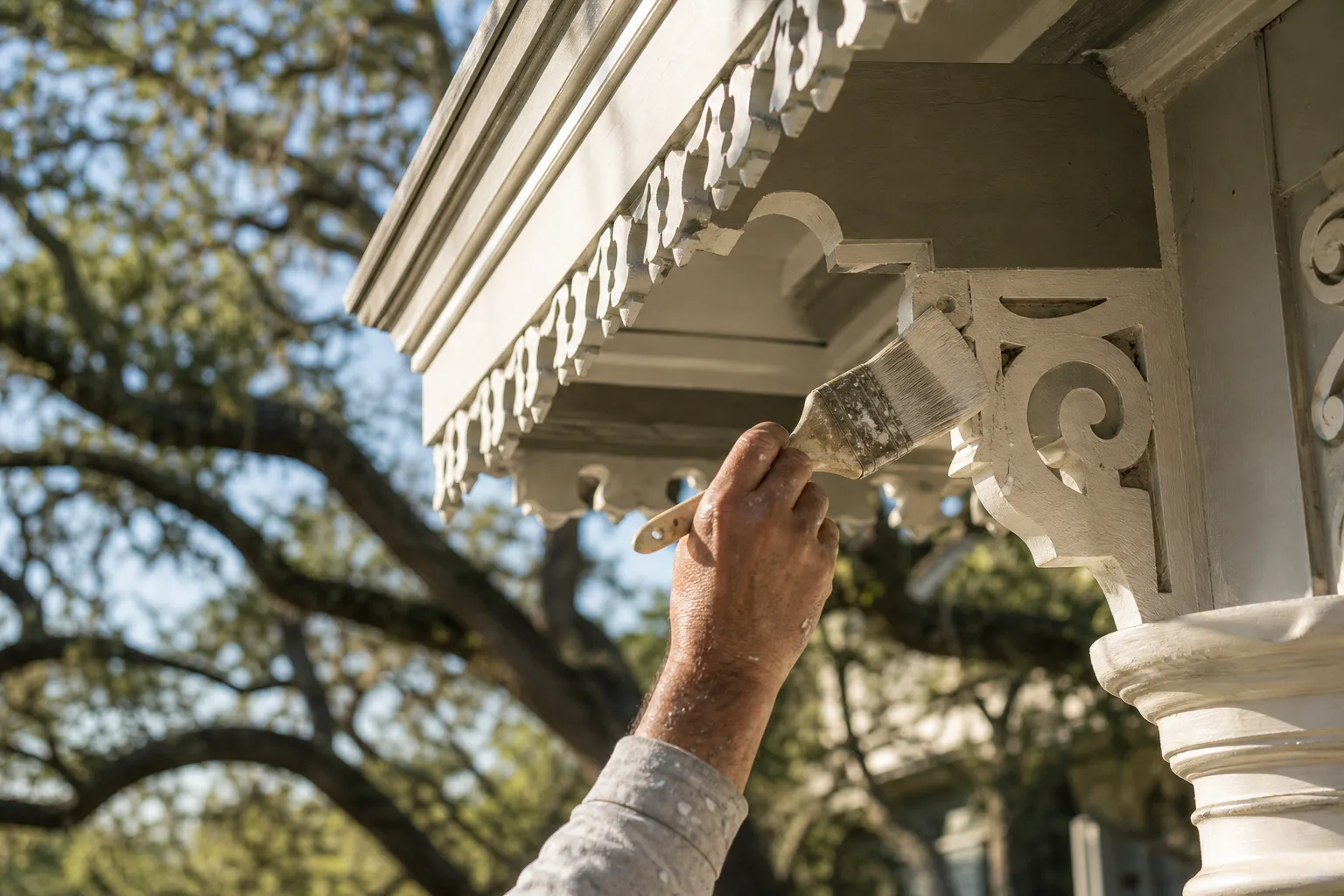
The brackets are the whole show. On a Victorian house, the carved eave brackets, the gingerbread along the porch, the spindlework and the deep window casings are what make people slow down on the sidewalk — and they're exactly the part that goes muddy if you rush the paint. Roll a flat wall and a few mistakes hide. Slop paint into a carved bracket and let it pool, or skip the prep in the recesses, and the detail reads blurry and tired from the street. Painting ornate trim is slow, fussy, hands-on work, and that's the secret: the care is the technique.
This is a how-to for the detail itself — the prep, the hand-brushing, and the color choices that make ornate Victorian trim and brackets read clean. In Mobile, this kind of woodwork lines the historic districts — De Tonti Square, Old Dauphin Way, Oakleigh Garden, Leinkauf, and Church Street East all hold blocks of carved porches and bracketed eaves, much of it weathering a century-plus of Gulf Coast humidity off Mobile Bay. If you want the neighborhood-level version for Mobile's historic districts, our post on painting Victorian and Italianate homes in De Tonti Square covers the architecture and the historic-district color review, and our wider Mobile neighborhood painting guide maps where these homes cluster. Here, we're zoomed in on the woodwork.
How to paint ornate Victorian trim and brackets, step by step
Painting ornate trim is a sequence, and skipping a step shows. Wash and fully dry the detail, scrape and sand the failing paint, repair the soft wood, prime the bare spots, then hand-brush the profiles and lay the accent colors in last. Each step exists because the carved detail holds water, hides rot, and shows every edge — so you handle all three before color goes on.
Wash and let the detail dry fully
Wash the trim, brackets, and gingerbread to strip dirt, chalk, and mildew, then let every carved recess dry completely. Ornate profiles trap water in their hollows, and paint over damp wood blisters — so the deeper the detail, the longer the dry time.Scrape and sand failing paint by hand
Scrape loose and flaking paint to a sound edge and hand-sand the profiles smooth. On a pre-1978 home assume lead is present: test, contain the area, and capture the debris instead of dry-sanding it into the open.Repair or replace soft and broken pieces
Probe brackets, spindlework, and casings for soft or rotted wood. Punky pieces can't be painted back to life — they get consolidated, filled, or milled and replaced to match the original profile before any finish goes on.Spot-prime every bare and repaired spot
Prime all bare wood, repairs, and exposed end grain. Primer is what bonds the finish to old wood and seals the porous spots so the topcoat lays down evenly across carved and flat surfaces alike.Cut in the profiles by brush
Hand-brush the brackets, gingerbread, and trim with a quality angled sash brush, working paint into the recesses and pulling it back out so it doesn't pool. Brushing keeps the carved edges crisp in a way spraying alone can't on fine detail.Lay in the accent colors last, edges clean
Apply the trim and accent colors after the body, keeping each color's lines sharp where it meets the next. On a multi-color Victorian scheme, clean transitions between body, trim, and accent are what make the detail read from the street.
Why are brackets and gingerbread hand-brushed?
Here's the answer up front: you brush ornate trim because a sprayer can't follow the carving the way a brush can. A spray gun lays paint fast on flat siding, but on a deep bracket or run of gingerbread it tends to bridge across the hollows, leaving the recesses thin and the high spots heavy. Plenty of crews spray and then back-brush, and that's fine on simple casings — but on the fine stuff, the brush is doing the real work.
The technique is patient cutting-in. You load a quality angled sash brush, work paint down into each recess so the carved profile gets full coverage, then pull the brush back across the high points so nothing pools and runs as it dries. Pooled paint in a carved corner skins over, sags, and softens every crisp edge the woodworker cut into that bracket a hundred-plus years ago. The goal on ornate trim is sharp profiles — paint that follows the carving instead of filling it in.
Choosing accent colors that read clean
A Victorian invites color, which is exactly how people get into trouble. The classic move is a three-color scheme — a body color, a trim color, and one saturated accent for the door, the sash, or the deepest detail. That structure highlights the architecture: the body recedes, the trim outlines the form, and the accent draws the eye to the best detail. Add more colors and you can absolutely do it, but every color you add is another crisp transition you have to keep clean by hand.
The mistake is choosing the colors flat, on a tiny chip, and discovering at full scale that the accent fights the body or the trim disappears against it. Color on a carved, shadowed surface in bright Gulf light reads very differently than it does on a card.
When the wood needs more than paint
You can't paint your way out of rot, and ornate trim is where rot likes to hide. Brackets sit under the eaves catching runoff, gingerbread holds moisture in its cutouts, and casings wick water at the joints — so before any color goes on, every piece gets probed for soft spots. Surface checking and small soft areas can be consolidated and filled, but a bracket that's punky through has to be milled and replaced to match the original profile. That's where painting meets woodworking: our carpentry crew can rebuild a period bracket or a run of spindlework so the new piece matches what was carved originally, and we handle the repair and the repaint together rather than asking you to line up two trades.
This kind of detail work is the slow heart of exterior painting on an older home, and it's why a Victorian repaint takes longer than a flat-walled house of the same size.
Take your time and the trim takes care of itself
Ornate Victorian trim rewards patience at every step: wash and dry the carved detail, scrape and sand it clean, repair the soft wood, prime the bare spots, hand-brush the profiles so the edges stay crisp, and lay your accent colors in last with clean transitions. Do that and the brackets, gingerbread, and spindlework read sharp from the street for years — which on a Victorian is the entire point.
Pro 1 Painters is a family-owned Mobile-area crew that treats these homes like the landmarks they are. One accountable crew runs your project from the free estimate to the final inspection, a manager signs off before final payment, and it's backed by our 3-year workmanship warranty. For the bigger picture, read our guide to painting Mobile's historic homes, then call us for a free in-home estimate and a written quote within 24 hours.