
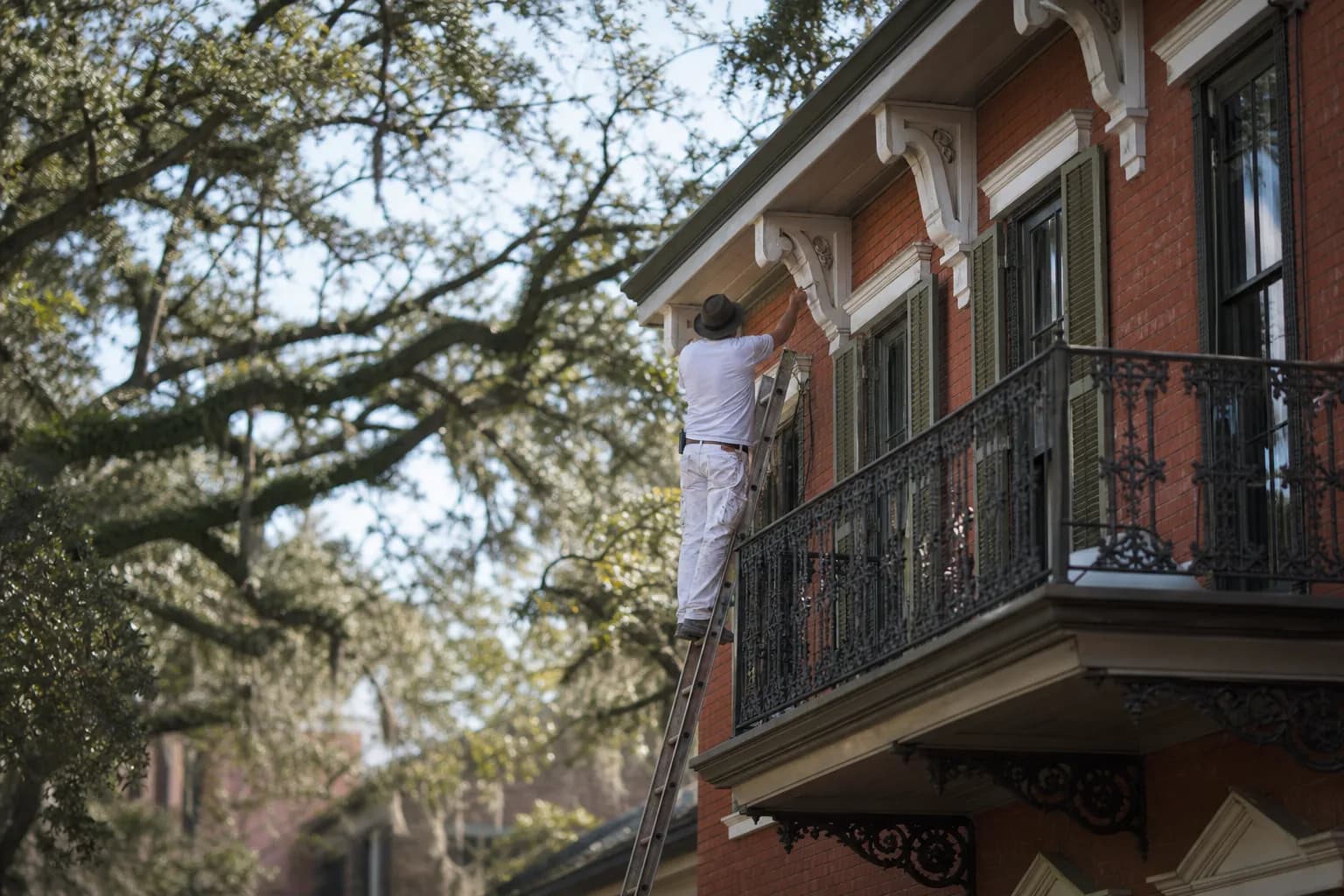
De Tonti Square is one of the oldest residential pockets in Mobile, a few square blocks of 19th-century townhouses just north of downtown where brick row houses, Italianate cornices, and cast-iron galleries sit shoulder to shoulder under the live oaks. Painting a home here is nothing like rolling a wall in a county subdivision. The surfaces are old, the detail is everything, there's iron and masonry in the mix, and exterior color falls under the eye of a historic district. Get it right and the house looks like the landmark it is. Get it wrong and the bay climate, or the review board, lets you know.
This is work we love, and it rewards doing it slowly. Here's how we approach painting a Victorian or Italianate home in De Tonti Square — the architecture and its color schemes, the brackets and iron that make these houses, and the prep that an antebellum home demands.
What you're really painting in De Tonti Square
De Tonti Square painting starts with reading the architecture, because the district isn't one style. Its antebellum core is Late Federal and Greek Revival brick, and woven through it are the Italianate and Victorian-era townhouses the neighborhood is known for — bracketed cornices, tall narrow windows, and the wrought- and cast-iron galleries that give the streets their character.
That mix changes the color conversation block to block. A restrained Federal brick townhouse usually wants something quiet that lets the masonry lead, while an Italianate or later Victorian house can carry a richer, layered scheme.
| Home type in the district | Character | Palette that tends to fit |
|---|---|---|
| Late Federal / Greek Revival brick | Antebellum, restrained, masonry-led | Crisp whites and soft greens on trim; let the brick lead |
| Italianate townhouse | Bracketed cornices, tall windows, vertical lines | Muted earth tones — olive, ochre, warm gray — with darker trim and one rich accent |
| Later Victorian | Layered detail, decorative trim | Multi-color scheme: a mid-tone body, two trim colors, a saturated door or sash |
| Cast-iron galleries + railings | Wrought and cast detail, balconies | Classic dark iron — black, deep green, bronze — kept consistent with the scheme |
The point isn't to memorize this. It's that a scheme that's perfect on an Italianate house can flatten a restrained Federal townhouse two doors down. The architecture should drive the palette, not the trend.
Color and the historic-district review
Here's the part owners worry about, so let's be straight. De Tonti Square is a designated Mobile historic district, and exterior changes — including paint color — can fall under architectural review by the city. The rules differ by what you're changing.
We're painters, not the city, so we won't tell you what your specific address requires. What we will tell you is the smart order of operations.
Confirm what review applies to your home
A designated district can carry review requirements on exterior color and materials. A quick check with the City of Mobile tells you exactly what applies to your address before you fall for a color.Choose period-appropriate colors early
If review applies, period-correct palettes move faster than something off-trend. We bring color help to your free estimate so you're choosing from schemes that suit your home's era and the district.Document before you paint
Photos of the existing exterior and your proposed colors make any approval conversation easier — and it's good record-keeping for a house this old.Schedule the work around the answer
Once you know what the district allows, we build the project around it. No surprises, no repainting because a color didn't clear.
The brackets, the iron, and why detail is the job
What makes a De Tonti Square house special is exactly what makes it slow to paint well. Italianate eave brackets, decorative cornices, tall window casings, and the wrought- and cast-iron galleries are each a series of small prep-and-paint tasks — not a flat wall you can roll in an afternoon.
On the woodwork, the detail gets worked by hand: scraping ornate trim to a sound edge, feathering, spot-priming bare wood, and cutting in the brackets and spindlework by brush so the profiles stay sharp. Rush that and the trim reads muddy from the street, which on a Victorian is the whole show.
The iron is its own craft. Mobile's humid, salt-tinged bay air rusts cast and wrought iron, and rust will bleed right back through fresh paint if you skip the step. The right way is to wire-brush railings and balcony galleries to sound metal, treat and prime with a rust-inhibiting primer, then finish in a durable classic dark — black, deep green, or bronze kept consistent with the rest of the scheme.
That bracket-and-iron detail is also where carpentry and painting meet. A rotted bracket or a punky cornice board can't be painted back to life — it gets repaired or replaced first. Our carpentry crew can rebuild period profiles so the detail matches what was there, which is why we handle the wood repair and the painting together instead of asking you to coordinate two trades. If you want the technique-level version, our guide on how to paint ornate Victorian trim and brackets goes deeper.
Lead-safe prep and breathable masonry on an antebellum home
Two things separate an old De Tonti Square house from new construction: lead, and how the wall handles moisture.
Lead is the baseline assumption. Every original home in this antebellum district far predates the 1978 ban on lead-based house paint, so in De Tonti Square lead in the existing paint isn't an edge case — it's the starting assumption until testing proves otherwise. That changes the prep. Dry-scraping or power-sanding old paint without containment throws lead dust into your yard and home. The careful way is to test, contain the work area, capture the debris, and clean up to a verifiable standard. We follow lead-safe work practices on older homes for exactly that reason.
Old masonry has to breathe. Many De Tonti Square homes are brick, and historic masonry was built to let water vapor move through the wall and escape. Seal an old brick wall under the wrong modern coating and you can trap that moisture inside, where it pushes the new paint off and can damage the masonry behind it. It's a common reason a repaint starts bubbling within a couple of seasons. The fix is matching the system to the substrate — a breathable product on masonry that needs to release moisture, rather than locking everything under a tight film.
How do you do a De Tonti Square landmark home right?
A Victorian or Italianate home in De Tonti Square is worth the extra care. Read the architecture and clear any color review the district requires, work the brackets and trim by hand, treat the iron before you paint it, prep pre-1978 surfaces lead-safe, and let an old masonry wall breathe — and you get a paint job that honors the house and stands up to Mobile Bay's salt air for years, not seasons. The same playbook carries to Mobile's other antebellum and Victorian pockets — Oakleigh Garden, Old Dauphin Way, Church Street East, and Leinkauf all share the same brackets, iron, and lead-era paint.
Pro 1 Painters has been a family-owned Mobile-area crew since 2013, and we treat these old homes like the landmarks they are. One accountable crew runs your project from the free estimate to the final inspection, a manager signs off before final payment, and it's all backed by our 3-year workmanship warranty.
If you're in De Tonti Square — or anywhere in Mobile — and you're thinking about repainting, start with the bigger picture in our guide to painting Mobile's historic districts, see our exterior painting work, then call us for a free in-home estimate. We'll bring the color help, work the home with you, and put a written quote in your hands within 24 hours.