
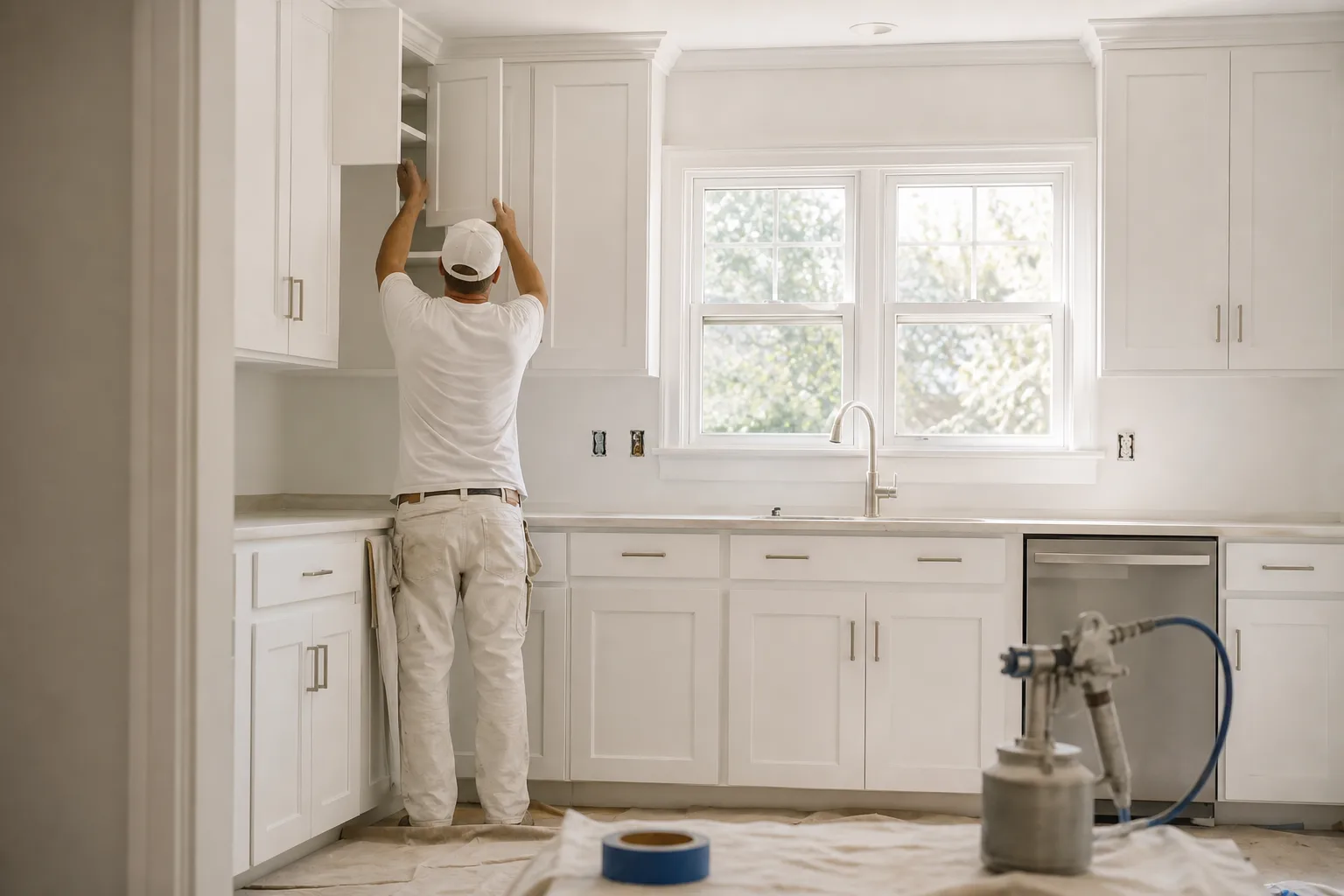
Your kitchen cabinets get touched more than anything else in the house. Coffee at six, dinner cleanup at eight, sticky hands and dish towels and grease in between. So when the doors start looking tired — yellowed oak, chipped corners, a color that screams a decade ago — the kitchen feels old even if everything else is fine. Tearing it all out is one answer. Painting the cabinets you already have is usually the smarter one.
This is the guide we wish every homeowner had before they called around. What it actually costs here, how the work really goes when it's done right, what colors hold up, how long the finish lasts in our Gulf-Coast humidity, and where painting beats refacing or replacing. We've been refinishing cabinets for Mobile and Baldwin County kitchens since 2013, and the part that makes or breaks a job is the part nobody sees.
Why paint cabinets instead of replace them
If your cabinet boxes are solid and the layout works for how you cook, painting is the move. The boxes — the carcasses bolted to your walls — are the expensive, labor-heavy part of a kitchen. Doors and drawer fronts are what you look at, and those take paint beautifully. Refinish them well and the kitchen reads as new without the demolition, the dumpster, or the month of takeout.
Replacement makes sense when the boxes are failing: water-swollen particleboard, sagging shelves, a layout you've always hated. Short of that, you're paying a lot to throw away wood that's perfectly good. Refacing — new doors over old boxes — sits in the middle on both cost and disruption.
There's a resale angle too. A clean, current kitchen is one of the first things buyers judge, and painted cabinets photograph as a fresh kitchen. If a full repaint is on your mind, our interior house painting guide for Mobile & Baldwin County walks through pairing the cabinets with walls, trim, and ceilings so the whole room moves together.
What cabinet painting costs in Mobile & Baldwin County
Here's the number we can actually stand behind: most kitchens we paint land in the $3,500–$9,000 range. That's a wide band on purpose, because no two kitchens are the same. A compact galley with twelve doors is a different job than a big L-shaped kitchen with an island, a pantry, and thirty-plus doors and drawers.
What moves you within that range:
| What drives the cost | Toward $3,500 | Toward $9,000 |
|---|---|---|
| Door + drawer count | Small kitchen, ~12–18 pieces | Large kitchen + island, 30+ pieces |
| Current finish | Sound paint, easy scuff | Slick factory coat or heavy grease |
| Prep needed | Boxes clean and tight | Grain filling, repairs, knot sealing |
| Color change | Light over light | Deep color or dark-to-white |
| Extras | Doors and boxes only | Glaze, new hardware, interior shelving |
A few things worth knowing. Going dark-to-white (or the reverse) usually means an extra coat for full coverage. Heavy grain — open-pore oak especially — can be left as character or filled smooth for that modern slab look, and filling is hands-on time. And if a door's beyond help or a box needs repair, we itemize that carpentry on your quote so there are no surprises.
We don't publish a flat per-door price, because quoting your kitchen sight-unseen would be guessing. The free in-home estimate is where it gets real — we count the doors, check the finish, and email a written quote within 24 hours. For a deeper breakdown of the math, see our companion piece on the full cost to paint a house in Mobile & Baldwin County.
How we paint cabinets — our least-invasive process
This is the part that separates a finish that lasts from one that peels in a year. Cheap cabinet jobs skip prep and roll paint over greasy doors. It looks fine for a few months, then it chips at every fingertip. Here's how we actually do it, start to finish — the least-invasive way, built around a controlled cure.
Degrease and clean
Kitchen cabinets are coated in invisible cooking grease — the number-one reason paint fails to stick. We degrease every surface so the primer can actually bond.Sand to bond
We scuff-sand the doors, drawers, and boxes to give the primer real tooth. On open-grain oak we can fill the grain for a smooth, modern look if that's the finish you want.Prime for adhesion
A bonding primer locks onto the prepped surface and gives the enamel a uniform base — and it seals tannins so they can't bleed through and yellow a white finish.Spray two enamel coats
We spray Sherwin-Williams Emerald Urethane Trim Enamel — a cabinet- and trim-grade enamel, not wall paint — in two coats with full cure time between them. Sprayed and leveled, it dries to a hard, smooth surface with no brush or roller texture.Reinstall and final fit
Once everything is fully cured, we rehang the doors, reset the drawers, adjust the hinges so they sit even, and walk the kitchen with you for the final inspection.
The piece that makes the spraying work in our climate: your doors and drawers are finished in the climate-controlled drying & preparation booths at our own facility. We take the least-invasive route — we remove the doors and drawer fronts, bring them to our shop, and spray and cure them in that controlled space, while the cabinet boxes bolted to your walls are sanded and painted right in your kitchen. Your home stays livable the whole time, and your parts are never left outside in the Gulf heat. That controlled cure does two jobs at once. It protects the finish — a dust-free, humidity-controlled space is what gives you the smooth, factory-grade result instead of a dusty, tacky one. And it protects your home — the spraying and overspray happen at our facility, not in your kitchen.
That matters more here than almost anywhere. On the Gulf Coast, humidity swings wreck an uncontrolled cure — finish stays tacky, dust settles into it, adhesion suffers. That is exactly what happens when a crew sprays in the driveway and leaves the doors to dry in the sun. Controlling the air around the wet enamel, indoors at our facility, is how the result holds up.
Choosing cabinet colors that hold up
Color is where homeowners freeze, and for good reason — it's the thing you live with every day. A few honest pointers from kitchens we've painted across the Eastern Shore and Mobile, from older Midtown and Spring Hill homes to newer West Mobile kitchens and houses out along Mobile Bay.
Soft whites and warm off-whites are still the safe, bright, resale-friendly choice, and they make a smaller kitchen feel larger. Greens — sage to deep forest — and the bay-blues and navies read beautifully in our coastal light and hide everyday wear better than a stark white. Two-tone kitchens (a deeper color on the base, lighter up top, or a contrasting island) are popular and let you be bolder without committing the whole room. Before you settle on a shade, our free AI color visualizer lets you upload a photo of your kitchen and see it repainted in the color you're considering, so you can picture it before you commit.
Sheen is part of the decision, not an afterthought. A satin or semi-gloss wipes clean and stands up to kitchen life better than a flat finish, which is why we steer cabinets there. If you want help landing the color and sheen before anything is sprayed, our color consultation is built for exactly this — so you don't repaint a color you end up regretting.
How long does a painted cabinet finish last?
With real prep and Sherwin-Williams Emerald Urethane, a painted cabinet finish holds up for many years of daily cooking, cleaning, and humidity. We won't slap a magic number on it, because longevity is earned in the prep, not promised on the label. Cabinets that were degreased, sanded, and primed before color went on are the ones still looking sharp years later. Cabinets that were painted over grease are the ones chipping by the next holiday.
Care helps it last. For about the first month the fresh enamel is still curing to full hardness — that final cure happens right in your kitchen after we reinstall, so go easy on it while it sets. After that, wipe spills and splatters instead of letting grease build, skip abrasive scrubbers and harsh degreasers on the finish, and a damp microfiber cloth handles almost everything. Our work is backed by a 3-year workmanship warranty, and we're a family-owned company that's been doing this here since 2013 — one accountable crew runs your job from the free estimate through to the final inspection, and a manager signs off before final payment.
Paint vs. reface vs. replace — which is right?
When folks weigh their options, it usually comes down to three. Here's the straight comparison.
| Option | What happens | Relative cost | Disruption |
|---|---|---|---|
| Paint / refinish | Keep boxes + doors, refinish them | $ (lowest) | Lowest — you keep using the kitchen |
| Reface | Keep boxes, new doors + fronts | $$ (middle) | Moderate |
| Replace | Tear out, install all-new cabinets | $$$ (highest) | Highest — weeks without a kitchen |
If your boxes are sound and you like the layout, painting wins on cost and on how little it upends your life. Reface if you want a different door style but the boxes are good. Replace when the boxes are genuinely failing or you're reworking the whole footprint. Most of the kitchens we see are squarely in the paint-and-be-done camp. For a deeper side-by-side on the dollars and the value, our guide to cabinet painting vs. refacing vs. replacing breaks it down further.
Ready for a smooth, factory-grade kitchen?
If your cabinets are solid and you're tired of looking at them, painting is the fastest, most affordable way to a kitchen that feels new. We'll come measure, count the doors, talk color and sheen, and email a written quote within 24 hours — free, in-home, no pressure. Have a look at our cabinet painting service page for the full scope, then reach out when you're ready. We'd be glad to take a look at your kitchen here in Mobile or Baldwin County.