
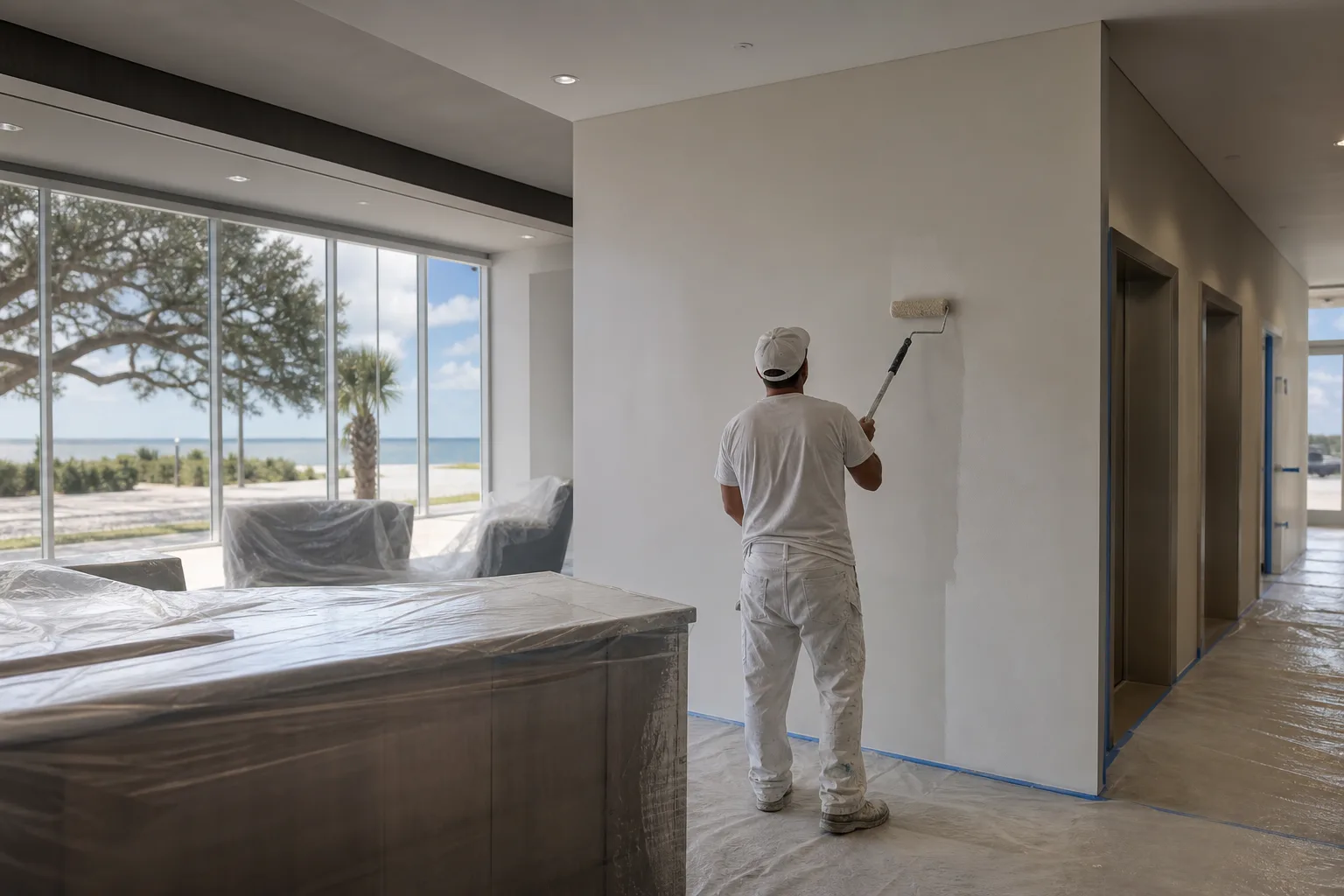
A worn office sends a message before anyone says a word. Scuffed corridors, a tired lobby, a conference room with a patch nobody ever painted over — clients notice, tenants notice, and so does the team that walks in every morning. But for a facility manager, the problem with fixing it is obvious: the building can't stop working while it gets painted. People have meetings. Tenants are paying rent for space they expect to use. The repaint has to happen around the business, not instead of it.
That's the whole challenge of office building painting in Mobile and Baldwin County — and it's a planning problem as much as a painting one. This is a facility manager's guide to getting it done: scheduling around your workdays, coordinating tenants and common areas, choosing finishes that survive office traffic, and landing a professional result that makes the building look the way you want clients to see it.
Plan the schedule around your workday first
Answer-first: the single biggest decision on an office repaint is when the work happens, not what color goes on the wall. Before anything else, we sit down with you at a free on-site estimate and map how the building actually runs — business hours, which floors and departments are busy when, where there's a quiet back office that can be painted during the day, and which spaces only free up after everyone goes home.
From there, an office job almost always becomes a blend of three timing approaches:
| Approach | Best for | Trade-off |
|---|---|---|
| After-hours / overnight | Lobbies, corridors, busy floors, client-facing rooms | More labor hours, but zero impact on the workday |
| Daytime behind a sealed zone | Quiet back offices, empty conference rooms, storage | Some daytime presence, but the space stays usable |
| Weekend blocks | Whole-floor pushes, common areas, occupied tenants | Limited window, so bigger buildings span several weekends |
A typical building gets its lobby and main corridors painted overnight, its private offices done one cluster at a time behind a sealed wall during the day, and a big conference room knocked out on a Saturday when nothing's booked. The point is that the schedule bends to your operation. You tell us the week you absolutely can't have disruption, and we build around it.
Coordinate tenants and common areas
A multi-tenant office building adds a layer a single-occupant office doesn't have: every suite is someone's business, and the common areas belong to all of them. Getting that right is mostly coordination.
For the tenant suites, we sequence the work suite by suite and floor by floor, working with building management and each tenant on timing so one office's repaint never bleeds into the business next door. The active suite gets sealed off so dust and odor stay contained, and the tenants on either side keep working like nothing's happening.
The common areas — lobbies, elevator banks, corridors, stairwells, restrooms — are the part that touches everyone, so they get special handling:
- Schedule them for off-hours. A lobby or main corridor can't be roped off at 10 a.m., so those get painted evenings or weekends when the building is quiet and every tenant's foot traffic keeps flowing.
- Keep paths, exits, and elevators clear. Wherever we're working, the routes people actually use stay open, marked, and safe — no tenant should have to detour through a work zone to reach their suite.
- Protect the shared finishes. Elevator interiors, stone or tile floors, handrails, and glass in the common areas get covered and masked before a brush opens, because these are the surfaces a whole building's worth of people will be looking at.
This is the same containment-and-sequencing discipline behind any repaint of an occupied commercial space without closing — an office building just adds the tenant coordination on top.
Choose finishes that survive office traffic
Office walls work harder than house walls. Chairs roll into them, carts and luggage scrape the corridors, hands hit the same spots by every doorway, and cleaning crews wipe them down constantly. A finish that looks great for a month and shows every mark by quarter's end is a false economy. So part of an office repaint is matching the right product and sheen to how each area actually gets used.
- Corridors, lobbies, and break rooms take the most abuse, so they get a tougher, scrubbable commercial-grade finish that wipes clean and holds up to daily contact.
- Private offices and conference rooms want a smoother, lower-sheen look that reads professional and calm, since they take less physical wear.
- Restrooms and high-moisture areas get a finish built to handle humidity and frequent cleaning without breaking down.
- High-touch trim, doors, and frames get a durable enamel that stands up to constant handling and still looks crisp.
We also lean on low-odor, fast-recoat coatings for office work. Low odor means a freshly painted floor doesn't drive anyone out the next morning; fast recoat means we can get two coats up in a single after-hours window instead of stretching the job across extra nights. It's a big part of how the building goes back to work quickly.
Get the look right — it's the building's first impression
Color does real work in an office. The lobby and client-facing areas set the tone a visitor forms in the first ten seconds; the work areas affect how the space feels to the people in it all day. So an office repaint is a chance to sharpen the building's whole impression, not just freshen the walls.
We can match your existing colors so a repaint blends in cleanly, or work to your brand palette in the lobby and client-facing spaces so the building reflects the company in it. If you're rethinking the look, choosing colors and sheens that hold up under office lighting — and don't read cold or dated — is worth a conversation; that's exactly what a free color consultation is for. A repaint is also the right moment to fix the small things that drag the look down — dinged corners, worn door frames, damaged drywall — so our carpentry and drywall repair and painting work can square those away before the finish coat goes on.
How does an office painting job actually run?
Every office building is its own mix of layout, tenants, traffic, and constraints, so we don't quote one off a catalog. We walk the building, read how it's used, and scope the work — the wall condition, the prep each area needs, the colors and sheens, and the realistic after-hours schedule — then put it in a written quote within 24 hours. From there it's one accountable crew running the job from your free estimate through to the final inspection, daily photo updates so you can track progress without standing on site at night, and a manager sign-off with you before final payment. You can see the full scope of what we handle on our commercial painting page, and the broader playbook in our commercial painting guide for Mobile and Baldwin County.
The bottom line on office building painting
A professional office repaint in Mobile or Baldwin County comes down to four things done well: a schedule built around your workday and your tenants, real coordination of suites and common areas so nobody loses use of their space, durable finishes matched to how each area gets used, and prep thorough enough to make the building look genuinely renewed. Get those right and your staff keeps working, your tenants keep trading, and your clients walk into a building that looks the way you want it to.
We're a family-owned crew that's painted offices and commercial buildings across Mobile and Baldwin County since 2013, and every job carries our 1-year workmanship warranty with a manager sign-off before it's called done. Reach out for a free on-site estimate and we'll send a written quote within 24 hours — you can pay by Cash, Check, or Credit Card.