
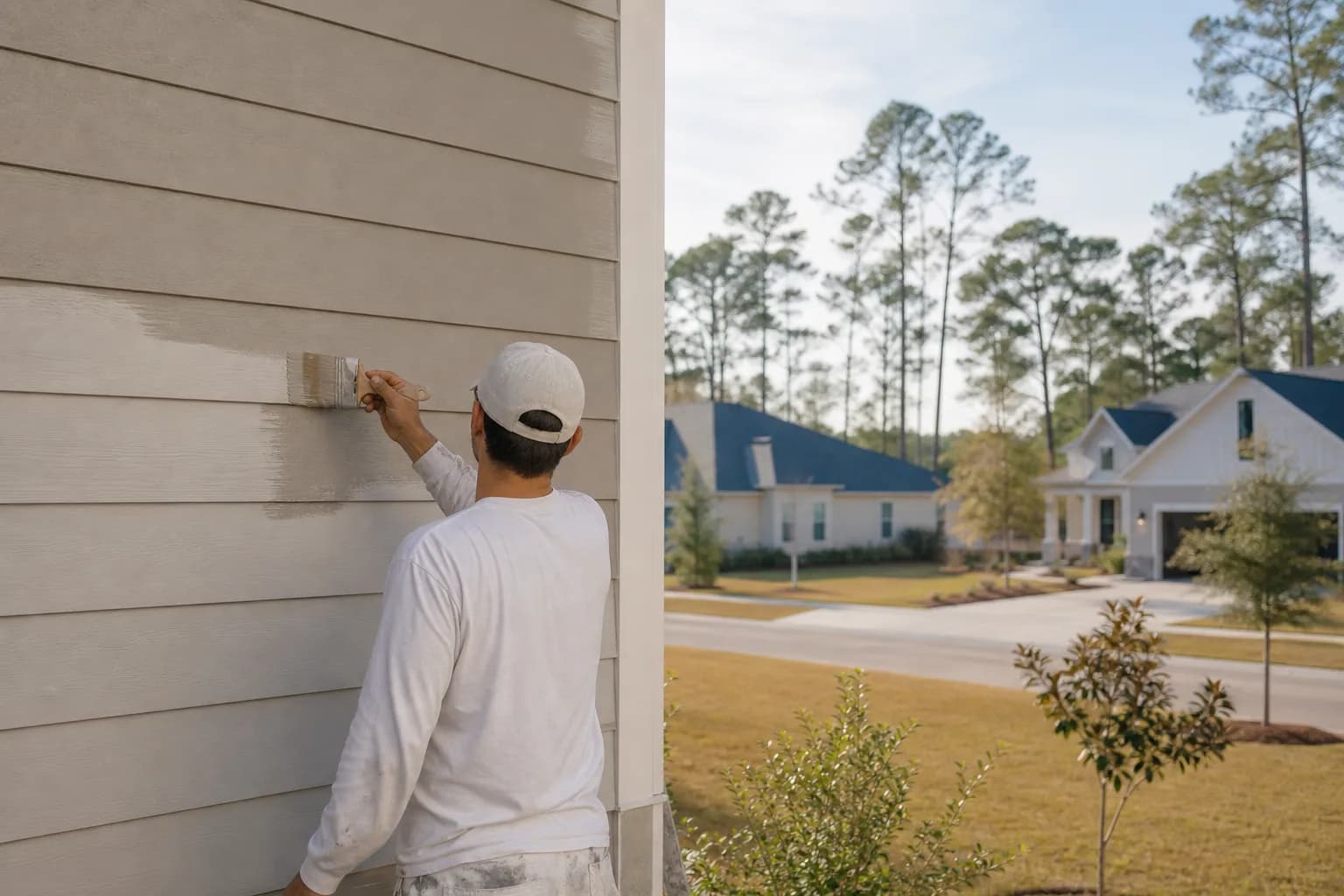
Drive a 2000s subdivision off Schillinger, Grelot, or out past Snow Road and the houses have a familiar look: two-story builds with fiber-cement lap siding, in one of about three builder colors, repeated down the street. When those neighborhoods went up, builders reached for fiber cement because it stands up to our humidity, gives termites nothing to eat, and won't rot or warp the way exposed wood does. Fifteen-plus years later, the board is still fine. The factory color is what's tired.
That's the moment most West Mobile homeowners reach: the original finish has faded and chalked, the builder's caulk lines are cracking, and you're ready for a color that isn't the same beige as the neighbors'. Good news — repainting fiber cement is one of the best, longest-lasting exterior jobs you can get down here. Here's how to repaint the fiber-cement siding on a newer West Mobile home, from the factory-finish fade to escaping the subdivision palette.
Why are West Mobile's newer homes fading now?
The direct answer: factory finishes are durable, but they aren't permanent — and West Mobile's sun is relentless nine months a year. The baked-on color on prefinished fiber cement (Hardie's ColorPlus and similar) holds up well, but after roughly 12 to 18 years it chalks and fades, especially on the south- and west-facing walls that take the most sun. A lot of the homes built in the 2000s building boom out here are hitting exactly that age now.
The important part: it's only the finish that's worn. The board itself isn't failing. Fiber cement doesn't rot, swell, or hold moisture the way wood does, which is why a repaint on it tends to outlast a repaint on older wood siding nearby — the kind you still find in the bungalows over in Midtown and Spring Hill. You're not fixing a problem with the house — you're renewing the one part that ages, whether the home is out here in West Mobile or anywhere across Mobile County's newer subdivisions.
How to repaint fiber-cement siding on a newer West Mobile home
Repainting builder-grade fiber cement is straightforward when you respect the order of operations. The wrinkle on newer homes isn't the board — it's the chalked factory finish and the aging builder-grade caulk. Here's the sequence we follow across West Mobile.
Wash off the chalk and salt film
Pressure-wash the siding to strip the surface chalk a faded factory finish leaves behind, plus salt film, pollen, and mildew. Let it dry fully. Paint over chalk and it peels — that chalk layer is the number-one reason a fiber-cement repaint fails early out here.Re-caulk the builder's failing joints
Production builders move fast, and the original caulk at trim, windows, corners, and butt joints is often dried and cracked by now. We cut it out and re-caulk with a quality paintable elastomeric caulk so wind-driven rain stays out of the wall.Spot-prime bare and cut areas
A sound factory finish doesn't need a full re-prime — but every bare spot, sanded area, repair, and raw cut end does. We spot-prime those with an acrylic exterior primer so the topcoat bonds evenly.Apply two coats of acrylic, back-brushed
We roll and back-brush two coats of 100% acrylic exterior paint, working it into the board texture, respecting dry times, and staying out of midday heat and impending rain so it cures right.
Two details separate a lasting West Mobile repaint from one that disappoints. The chalk wash — a faded factory finish leaves a powdery surface, and paint won't grip chalk; wash it off and you've solved the most common failure before you start. And back-brushing — working the paint into the board's texture with a brush instead of only rolling it on, which dramatically improves how long the coat hangs on. For the universal, material-level technique, our step-by-step on how to paint Hardie board siding on the Gulf Coast goes deeper, and our overview of whether you can paint fiber-cement siding in coastal Alabama covers the repaint-versus-replace decision.
Escaping the builder-grade color
Here's the part most homeowners are really after: getting off the beige. You can repaint factory-finished fiber cement any color you want. Tired of the builder's tan that every third house on the street wears? Want a deeper, more current exterior than the original palette offered? Once the surface is washed and any bare spots are primed, a fresh acrylic coat bonds to a prefinished board beautifully, and you can go any direction.
A few things worth thinking through before you pick the new shade out here:
- A dramatic swing from the builder color usually wants two full coats to cover evenly — pale tan hiding under a deep charcoal, or a light fresh tone going over the old darker palette.
- Deep shades soak up our heat, which fiber cement handles fine, but the exposure matters — talk it through for the walls that bake in afternoon sun.
- Judge it on the house, not the chip. A swatch that looks perfect in the garage can read totally different across a sunlit West Mobile elevation. Snap a photo of your home and preview real colors on your own siding with our free AI Color Visualizer, and our color consultation helps you land a scheme that stands out from the subdivision without fighting it.
How West Mobile's climate sets your repaint cycle
A good acrylic repaint on fiber cement generally lasts 10 to 15 years — but plan for the shorter end out here. Our sun fades color and breaks down paint film faster than it does up north, and the south- and west-facing walls always go first. Heavy humidity and the occasional storm season add to it: a single failing caulk line can let water behind boards long before the paint itself looks worn.
The practical move is to watch the house instead of waiting for it to look bad all over. Every couple of years, take a slow lap around the exterior and eye the south and west walls and the caulk joints. Re-sealing two or three joints the season they open keeps water out of the wall and buys you years before the next full repaint — the same prep-first thinking that makes the original job last.
Get your West Mobile fiber cement repainted to last
Repainting a newer West Mobile home well isn't complicated, but it is exacting: wash off the chalk, re-caulk the builder's tired joints, spot-prime what's bare, and back-brush a quality acrylic — that's what turns a repaint into one that holds up to a decade-plus of Gulf sun, and lets you finally trade the builder beige for a color that's yours.
For the bigger picture on painting houses across our area, see our Mobile neighborhood painting guide, our take on house painters across West Mobile and the Schillinger corridor, and how we handle the newer subdivisions up in Saraland. When you're ready, our family-owned crew — running one accountable team from your free estimate through the final inspection, with a manager sign-off before final payment and a 3-year workmanship warranty behind a 4.8-star reputation — will give you a free in-home exterior painting estimate anywhere in Mobile. We'll send a written quote within 24 hours. Pay by Cash, Check, or Credit Card.