
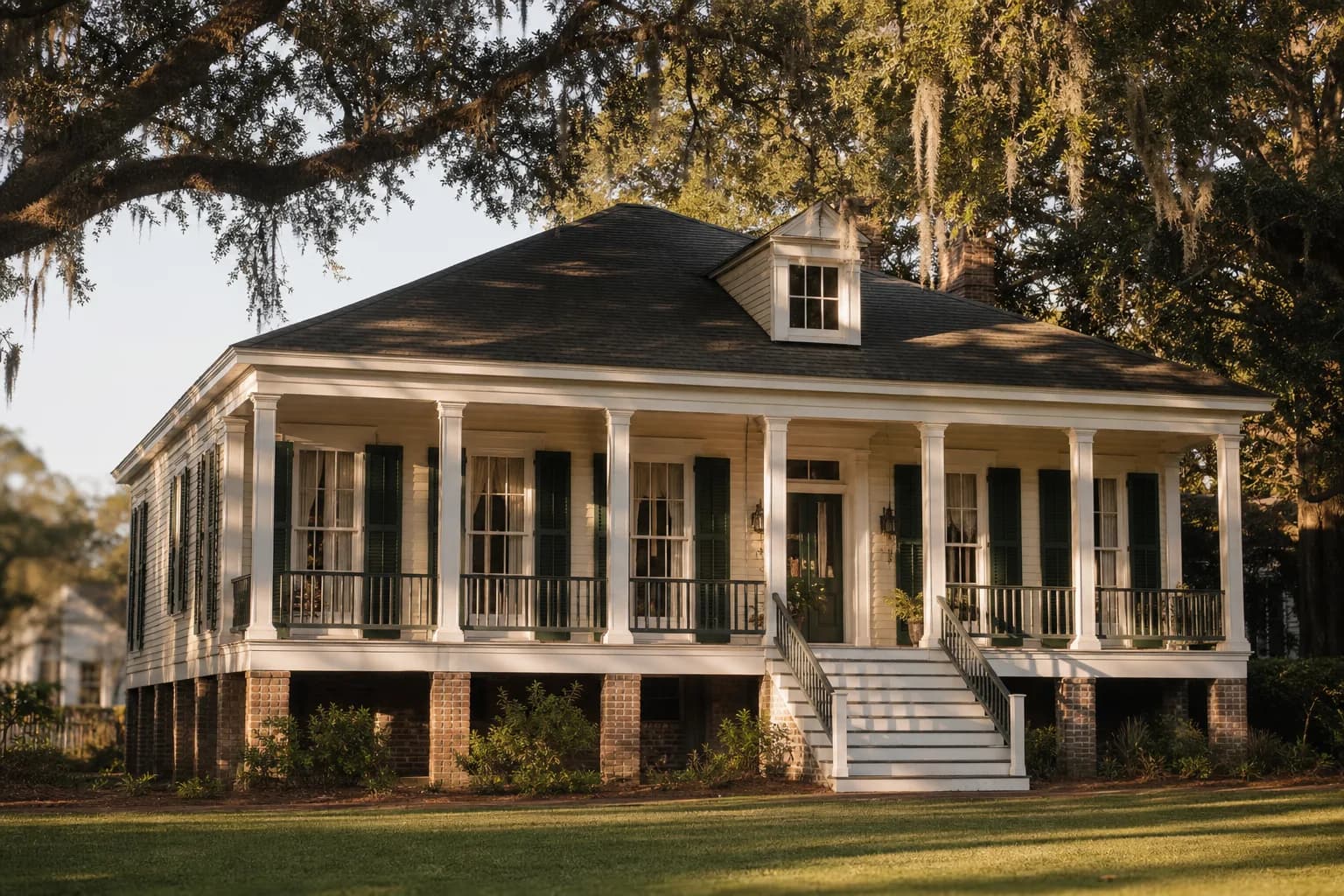
There's a house form you see all over Oakleigh Garden that you won't find in most American neighborhoods: a low cottage lifted off the ground on brick piers, with a wide porch running the full front under a broad, gentle roof. That's a raised Creole cottage, and it's one of the oldest ways the Gulf Coast learned to build for its own weather. Painting one well is less about picking a fashionable color and more about understanding why the house is shaped the way it is — and protecting the parts that take the brunt of Mobile's climate.
Painting a raised Creole cottage in Oakleigh Garden starts with reading the architecture. The pier foundation, the gallery, and the deep eaves aren't just charm; they tell you exactly where the wood is going to fail and where your prep has to be relentless. Here's how we approach these homes.
Read the form before you read the paint chips
The raised Creole cottage was built for heat and water. Lifting the living floor on brick piers got it up off damp ground and let air move underneath; the full-width gallery and the broad, low roof shaded the walls and threw rain away from the foundation. Some are a single story, some a story and a half with a steeper roof and dormers, but the bones are the same.
That form decides your painting plan. The three features that define the house are also the three that drive the work.
| Feature of the cottage | What it means for painting |
|---|---|
| Brick pier foundation (open underside) | Damp air reaches the sills, floor framing, and lowest siding boards — the first place paint peels and wood goes soft |
| Full-width front gallery | Columns, railings, beadboard ceiling, and decking all weather differently and need separate prep and finish |
| Broad, low eaves | They shade and protect the upper walls, but the eave boards and soffits collect grime and need careful washing |
Notice the pattern: the action is low and at the edges. On a two-story Victorian a few streets over in Old Dauphin Way or De Tonti Square, the paint tends to fail up high where sun and rain hammer the exposed walls. On a raised cottage, the trouble starts down low — at the skirting, the bottom courses of siding, the gallery floor, and the framing the open foundation exposes to humid air. Get under the house at the estimate and you learn most of what the job will actually take.
The gallery is its own project
The front gallery is the signature of the house and, honestly, the hardest part to paint right. It's not one surface — it's five or six, each with its own demands. The slender wood columns get touched, leaned on, and splashed. The railings and balusters take sun and hands. The beadboard porch ceiling holds onto a damp, shaded film. The decking gets the worst of the foot traffic and standing water. And the trim where the gallery meets the body has to seal out the rain that the porch is supposed to be shedding.
We prep and finish those separately. Columns and railings get the closest inspection for soft wood, because the bottoms — where they meet the deck and wick up moisture — are usually the first to go. Where a column base or a rail end has gone punky, that's carpentry before paint, not a thick coat hiding a problem. A finish only lasts if the wood under it is sound.
Creole cottage exterior painting in Mobile starts with prep
Many Oakleigh Garden cottages were built in the 1830s, '40s, and '50s, which means original cypress and heart-pine siding that's pushing 150 years or more. That old-growth wood is a gift — dense, stable, and willing to hold a finish beautifully — but only if you prep it right. Prep is 80% of a paint job that lasts.
Wash the whole envelope
Pressure-wash chalk, mildew, and grime off the body, the gallery, and the shaded eave boards. A clean, dry surface is the foundation for everything after it.Scrape and feather, lead-safe
Scrape failing paint back to a sound edge and feather the transitions so old and new layers blend. On a pre-1978 house we assume lead is in the lower layers and contain the work.Treat the wood and seal the gaps
Repair or replace soft sills, column bases, and lower siding, then caulk the joints where wind-driven rain would get behind the boards.Prime every bare spot
Spot-prime all bare and repaired wood before finish goes on, so the topcoat bonds instead of soaking unevenly into thirsty old grain.
Because the foundation is open, we pay special attention to the lowest two or three courses of siding and the skirting. That's where ground humidity and splash-back keep the wood damp longest, and it's where a rushed crew's work shows up first as peeling. On these homes, slow and thorough at the bottom of the wall is what buys you years at the top.
Why is the Mobile climate so hard on a raised cottage?
Mobile is hard on exterior wood, and a raised cottage gives the weather more edges to attack. The city sees roughly 52 inches of rain a year, July highs near 94°F, and humidity that barely lets up — and Oakleigh Garden sits in a FEMA AE flood zone, so wind-driven rain and the occasional high water are part of the deal on these low-set, near-downtown blocks. It's the same Gulf Coast load that works on every historic Mobile County home, from the houses along the Government Street historic corridor to the cottages a few streets over. That open pier foundation that keeps the floor dry also means damp air is always working at the underside.
Our exterior painting service is built around that reality: wash, scrape, repair, prime, then finish, with the most attention paid exactly where the architecture is most exposed. Mobile's median home is about 50 years old, so we spend our days on houses that need this kind of patience — and a 175-year-old cottage simply asks for more of it.
Color comes after the form
Once the wood is sound and prepped, color makes the cottage sing — but on a house this early, the palette is its own subject, and it's antebellum ground, not Victorian. For the body, trim, shutter, and gallery scheme that fits these homes, see our Oakleigh Garden paint colors guide, and if you want to test a combination on your own facade, our free AI Color Visualizer lets you upload a photo and preview real colors before a gallon is opened.
Because Oakleigh Garden is a locally designated historic district, exterior color changes can be subject to review — check with the City of Mobile's Architectural Review Board about your block and scope before you settle on a scheme. For the wider district and approval process, see our guide to painting Mobile's National Register historic homes. And for the simpler, narrower historic form a few neighborhoods over, here's how we approach painting a shotgun house in Mobile's historic neighborhoods.
Putting it together
A raised Creole cottage rewards a painter who respects its form: protect the open foundation's exposed wood, treat the gallery as its own careful project, prep the old siding the way old-growth wood deserves, confirm the district's rules, then choose a period color. Do that and your cottage looks like the best version of what it's been for a century and a half.
Pro 1 Painters is family-owned since 2013 with a 4.8-star Google rating, a Mobile office about 15 minutes from the district, and a 3-year workmanship warranty on our work. Ready to start? Call us for a free on-site estimate and a written quote within 24 hours. Pay by Cash, Check, or Credit Card.