
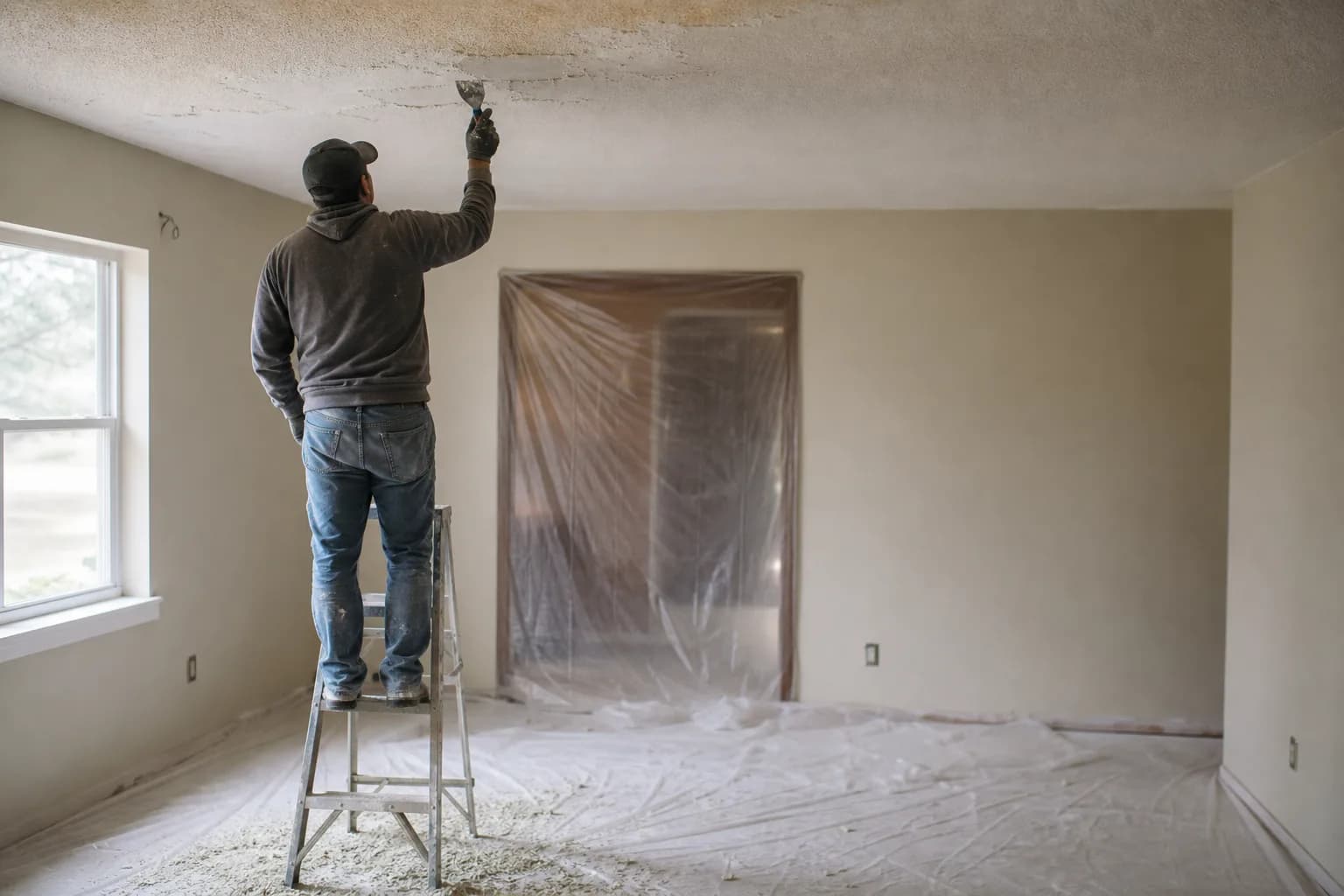
Look up. If you're staring at a bumpy, shadow-catching popcorn ceiling in a Mobile home, you're not alone — and you're probably wondering what it actually takes to get rid of it. The short answer: it's very doable, the results look fantastic, and it's messier and more involved than most people expect, especially in an older house. The longer answer is worth reading before you grab a scraper, because in Mobile there's one step you can't skip.
This is what popcorn ceiling removal in Mobile really involves — the process start to finish, why older homes need testing first, and the honest factors that drive the cost.
Why Mobile homes need a test before the scraping starts
Answer first: if your Mobile home was built before the mid-1980s, get the popcorn texture lab-tested for asbestos before anyone scrapes it. This is the non-negotiable step.
Here's why it matters so much here. Mobile's housing stock skews older — the median home in the city was built around 1973, which puts a huge share of local homes squarely in the era when popcorn ceilings were standard and asbestos was still used in textured ceiling products. We see it constantly in the mid-century ranches around Spring Hill and West Mobile and the older bungalows in Midtown and Toulminville. Scraping that texture without testing it can release fibers into the air. So the very first move on an older ceiling isn't a scraper — it's a sample sent to a lab.
Once a ceiling tests clean (or has been properly abated), it becomes a straightforward — if dusty — drywall and paint job, and that's where we come in.
The popcorn ceiling removal process, step by step
Answer first: removing a popcorn ceiling is a scrape-and-refinish process — soften the texture, scrape it off, repair what's underneath, then skim it smooth and paint. The scraping gets the attention, but the finish work is what makes it look like it was never there.
Test older ceilings first
On any pre-mid-1980s Mobile home, the texture gets lab-tested for asbestos before a blade touches it. Positive results go to a licensed abatement contractor.Seal off and protect the room
Everything gets removed or covered, doorways and vents are sealed with plastic, and floors are protected. Containment is what keeps popcorn dust from migrating through the whole house.Mist and scrape
We lightly mist the ceiling so the texture softens, then scrape it off in sections with a wide blade, working clean so debris falls onto the protected floor instead of everywhere.Repair and skim-coat
Scraping exposes tape lines, nail pops, and gouges. We patch the flaws, then skim-coat the ceiling and sand it flat so the surface is genuinely smooth, not just de-textured.Prime and paint
The repaired ceiling gets primed so the finish bonds evenly, then a flat ceiling paint goes on for a clean, modern, shadow-free look.
That skim-and-sand step is the difference between a professional result and a botched one. A scraped ceiling that isn't properly repaired and skimmed shows every old seam and gouge under raking light — which is exactly the problem you were trying to fix. Our drywall repair and painting service is built around getting that smooth finish right.
One honest note about painted-over popcorn: if a previous owner painted the texture, it won't soften with water the same way, which makes scraping slower and messier and sometimes tips the math toward a cover-up instead. We weigh both paths in our guide to popcorn ceiling removal versus cover-up options.
What drives the cost of popcorn ceiling removal in Mobile?
Answer first: popcorn ceiling removal is usually priced per square foot of ceiling, and the cost swings based on a handful of real factors — not a flat rate. Anyone who quotes you a firm price sight-unseen is guessing.
Here's what actually moves the number:
| Cost factor | Why it matters |
|---|---|
| Area and square footage | More ceiling means more scraping, skimming, and paint — the biggest single driver. |
| Ceiling height | High and vaulted ceilings need staging and take longer than standard 8-foot ceilings. |
| Repair needed after scraping | A ceiling that's gouged, water-stained, or full of bad seams takes more skim and patch work to finish smooth. |
| Painted-over texture | Painted popcorn resists water, so it scrapes slower and harder — that's added labor. |
| Testing / abatement | Older Mobile homes may need asbestos testing first, and a positive result means licensed abatement before any removal. |
Because of those variables, the right way to get a number is a real look at your ceilings. We give a free in-home estimate and a written quote within 24 hours, so you know your actual cost before you commit to anything.
People often ask whether this is a DIY job. You can scrape a small, tested-clean ceiling yourself, and plenty of homeowners do. But the part that goes wrong on DIY popcorn removal isn't the scraping — it's everything after. Containing the dust so it doesn't coat the whole house, then skim-coating and sanding the bare ceiling truly flat, is finish drywall work that takes the right tools and a practiced hand. A ceiling that's scraped but poorly skimmed looks worse than the popcorn did, and fixing a bad skim coat usually costs more than doing it right the first time. On older Mobile homes that need testing, the calculus shifts further toward hiring it out — the asbestos question alone makes a careful pro the safer call.
It's also worth thinking about value. Smooth ceilings read as updated and well-kept, they bounce light around a room instead of trapping it in shadows, and they're far easier to dust and clean. In an older Mobile home especially, losing the popcorn is one of the cheapest ways to make a space feel current — which tends to pay off both in daily living and at resale time.
While the ceilings are open and the room's already protected, a lot of Mobile homeowners take the opportunity to repaint the walls too — it's efficient, and it gives the whole room a fresh, finished look in one go. Our interior painting service pairs naturally with ceiling work, and if you're choosing wall colors, you can preview them first with our free AI Color Visualizer.
Smooth ceilings, done right in Mobile
Getting rid of popcorn ceilings is one of the highest-impact updates you can make to an older Mobile home — it modernizes a room instantly, reflects light better, and is easier to keep clean. The keys are doing the testing first on older homes, containing the mess, and finishing the ceiling smooth so it looks like it was always that way.
We're family-owned and have been doing interior and drywall work across Mobile County since 2013. We run your project with one accountable crew from your free estimate through to the final inspection, a manager signs off before final payment, and the work is backed by a 3-year workmanship warranty and a 4.8-star Google rating. You can see the rest of the areas we serve on our Mobile service area page, and our drywall repair and texture matching guide digs deeper into getting ceilings and walls genuinely smooth.
If a water-stained ceiling is part of the picture, our guide on when to cut out a water-damaged ceiling is worth a read first.
Ready for smooth, modern ceilings? Call Pro 1 Painters for a free in-home estimate and a written quote within 24 hours. Family-owned since 2013, backed by a 3-year workmanship warranty. Pay by Cash, Check, or Credit Card.