
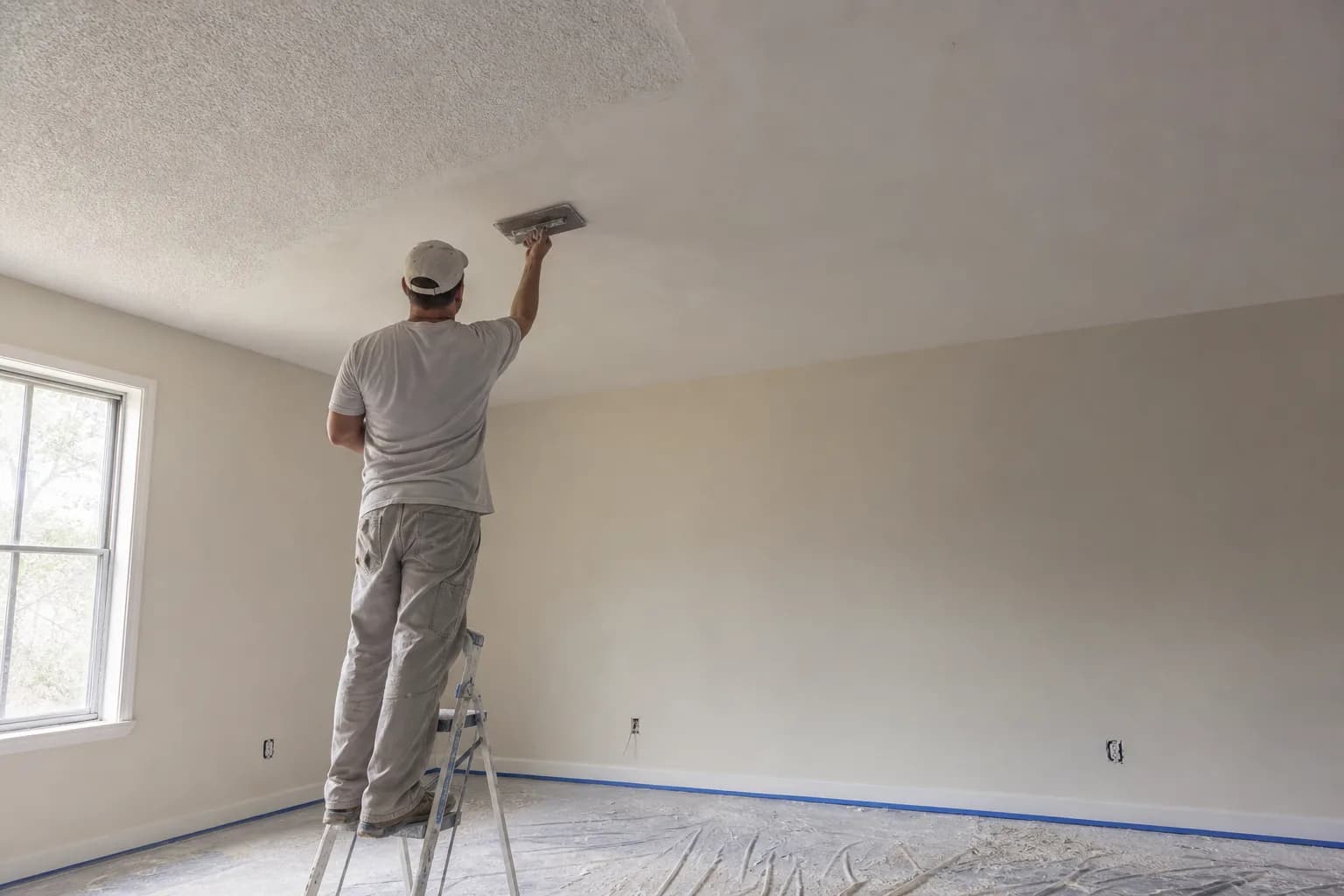
You've decided the popcorn ceiling has to go. Good — it dates a room faster than almost anything else up there. But "get rid of it" splits into two very different projects, and people usually only hear about one. You can remove the texture by scraping it off, or you can cover it — bury it under a smooth skim coat, or hang new board right over it. Both get you a flat, modern ceiling. They just get there with different amounts of mess, money, and hassle.
The wrong move is picking before you've looked at your actual ceiling, because the right answer changes with what's up there. Here's an honest comparison of removing a popcorn ceiling versus covering it up — the pros, the cons, what older Gulf-Coast homes have to test for first, and how to tell which path fits your room.
The one test that comes before any choice
Answer first: if your home was built before the mid-1980s, get the popcorn texture lab-tested for asbestos before you decide anything. This is the non-negotiable step, and it actually shapes the remove-or-cover decision.
Popcorn texture from that era can contain asbestos, and scraping it is what releases fibers into the air. Older homes are common across the Gulf Coast — plenty of local housing stock predates the mid-'80s — so this comes up constantly. If the texture tests positive, removal isn't a weekend project or a standard scrape job; it goes to a licensed abatement contractor. That's also one reason covering can appeal on an older ceiling: a skim coat or new board over an intact, undisturbed ceiling doesn't tear into the texture the way scraping does. Testing first is still the smart move either way.
Option 1: Remove the popcorn (scrape and refinish)
Answer first: scraping gives the best, thinnest, most permanent smooth ceiling — and it's the messiest path to get there.
Removal means softening the texture, scraping it off, repairing the bare drywall underneath, then skim-coating and sanding it truly flat before primer and paint. When the ceiling is sound and the popcorn was never painted, this is usually the right call. You end up with a genuine smooth ceiling at the original height, nothing added on, nothing to fail later.
The catch is twofold. First, the mess: wet-scraping popcorn coats a room in debris, so containment — sealing doorways and vents, protecting floors — is most of the discipline of doing it well. Second, painted popcorn. If a previous owner painted over the texture, it won't soften with water, and scraping turns slow, brutal, and even messier. That single fact pushes a lot of painted ceilings toward a cover-up instead. For the full step-by-step on the scrape itself and what drives its cost, see our guide to popcorn ceiling removal cost and process.
Option 2: Cover the popcorn (skim coat or new board)
Answer first: covering buries the texture instead of fighting it — cleaner than scraping, and often the smarter move on a painted or problem ceiling.
There are two common ways to cover:
Skim coat over the texture. Knock down the high points, then trowel joint compound over the popcorn in passes until the surface reads flat, sand it, and paint. It produces the same smooth look as removal with far less airborne mess, and it's a strong choice when the texture was painted (so it won't scrape) or you simply want to avoid the dust storm. The trade-off: a heavy texture takes more compound and more coats to bury completely, and it adds a little build to the ceiling. This is finish drywall work — the flatness is only as good as the hand troweling it, which is the same skill behind our skim coat smooth-finish guide.
New board over the ceiling. Hang a fresh layer of thin drywall directly over the popcorn, then tape, finish, and paint it like a new ceiling. It's the cleanest option of all — almost no scraping mess — and it gives you a brand-new surface. The cost is the most added material and weight, slightly lower ceiling height, and the labor of fastening into the framing. It tends to make sense when there's other ceiling work happening anyway.
Remove or cover — which is right for your ceiling?
Answer first: there's no universal winner — the right path depends on whether the popcorn was painted, the ceiling's condition, your tolerance for mess, and your budget. Here's how the options stack up.
| Factor | Remove (scrape) | Skim-coat cover | New board over |
|---|---|---|---|
| Final look | Smooth, original height | Smooth, very slight build | Smooth, slightly lower |
| Mess / dust | Highest — wet scraping | Moderate — sanding only | Lowest — minimal debris |
| Best when | Sound, never-painted ceiling | Painted popcorn or flaws to bury | Other ceiling work happening anyway |
| Painted popcorn | Slow, hard, messy | Works well — no scraping needed | Works well — covers it entirely |
| Permanence | Most permanent | Permanent if troweled flat | Permanent, adds a layer |
| Added weight / height | None added | Minimal | Most added |
A few honest tiebreakers. If your popcorn is bare and the ceiling is sound, removal is usually worth the mess for the cleanest, thinnest result. If it's painted, or you can't face the dust, or the ceiling underneath has flaws, covering often wins on both mess and cost. And if the ceiling is water-stained or sagging, neither option is step one — that's a repair question first, and our guide on when to cut out a water-damaged ceiling walks through it.
People often ask if this is a DIY job. You can scrape a small, tested-clean, never-painted ceiling yourself. But the part that goes wrong on DIY isn't the scraping or the knockdown — it's the finish. Getting a ceiling truly flat, whether by skim coat or repair-and-sand, is practiced drywall work, and a ceiling that's de-textured but poorly finished shows every flaw under raking light. That's the same problem you started with.
How we help you decide
Whichever way you lean, the goal is the same: a smooth, modern ceiling that reflects light and looks like it was always there. The decision just comes down to your specific ceiling — painted or bare, sound or flawed, and how much mess and budget you're working with. While the room is protected for ceiling work, a lot of homeowners repaint the walls in the same visit; our interior painting service pairs naturally with it, and you can preview wall colors first with our free AI Color Visualizer.
We're family-owned and have been doing interior and drywall work since 2013, with one accountable crew on your job from the free estimate through to the final inspection, a manager sign-off before final payment, a 3-year workmanship warranty, and a 4.8-star Google rating. For the deeper how-to on getting ceilings and walls genuinely flat, our drywall repair and texture matching guide is the place to start.
Ready to lose the popcorn? Book a free in-home estimate. We'll look at your ceiling, tell you honestly whether to scrape or cover, and email a written quote within 24 hours. Pay by Cash, Check, or Credit Card.