
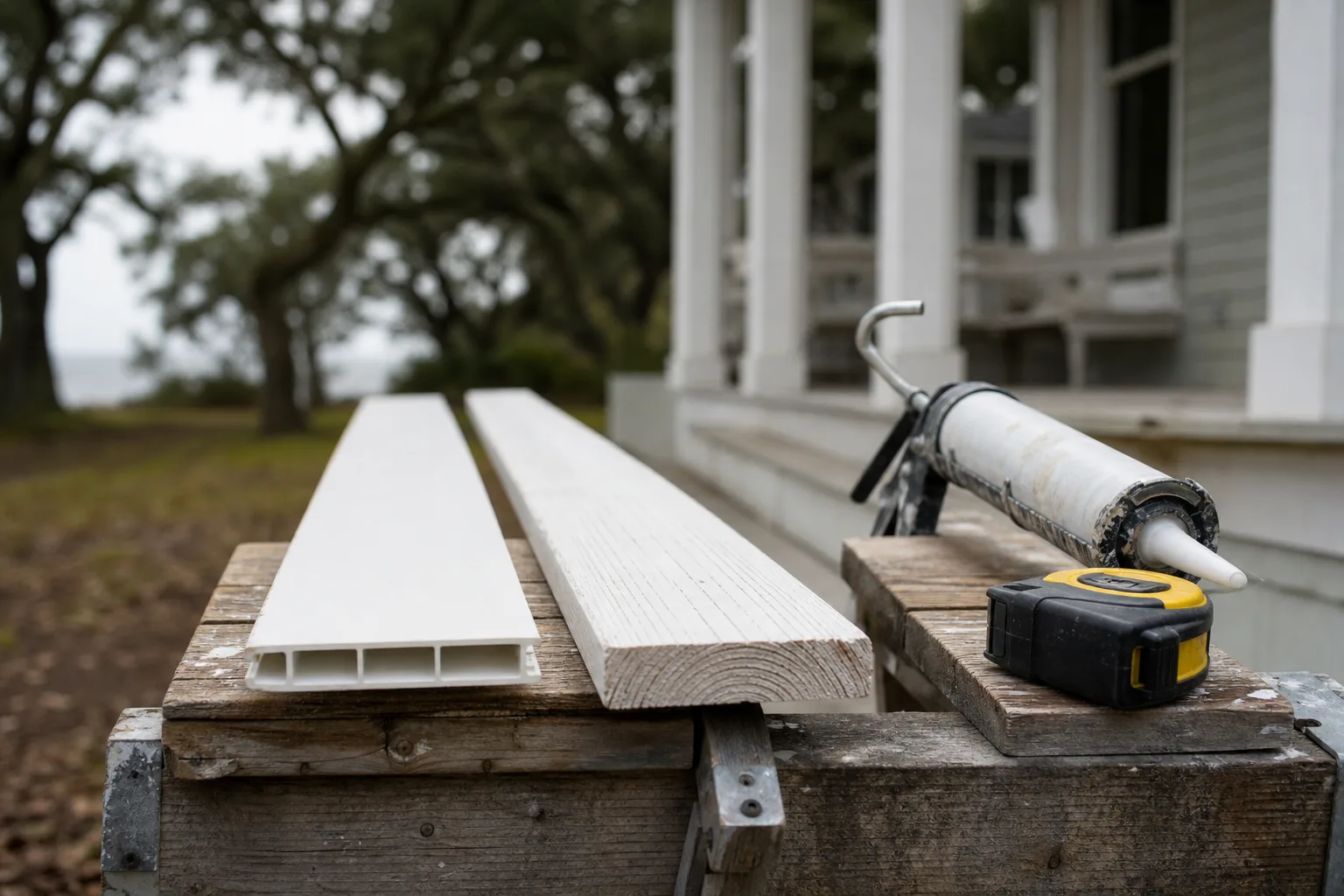
A fascia corner sinks under a screwdriver. The homeowner painted it two years ago and it already feels like a wet sponge. That moment — repeated on Gulf Coast homes every wet season — is what the PVC trim vs wood trim question really comes down to. It isn't about which board is "better" in a catalog. It's about which one survives salt air, summer humidity, and wind-driven rain on the exact spot where you're putting it.
We repair and replace trim across Mobile and Baldwin County, and we paint both materials all the time. So here's the straight comparison — rot resistance, how each takes paint, and what the cost difference actually buys you — without the sales pitch.
PVC trim vs wood trim: which one resists rot?
Start with the question that matters most on the coast: rot. PVC trim cannot rot. It's a cellular plastic — no organic fiber for moisture or fungus to break down — so it shrugs off the salt air and humidity that destroy wood. Leave it sitting in standing water for a decade and it's still sound.
Wood is organic, which is its strength and its weakness. Wood drinks moisture through every face and every cut end. Seal it well and keep it painted and it lasts a long time; let one caulk joint fail or one fastener back out, and water gets behind the paint and rots the board from the inside while the front still looks fine. That's the failure we find behind peeling exterior paint over and over.
Mobile homes lean older — the median home here was built around 1973, so a lot of our trim work is on houses that have already cycled through a few paint jobs and a few rot repairs. On an older home, the wet spots are usually obvious because they've failed before. Those are the spots where switching to PVC ends the cycle.
How PVC and wood take paint
A common myth is that PVC "doesn't hold paint." It does — it just plays by slightly different rules.
- Wood takes paint readily once it's primed. Bare wood needs a quality primer on all six sides (including the cut ends) so it doesn't wick moisture, then two coats of exterior acrylic. Prep is the whole game: sand, prime, caulk, paint.
- PVC comes solid-color (usually flat white) and doesn't need paint to survive. But most homeowners want a trim color that matches the house, so we paint it with a quality 100% acrylic exterior — no primer needed on PVC, just a clean, deglossed surface. A lighter color is the safe move, because very dark paint on PVC absorbs heat and can push the board to move more.
| Factor | Wood trim | PVC trim |
|---|---|---|
| Rot resistance | Good if kept primed & painted; fails where water sits | Will not rot, anywhere, ever |
| Takes paint | Yes — needs primer on all sides first | Yes — acrylic, no primer; favor lighter colors |
| Needs paint to survive? | Yes — bare wood rots | No — paint is for color, not protection |
| Movement in heat | Stable | Expands more; needs correct fastening & gapping |
| Upfront cost | Lower | Higher (material + install care) |
| Best for | Dry, protected, well-drained trim | Wet spots: sills, fascia ends, ground-level |
The one place PVC asks for respect is movement. It expands and contracts with temperature more than wood, so on long runs it has to be fastened and gapped correctly and the joints sealed with a flexible sealant. Done right, a painted PVC run stays tight through an Alabama summer. Done carelessly, you'll see seams open up — which is an install problem, not a paint problem.
The cost difference — and what it actually buys
PVC costs more than paint-grade wood, both for the material and for the extra install care it needs. So the real question isn't "which is cheaper today" — it's "which is cheaper over the years you'll own the house."
Here's the math we walk homeowners through. If a fascia end or a sill corner has rotted once, it will almost certainly rot again, because the thing that rotted it — water that collects there and won't drain — hasn't changed. Replacing wood with wood in that spot means paying for the same repair again in a few seasons. Replacing it with PVC costs more once and then stops the cycle for good. On the dry, protected trim that's never given you trouble, there's no payoff to PVC — sound wood, primed and painted, is the smart spend.
That's why we don't swap a whole house to PVC by default. We:
- Test every board with a screwdriver to separate sound wood from rot.
- Keep and repaint the wood that's still solid — no reason to replace it.
- Recommend PVC only on the spots that keep rotting or sit where water collects.
- Prime and paint whatever we install so the trim color matches and the whole exterior reads as one finish.
Trim and rot repair are part of exterior painting done right — paint protects sound wood, it can't fix bad wood. The full picture on finding and fixing rotten boards before a brush comes out is in our wood rot, fascia, and trim repair guide, and if you're weighing the same call on your eaves, our soffit and fascia replacement breakdown compares wood, aluminum, and PVC for those parts specifically.
The bottom line for coastal Alabama homes
PVC trim vs wood trim isn't a winner-take-all fight. PVC wins the wet, rot-prone spots because it can't rot. Primed, painted wood wins the dry, protected spots because it costs less and lasts plenty long when it's sealed right. The expensive mistake is using either one in the wrong place — wood where water collects, or PVC everywhere just to be safe.
The honest move is to look at your trim board by board and spend where it counts. That's exactly what we do at a free in-home estimate: we test the wood, show you which spots are sound, which are rotted, and which earn the PVC upgrade — then put it all in a written quote within 24 hours. Reach out through our carpentry and wood repair page when you're ready, and we'll take a look.