
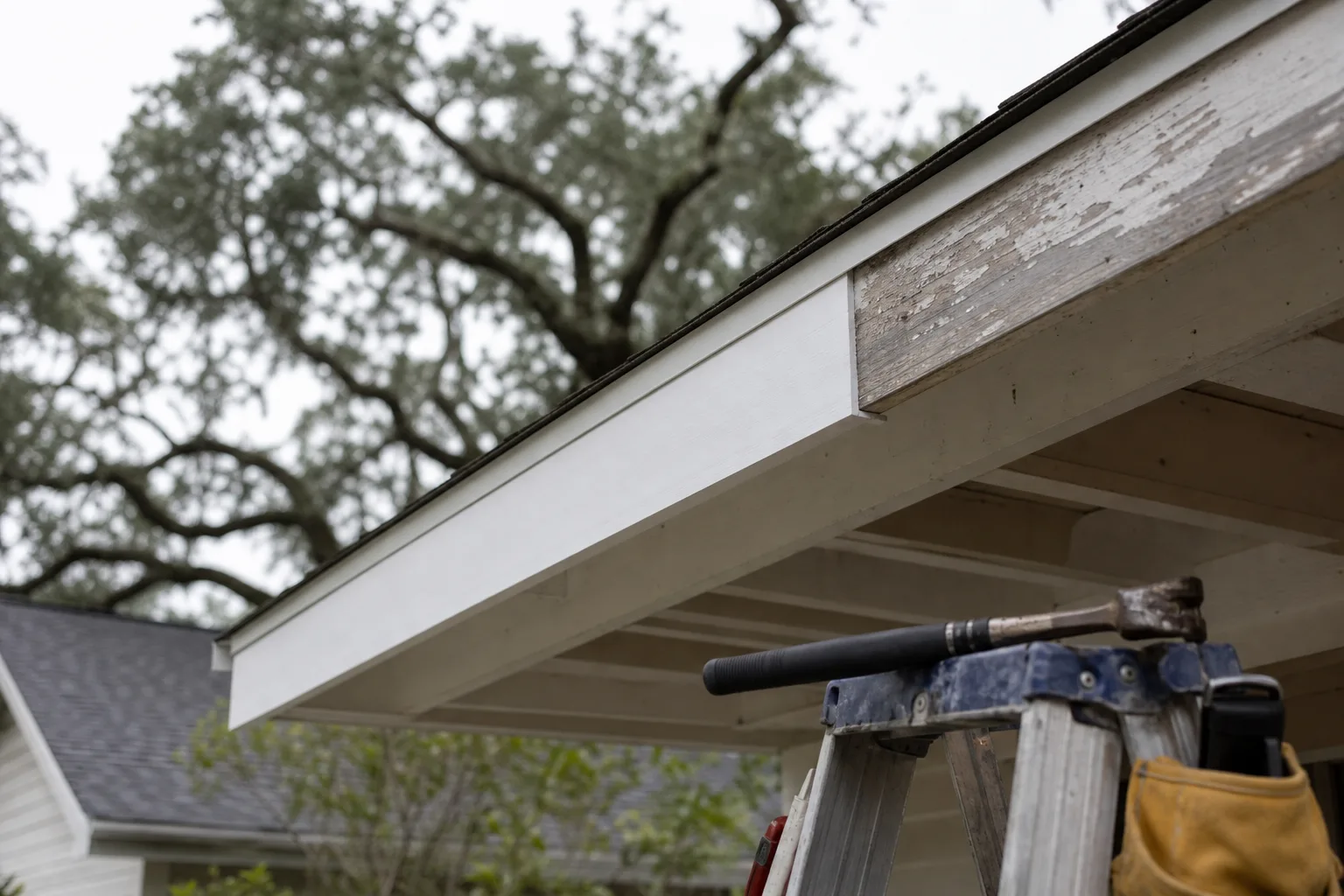
Once a fascia or soffit board is too far gone to patch, the next question isn't whether to replace it — it's what to put back up. And on the Gulf Coast, that choice carries more weight than it does anywhere dry, because whatever you install is going to spend its life in salt air, summer humidity, and the runoff of every storm that crosses Mobile Bay. Pick the wrong material for a wet spot and you'll be back at the same board in a few years. Pick the right one and you may never think about it again.
This is the material comparison: wood, aluminum wrap, or PVC for soffit and fascia replacement. We'll go through how each one handles coastal moisture, whether it needs paint, what it costs, and how much upkeep it asks for over the years — so you can see why the best answer is usually not one material for the whole house, but the right material for each run of the roofline.
The three options at a glance
Before the details, here's the shape of the decision. These aren't three flavors of the same thing — they're three different bets on moisture, cost, and maintenance.
| Material | Moisture behavior | Paint | Relative cost | Upkeep |
|---|---|---|---|---|
| Paint-grade wood | Rots if it stays wet; fine when primed and well-drained | Needs priming on all sides + topcoat | Lowest up front | Repaint and reseal on a regular cycle |
| Aluminum wrap over wood | Sheds weather; but hides the wood — rot behind a bad seam goes unseen | Pre-finished; not usually painted | Middle | Low — but seams and gutter leaks must be watched |
| PVC / cellular trim | Won't rot or absorb water, period | Optional, usually painted for color | Highest up front | Lowest — occasional repaint for color only |
The pattern to notice: cost and rot-resistance run in opposite directions. Wood is cheapest and rots; PVC resists rot and costs most; aluminum wrap sits in the middle with a catch of its own. None of them is wrong — each is right in the spot that matches its strengths.
Paint-grade wood: cheapest, and fine where it's dry
Wood is what most of these rooflines were built with, and there's nothing wrong with putting good wood back where good wood works. It's the lowest material cost of the three, it's easy to work and match to existing trim profiles, and properly handled it lasts for years.
The whole question with wood is moisture, and the answer comes down to two things: drainage and priming. Wood that's well-drained and sealed on every face holds up; wood that stays wet rots, full stop. That's why a real wood replacement gets primed on all sides — including the back face and every cut end — before it goes up, because bare end grain and back faces drink water fastest and rot the board from the inside while the front still looks painted. Skip the all-side priming to save time and you've installed a board that's already on a short clock.
Where wood is the smart spend: protected, well-drained sections of the roofline that have never given trouble. A fascia run under a generous overhang with gutters that actually work, a soffit that ventilates and dries — those spots don't need a premium material, and paying for one is money you could keep. Where wood stops making sense is anywhere that's already rotted once or stays chronically damp. Putting wood back into a wet spot is signing up to do it again.
Aluminum-wrapped fascia: low upkeep, one real catch
Aluminum wrap — sometimes called fascia wrap or capping — is a custom-bent aluminum coil stock formed over the fascia board and trim. It comes pre-finished in a baked color, so it doesn't get painted, and it does a genuinely good job of keeping sun and rain off the wood with very little maintenance. For homeowners chasing low upkeep, that appeal is real.
But there's a catch you have to understand before you choose it, and it's specific to a wet climate: wrap covers the wood, it doesn't replace it. There's still a wood board under that aluminum. As long as the wrap is tight and the seams are sealed, the wood stays dry and protected. But if water finds a way behind the wrap — through a seam that opens up, a nail hole, or a gutter that leaks down the back of the fascia — it gets trapped against the wood with no airflow and no way for you to see it. The board can rot underneath a wrap that still looks perfect from the street.
That makes aluminum wrap a strong option in one situation and a poor one in another. Over sound, dry wood with good gutters, it's a low-maintenance way to shield the fascia and buy years of hands-off life. Over wood that's already rotting, or in a spot that stays wet, it's a cover-up — you're hiding the problem behind metal instead of solving it. Wrap is only as good as the wood beneath it and the seams that keep water out.
PVC and cellular trim: it just won't rot
PVC trim — cellular PVC, sold under names like Azek and similar — is the option that takes rot off the table. It doesn't absorb water and it doesn't rot, so in a chronically wet spot it solves the actual problem instead of managing it. That's the entire appeal in a climate like ours, and it's a strong one.
A few things worth knowing so the expectations are right. PVC doesn't need paint to survive — it's fine bare — but most homeowners paint it anyway, both to match the rest of the trim and because a coat helps it handle UV and heat over the long haul on a sunny exposure. It takes exterior paint well when it's cleaned and prepped properly, so you get the no-rot benefit and the color you want. It also moves a little more with temperature swings than wood does, which just means it has to be installed with that in mind — proper fastening and gapping — so a careful install matters.
The honest downside is cost: PVC runs higher per board than paint-grade wood up front, and that's exactly why it isn't the automatic answer for the whole house. Where it earns the premium is the spots that keep losing to water — sill-corner-adjacent trim, ground-level boards, fascia ends that stay damp, anywhere that's already rotted once or twice. Replacing those once with PVC beats replacing wood there again every few years. Where it's overkill is the dry, protected runs that good wood handles fine for less.
So which should you choose?
By now the answer should be clear: it's rarely all of one. The roofline doesn't get wet evenly — the fascia behind a problem gutter, the ground-level trim, and the shaded soffit under a leak live a wetter life than the fascia under a deep, well-drained overhang. The smart job matches the material to how wet each spot actually gets.
In practice that usually looks like a mix. PVC goes where moisture keeps winning, because no-rot is worth the premium there. Good primed wood goes on the protected, well-drained runs, because it's plenty durable for less money. Aluminum wrap is the call when the wood underneath is sound and dry and you want low upkeep without replacing the board. And underneath all of it sits the rule that beats every material choice: fix the water source first. A clogged gutter, a roof or flashing leak, dead eave ventilation — leave any of those in place and even PVC is going up against a problem it shouldn't have to fight. PVC won't rot, but trapped water behind it still finds the wood it's fastened to, and a wrapped or wood board doesn't stand a chance.
That's the decision we walk through at a free in-home estimate — run by run along your roofline, matched to your actual moisture, your budget, and the look you want. To understand why this whole conversation starts with carpentry, see our carpentry as paint-prep guide for fascia, soffit, and trim, and if you haven't pinned down where your problem spots are yet, how to spot rotted fascia and soffit before it spreads shows you what to look for. The same wood-versus-rot-proof trade-off applies elsewhere on the house too — PVC trim versus wood trim on Gulf Coast homes extends it to the rest of your exterior trim, and exterior trim carpentry before you paint covers how that repair sets up the finish coat.
Whatever material goes up, the wood and the paint are one job for us — every board gets sealed and finished to match in the same pass, not left bare for someone else. You can see our carpentry and wood-repair service and how it pairs with our exterior painting service. If you've got soffit or fascia that needs replacing and you're weighing the options, call us for a free in-home estimate. We'll recommend the right material for each spot and email you a written quote within 24 hours — family-owned and working Mobile and Baldwin County since 2013, backed by our 3-year workmanship warranty and a 4.8-star rating across hundreds of Google reviews.