
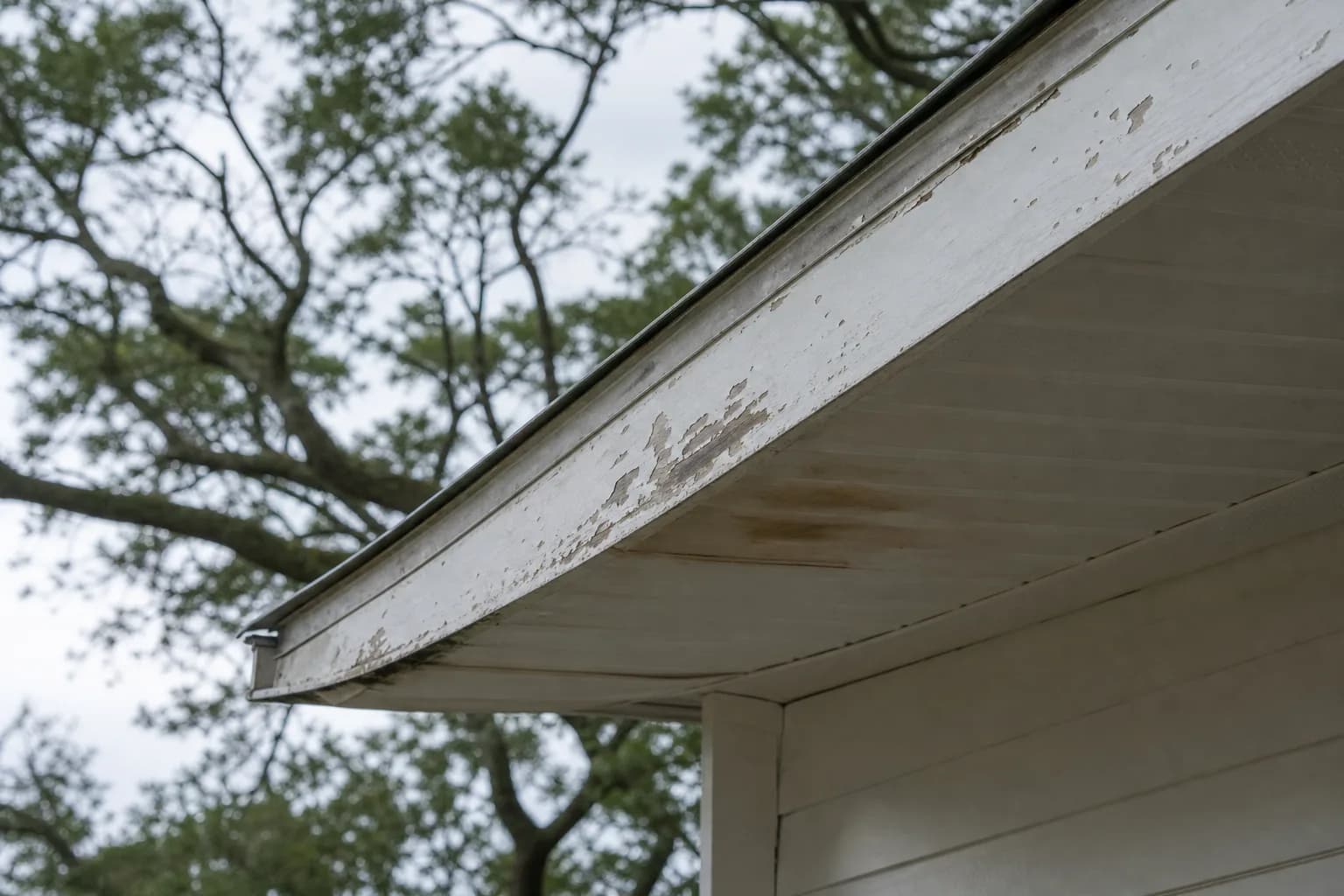
The rot at the roof edge almost never shows up where you'd expect — as a hole or an obviously broken board. It shows up as a faint brown stain on the underside of the eave, a gutter that's started to pull away, or paint that peels in the same stripe along the fascia every time the house gets repainted. Homeowners walk past those signs for years because nothing looks broken. Meanwhile the wood behind the gutter and above the soffit is quietly going soft, and rot at the roofline doesn't stay at the roofline.
This is a spotting guide — how to catch rotted fascia and soffit early, while it's still a quick repair, before it spreads behind the paint and into the roof edge. We'll cover the warning signs that show up first, the spots that rot where you can't see them, and a simple ground-up check you can run yourself in an afternoon. Fascia and soffit take the worst of your roof's runoff, so they're often the first wood on the house to fail — which makes them the first place worth looking.
The early signs of rotted fascia and soffit
The wood tells on itself long before it looks rotten, but the early tells are easy to dismiss. Here's what to actually watch for, roughly in the order it tends to show up.
- Peeling or blistering paint in a band. A horizontal stripe of failing paint along the fascia, or bubbling on a soffit panel, usually means moisture is moving through the wood from behind or above — not that the paint quit on its own.
- Brown staining or streaks under the eave. Water tracking through rotting wood leaves tea-colored stains on the soffit and dark streaks running down the fascia. Clean paint doesn't streak; stained paint is reporting a leak.
- A gutter pulling away or sagging. Gutters bolt into the fascia. When the board behind them softens, it can't hold the fasteners, so the gutter starts to droop or lean out. A sagging gutter is often a rot symptom wearing a gutter costume.
- Soffit sag, gaps, or daylight. A soffit panel that's bowing down, separating at the seams, or letting daylight through has lost its grip on softened wood or framing.
- Birds, wasps, or squirrels at the eave. Pests get into a soffit where the wood has already opened up. If something's nesting up there, the wood made the door first.
- A musty smell or visible dark growth. Persistent damp at the eave shows up as that wet-wood smell and dark blotching — both signs water is sitting where it shouldn't.
Why do fascia and soffit rot where you can't see it?
Part of what makes fascia and soffit rot dangerous is where it starts. Both of them hide their most vulnerable faces, so the rot is usually well along before any of it reaches the painted surface you can see.
The fascia's weak spot is its back. The gutter mounts to the front of the fascia, which means the board's rear face — pressed against the gutter, shaded, with no airflow — stays wet every time water runs behind the gutter or the gutter overflows. That back face rots first, working inward, while the painted front still looks intact. By the time the front blisters, the hidden side is often soft most of the way through. This is exactly why a clogged or pulling gutter is an early rot warning and not just a drainage nuisance.
The soffit's weakness is that it's looking up at every leak above it. It's the underside of the eave, shaded and slow to dry, sitting directly under the roof edge and the gutter line. A roof leak, a flashing failure, or a gutter backing up sends water onto the top of the soffit, so it rots from above, out of sight, and only shows once the stain or the sag reaches the painted face you can see from the yard. Poor attic and eave ventilation makes it worse by trapping humid air against the back of the panel.
Spot it yourself: a ground-up fascia and soffit check
You don't need to be on the roof to catch this early. Most of the warning signs read from the ground, and the ladder work is just confirmation once you know where to put the ladder. Here's the check we'd run, and you can run the first half of it from your own yard.
Do a ground-level perimeter sweep
Walk the entire house and look up at the fascia-and-soffit line. Mark anywhere you see staining, sag, a band of peeling paint, gaps at the seams, or a gutter leaning out from the wall. You're building a map of suspect spots before you climb anything.Watch the gutters in the rain
During the next steady rain, step out and watch the eaves. Gutters that overflow the front, drip down behind the board, or send water sheeting down the fascia are showing you the water source that feeds rot. Note every spot that doesn't drain clean.Probe the high-risk spots
On a stable ladder, press a screwdriver into the fascia ends, the wood directly behind and below the gutter, and any soffit panel that's stained or sagging. Firm wood pushes back; soft wood gives, sinks, or crumbles. Tap along the fascia too — solid rings, soft thuds.Check the soffit underside and vents
Look straight up at the soffit for stains, sag, daylight showing through, or pest entry, and press on suspect panels for softness or damp. Soffit rot often starts from a leak above, so the underside is where you confirm what the stains hinted at.Trace it back to the water source
For every soft spot you find, find what's wetting it — a clogged or loose gutter, a roof or flashing leak, missing or blocked eave ventilation. The wood is the symptom; the water is the cause, and the repair has to address both.
If your sweep turns up nothing soft and the paint's holding evenly along the whole eave, that's a good day — keep the gutters clear and check again after the next rough storm season. If you do find give, you've caught it at the stage where it's a manageable repair, which is the entire point of looking early.
What we do when we find it
When we spot rotted fascia or soffit at a free in-home estimate, the first thing we do is figure out how far it's gone and what's been feeding it — because a repair that ignores the water source just rots again. We chase the soft wood to where it's firm, check whether it's moved back into the rafter tails or up into the framing, and look for the gutter, roof, or ventilation problem that started it.
From there it's about getting the roofline sound and sealed again. We repair or replace the damaged fascia and soffit, make sure the area can actually dry, and then — because the wood and the paint are one job — prime every face and cut, caulk the seams, and carry the repair into the same finish as the rest of the exterior. The roof edge ends up watertight and matched, not patched and left bare. When it comes to choosing what to put back up, soffit and fascia replacement in wood, aluminum wrap, or PVC walks through the material options for spots that keep getting wet.
For the bigger picture on how carpentry sets up a lasting paint job, see our carpentry as paint-prep guide for fascia, soffit, and trim, and because gutters cause so much of this, how gutters cause fascia rot is worth a read if yours overflow or sag. You can also see our carpentry and wood-repair service and our exterior painting service.
The takeaway: the roof edge rots quietly and from the inside, so the win is catching it by its early signs — peeling bands, stains, sagging gutters — instead of waiting for the board to fall apart. If you've spotted any of those on your eaves, or a gutter that's started to pull away, call us for a free in-home estimate. We'll check the fascia and soffit honestly, find the water source, and email you a written quote within 24 hours — family-owned and working Mobile and Baldwin County since 2013, backed by our 3-year workmanship warranty.