
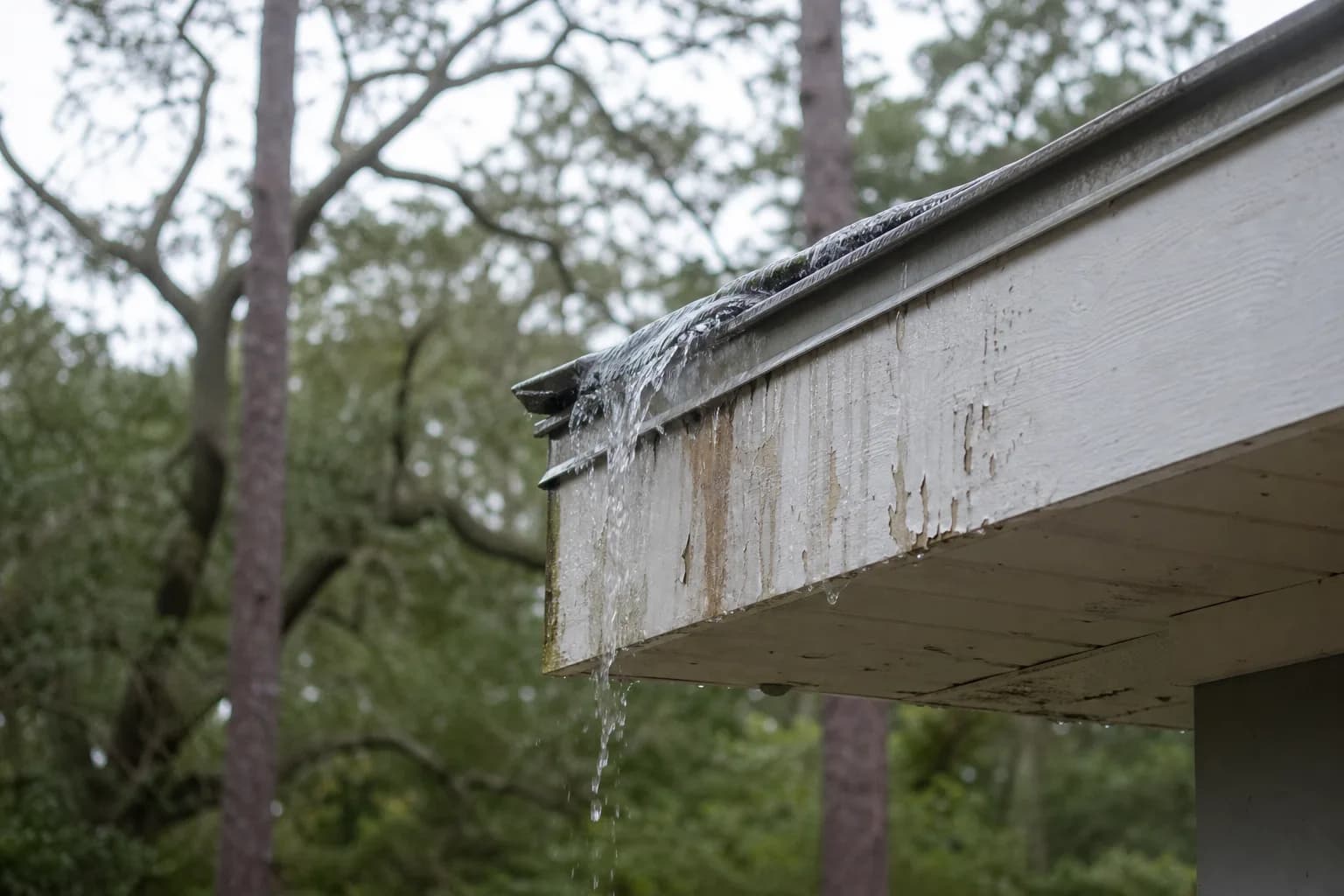
Walk around your house after a hard summer downpour and watch the gutters. If water is sheeting over the back edge instead of running cleanly to the downspout, you're not just looking at a drainage nuisance — you're watching gutters cause fascia rot in real time. On the Gulf Coast, that quiet overflow is one of the fastest ways a sound trim board turns soft, and most homeowners don't notice until the paint starts peeling in a straight line.
Here's how it actually happens, what the early warning signs look like, and how to stop the damage before it spreads into the soffit and framing — and before it turns a repaint into a carpentry job.
How clogged gutters cause fascia rot
The fascia is the long horizontal board that runs along the edge of your roof — the board your gutters are screwed directly into. That mounting is exactly why a failing gutter is so hard on it. When everything works, water lands in the trough and runs out the downspout, and the fascia stays dry. When the gutter clogs or fails, the water has nowhere to go but over the back lip, straight down the face and behind the board.
That sets up the one condition wood can't survive: it stays wet. Here on the Gulf Coast, our humidity means a soaked board dries slowly even between rains, and in storm season it barely dries at all. Constant moisture breaks down the wood fibers, mildew and fungus move in, and the fascia goes soft and spongy. From there it spreads — into the soffit panels underneath, then into the rafter tails and roof framing the fascia is nailed to. What started as a leaf-clogged gutter becomes a structural repair.
A few specific failures do the most damage on local homes:
- Debris clogs. Pine needles, live-oak leaves, and seed pods build a dam, and water backs up over the board. This is the number-one cause we see in Baldwin and Mobile counties.
- Bad slope or sagging. A gutter that's pitched wrong or pulling loose holds standing water against the fascia between rains, keeping it permanently damp.
- Leaking seams and end caps. A failed joint drips onto the same spot every storm, soaking one section of fascia until it goes soft.
- Overshooting valleys. Where two roof planes meet, heavy rain can blast right past the gutter and pour down the fascia and trim below.
The warning signs on a Gulf Coast home
The good news is fascia rot tells on itself early, if you know what to look for. The first sign is almost always in the paint. Catch it here and you save the board.
| What you see | What it usually means |
|---|---|
| Paint peeling or bubbling in a straight line along the fascia | Water is running behind the gutter and soaking the board — the classic early tell. |
| Dark streaks or stains down the fascia and trim | Repeated overflow or a leaking seam dripping on the same spot. |
| Gutters sagging or pulling away from the house | Loose fasteners and possibly soft wood that no longer holds the screws. |
| Soffit panels below looking damp, stained, or drooping | Rot has spread down from the fascia into the soffit. |
| Wood that's soft when you press it | Active rot — the board needs repair or replacement, not just paint. |
The screwdriver test is the simplest check you can do yourself. From a ladder, press a screwdriver tip firmly against the fascia in a few spots, especially near downspouts and any stained areas. Sound wood resists; rotten wood gives and sinks in. If it sinks, that section is compromised and painting over it won't help. For a fuller field guide to catching trim rot early, see our post on spotting rotted fascia and soffit before it spreads, and our rundown of the most common spots wood rot starts on a house covers the other usual offenders.
How to prevent gutters from rotting your fascia
Preventing fascia rot is mostly about keeping water moving and keeping the board sealed. None of it is complicated — it just has to actually get done, on a schedule that fits our climate.
Clean the gutters at least twice a year
Spring and fall at a minimum on the Gulf Coast — more often if you're under pines or live oaks that shed year-round. Clearing debris is the single most effective thing you can do to keep water in the trough and off the fascia.Make sure they drain and slope correctly
Water should run to the downspouts and leave, not pool in the trough. Re-pitch any flat or sagging runs and re-secure loose hangers so the gutter pulls away from the fascia, not toward it.Seal leaking seams and re-secure the gutter
Reseal failed joints and end caps so they stop dripping on the same spot, and replace stripped fasteners so the gutter holds firm to a sound board.Keep the fascia and trim painted and caulked
Sound paint and tight caulk are the wood's raincoat. Properly finished fascia sheds the water that does get behind the gutter; bare or cracked paint lets it soak straight in.Fix small problems fast
A sag, a clog, or a peeling patch is cheap to handle now. Left alone through a Gulf Coast storm season, it becomes a rotted board — and often a soffit and framing repair too.
That last point is the whole game. Clean gutters and well-maintained trim are far cheaper than replacing rotted fascia, and replacing fascia is far cheaper than the framing repairs that come when rot spreads into the roofline. Staying ahead of it is the cheapest version of this project, every time.
What if the rot is already there?
If you've already found soft wood, painting over it is the worst move — fresh paint seals moisture in, hides the spread, and peels again within a season. The right order is always: fix the water source first, then repair or replace the damaged wood, then prep and paint the new boards properly.
That sequence is exactly why we handle gutter-driven rot as carpentry and paint together. Our carpenters cut out the rotted fascia and soffit and replace it with sound wood; our painters then prime and finish the new boards so the repair blends in and actually lasts in our climate. Running both with one accountable crew means the wood repair and the paint don't fall through the gap between two trades — and the whole job is backed by our 3-year workmanship warranty, with a manager sign-off before final payment. You can read more about that hand-off on our carpentry service page and in our full guide to carpentry, prep, and rot on Gulf Coast trim. When you're ready for fresh, lasting trim, our exterior painting crew finishes the job.
Noticed paint peeling along your fascia or a gutter that won't stop overflowing? Don't wait for it to turn soft. Book a free in-home estimate, and we'll tell you honestly whether you're looking at a clean repaint or a board that needs to come off first — with a written quote in your hands within a day.