
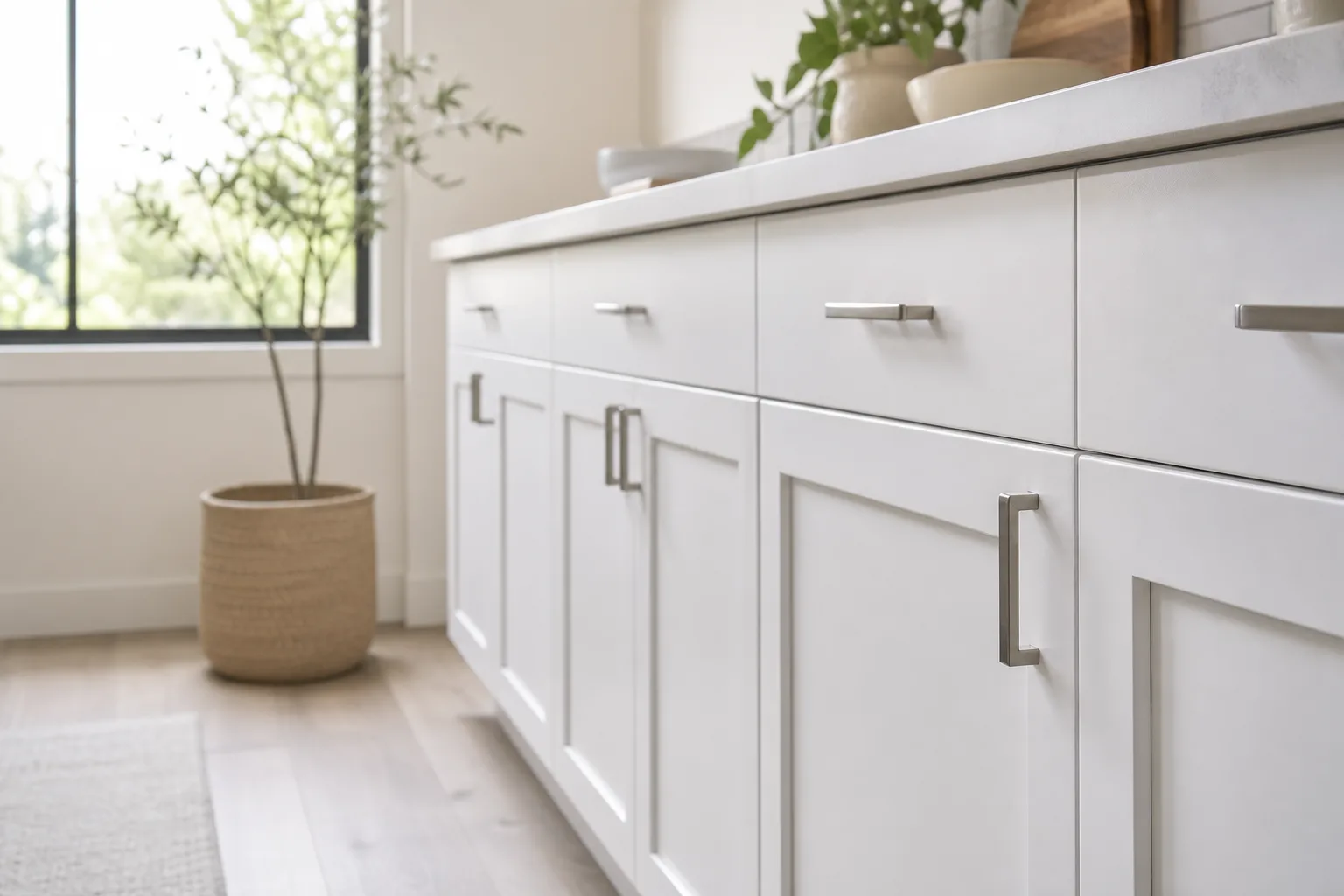
Run your hand across a cabinet door that was painted with leftover wall paint, and you can feel the problem. It's a little tacky. The edge by the handle is already worn shiny. A year in, there's a chip at the corner where a pan caught it. That's not bad luck — it's the wrong paint on the hardest-working surface in your kitchen.
The best paint for kitchen cabinets is a hard, cabinet-grade enamel, not the same can you'd roll onto a bedroom wall. Cabinets get touched, wiped, splashed, and bumped every single day, so they need a coating that cures to a tough, washable shell. Below is what actually holds up — the enamel types, the sheen, and why the finish matters even more here on the humid Gulf Coast. For the full picture on the whole project, our kitchen cabinet painting guide walks the process start to finish.
Why Wall Paint Fails on Cabinets (and Cabinet-Grade Enamel Doesn't)
Wall paint and cabinet enamel are built for two different jobs. Wall paint is formulated for vertical drywall that essentially nobody touches — it's made to hide, breathe, and go on fast. It stays relatively soft on purpose. Put it on a cabinet door and that softness turns into a liability: it marks under fingernails, gums up where hands rest, and the film around the knob burnishes to a dull shine within months.
Cabinet-grade enamel is the opposite animal. It's engineered to flow out level, knock down brush and roller texture, and cure into a hard, furniture-like surface you can scrub. That's the whole point of "cabinet grade" — it earns the name by surviving the abuse a kitchen hands out.
The Best Paint and Enamel for Kitchen Cabinets, by Type
When painters talk about the best cabinet enamel, they almost always mean one of a few modern waterborne formulas. Each cures harder than ordinary latex and levels far smoother. Here's how the common categories compare.
| Cabinet paint type | How it behaves | Best for |
|---|---|---|
| Waterborne acrylic-alkyd enamel | Self-levels well, cures hard, low odor, easy water cleanup | Most repaints — the modern go-to for a smooth, durable finish |
| Urethane-modified trim & cabinet enamel | Extra-tough, very washable, premium leveling | High-traffic kitchens that take a beating |
| Conversion / catalyzed enamels | Hardest film, factory-style; needs strict conditions | Specialty or new-cabinet work, not typical home repaints |
| Standard latex wall paint | Stays soft, marks and burnishes, peels at edges | Walls — not cabinets |
In practice, a quality waterborne acrylic-alkyd or urethane-modified trim enamel is the sweet spot for nearly every kitchen we paint. We default to Sherwin-Williams and match your color in-house, choosing the specific cabinet-grade enamel that fits your doors and finish. The well-known cabinet enamels in this class — Sherwin-Williams Emerald Urethane Trim Enamel and ProClassic — are popular for the same reason: they cure to a smooth, hard, washable surface that ordinary wall paint can't touch.
Best Sheen for Painted Kitchen Cabinets
Sheen isn't just looks — on cabinets it's about cleanability. Satin and semi-gloss are the two right answers, and the choice between them is mostly taste. Semi-gloss is the most washable and the best at shrugging off grease and hand marks; it reads crisp and a little reflective, which makes it great for busy family kitchens, though it will show surface flaws, so the prep underneath has to be clean. Satin gives a softer, lower-glare look that still wipes down well and hides minor imperfections a bit better — a popular middle ground for a modern, understated finish. Flat and matte sheens look beautiful on day one, but they smear, burnish, and hold grease where hands and rags do their work, so we steer homeowners away from them on cabinets that get daily use.
If you're still weighing colors and sheen together, our guide to the best sheen for painted cabinets goes deeper, and you can preview real colors on your own kitchen with our free AI Color Visualizer before you commit to anything.
How the Right Enamel Actually Goes On
The best cabinet enamel only earns its reputation when it's applied right. Picking the product is step one of a process that makes or breaks the finish — here's how a quality cabinet repaint comes together.
Clean and degrease
Kitchen cabinets carry invisible cooking grease that wrecks adhesion. Every surface gets degreased before anything else, because no enamel bonds to oil.Sand or scuff for grip
Scuff-sanding gives the primer something to bite. Skip it and even a great enamel can peel at the edges later.Bonding primer
A bonding primer is the bridge between your old finish and the new enamel — especially important over slick factory finishes or previously painted doors.Spray the enamel in thin, even coats
Cabinet-grade enamel is sprayed in light coats so it levels glass-smooth, with proper dry time between passes — which on the Gulf Coast means controlling the humidity it cures in.
If you'd rather hand the whole sequence to a crew that does it every week, that's exactly what our cabinet painting service is for.
Why does the finish matter more on the Gulf Coast?
Here's the part the paint can label won't tell you: even the best cabinet enamel is only as good as the conditions it cures in. On the Gulf Coast, humidity is the enemy of a hard, even cure. Spray a beautiful coat in a muggy kitchen and it can stay soft, blush, or trap dust before it sets.
That's why we take the doors and drawers off and finish them in the climate-controlled drying and preparation booths at our own shop, where the air stays clean and the humidity stays in check while the enamel levels out and hardens the way the manufacturer intended. The cabinet boxes that bolt to your walls get sanded and painted right in your kitchen, so your home stays livable the whole time and your doors never sit out in the Gulf heat the way they do when a crew sprays in the driveway and lets parts bake in the sun. The result is a smooth, factory-grade finish that survives Gulf Coast kitchens, paired with our 3-year workmanship warranty.
Best Paint for Kitchen Cabinets: The Short Version
The best paint for kitchen cabinets is a hard, cabinet-grade enamel — a waterborne acrylic-alkyd or urethane-modified trim enamel — applied over a proper bonding primer in satin or semi-gloss. Skip wall paint and skip the all-in-one kits. And remember that the finish is half product, half conditions: a great enamel cured in a humid kitchen still disappoints, which is exactly why we harden your doors and drawers in the climate-controlled drying and preparation booths back at our shop instead.
Family-owned since 2013, we run one accountable crew on your kitchen from the free estimate through the final inspection, our manager signs off before final payment, and our work is backed by a 4.8-star reputation across the Eastern Shore. When you're ready, see our full cabinet painting service or learn how long a cabinet paint job lasts in our humid climate — then book your free estimate and we'll confirm the right enamel for your cabinets. Pay by Cash, Check, or Credit Card.