
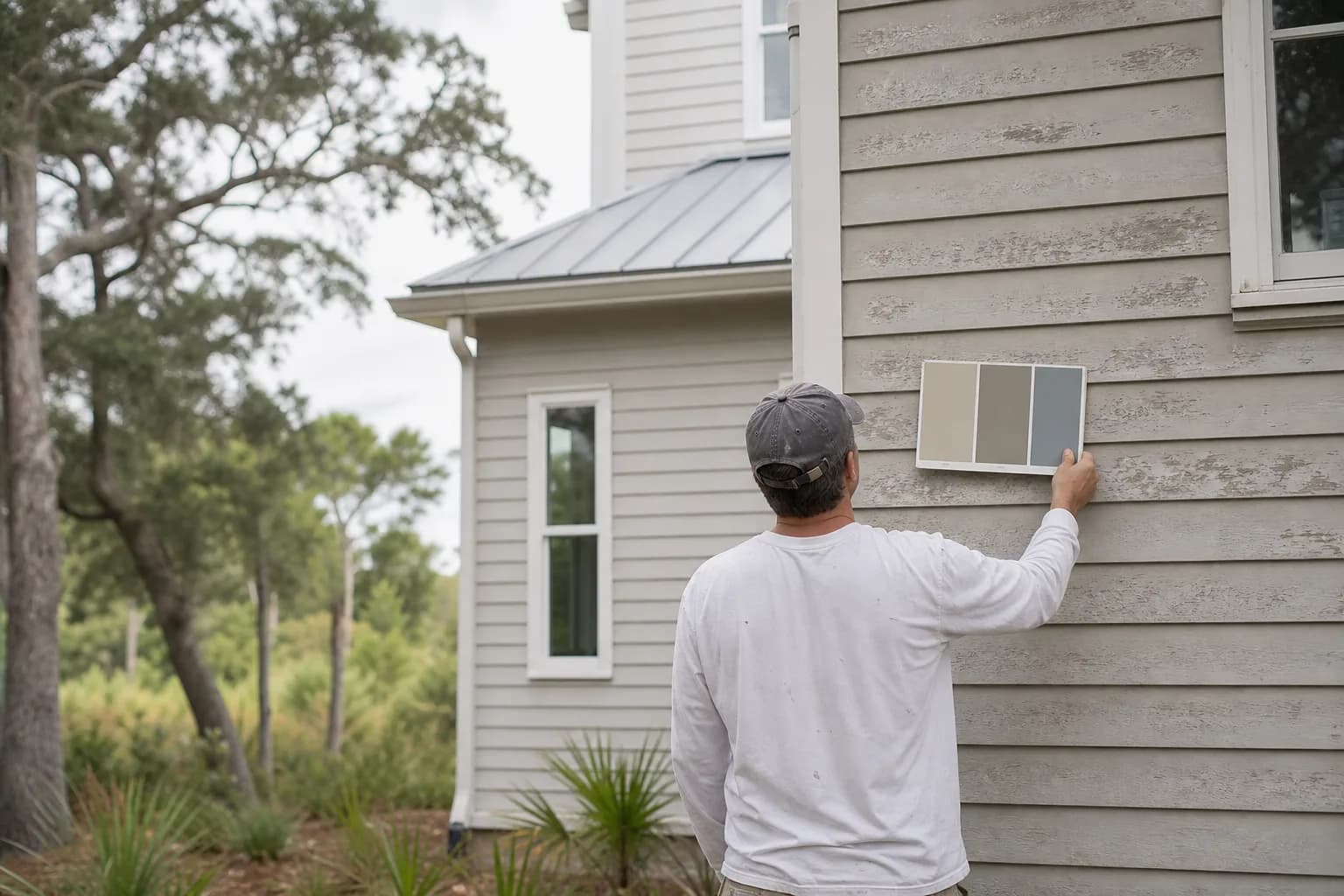
The addition came out beautiful — until the siding went on. The builder ordered the same James Hardie ColorPlus color as the rest of the house, and on the wall the new section still looked like a patch: a touch brighter, a touch cooler, obviously newer than the siding it butted against. Nothing was wrong with the order. The existing walls had simply spent years in Gulf sun and quietly drifted away from the color on the chip. That gap is what color matching Hardie board on a repaint is really about — not finding the original name, but matching the wall as it actually looks today.
We paint fiber cement across Mobile and Baldwin County, and prefinished ColorPlus board is the version that trips people up most, because the factory finish makes folks think the color is fixed forever. It isn't. Here's when you repaint it, when you touch up the factory color, and how we blend old and new siding so an elevation reads as one house.
Can you paint over a prefinished ColorPlus finish?
Answer first: yes, you can paint over prefinished ColorPlus Hardie board, and a quality exterior acrylic bonds to it well. The factory finish is a baked-on coating, not some non-paintable seal — once the surface is washed and lightly deglossed, paint sticks and lasts. The whole "can you even paint it" question, plus repaint timing for our climate, is covered in can you paint fiber cement siding; this post picks up after that, at the color call.
So if you can repaint it, when should you? A few honest triggers:
- You want a different color. The simplest reason. A whole-house repaint gets you any color you like, not just the shade the builder picked.
- The factory color has faded unevenly. South and west walls weather faster than the shaded sides, so a once-uniform ColorPlus house can end up two-toned. Repainting evens it back out.
- You're blending an addition or a big repair. New board rarely matches old board exactly. Painting both together is the fix.
- The factory color is discontinued. If you can't reorder a matching board, chasing the original color gets harder every year — repainting ends the chase.
Touch up the factory color, or repaint the wall?
This is the decision that saves or wastes money, so be honest about which situation you're in.
Touch up only makes sense on a fairly new wall with an even, unfaded finish, and only for small, isolated spots. Even then, expect the patch to show a little — the surrounding finish has aged and the dab of fresh paint hasn't, so they reflect light differently. On a tight, newer wall you can get close enough that it's not worth repainting the whole elevation for one ding.
Repaint the full elevation anytime the wall has faded, anytime you're blending an addition, and anytime a "touch-up" would land in the middle of a sun-beaten south or west wall. A fresh patch against weathered siding almost always reads as a patch. Painting corner to corner — whole walls, not partial ones — is what makes the color look continuous. The reason the sunny walls are the hard ones is the same reason they fade first; we break down which side of a house fades first and why if you want the full picture.
| Your situation | Touch up the section | Repaint the elevation |
|---|---|---|
| Small ding, newer even wall | Reasonable — expect a faint patch | Overkill for one spot |
| Faded south/west wall | Will read as a bright patch | Right call — even color corner to corner |
| New addition meeting old siding | Won't blend — board ages differ | Paint both together in one matched color |
| Discontinued factory color | Match gets harder every year | Repaint frees you from chasing it |
How we match the color on a coastal repaint
Matching prefinished fiber cement well is a hands-on process, not a paint-counter lookup. Here's how we approach it.
Identify the existing finish
Find out whether the siding is a named James Hardie ColorPlus shade or already field-painted. The factory name is a starting point, but the wall has weathered away from it.Read the weathered wall, not the chip
Match to the siding as it looks today on the sun-beaten walls, not to the original color chip. Years of coastal UV shift the real color lighter and flatter than the card shows.Sample on the actual siding in daylight
Brush real paint samples directly on the board, next to the existing finish, and judge them in natural light at different times of day before committing.Decide: blend a section or repaint the elevation
For a small repair on a newer, even wall, blend a tight match into the section. For a faded wall or an addition, paint the full elevation corner to corner so it reads as one color.
The piece people most often skip is sampling on the real wall. A color chip is judged indoors under store light; your siding lives in bright, slightly cool coastal daylight that shifts the color, and it sits next to your roof and trim, which pull it one way or another. We color-match in-house and default to Sherwin-Williams, so instead of trusting a printed chip we can mix to the board that's actually on your house — including dialing a fresh batch to where a faded wall has landed.
See the color on your own siding first
Before you commit either way — match the existing shade or change the whole house — it helps to see it. Our free AI Color Visualizer lets you upload a photo of your home and preview real paint colors on your actual siding, against your real roof and trim, in your home's light. It's the fastest way to decide whether you're trying to disappear an addition into the existing color or take the whole exterior somewhere new. And if you're matching a repair on a non-Hardie surface, the same logic applies in our guide on matching existing exterior paint color on a repair.
The bottom line on matching prefinished Hardie
Color matching Hardie board on a repaint comes down to one shift in thinking: match the wall you have, not the chip it came from. A prefinished ColorPlus finish is fully paintable, the factory color is only a starting point, and coastal sun guarantees the real siding has drifted from it. Touch up only small spots on newer, even walls; repaint full elevations when a wall has faded or an addition has to blend. And always judge the color on the actual board, in daylight, before you buy.
Got a new section that won't blend, or a ColorPlus house that's gone two-toned in the sun? That's exactly what we sort out at a free in-home estimate. Our exterior painting crew has matched and repainted Gulf Coast fiber cement since 2013 — one accountable crew from your free estimate through the final inspection, backed by our 3-year workmanship warranty. Preview a color with our color visualizer, then reach out and we'll match it on the wall. We accept payment by Cash, Check, or Credit Card.