
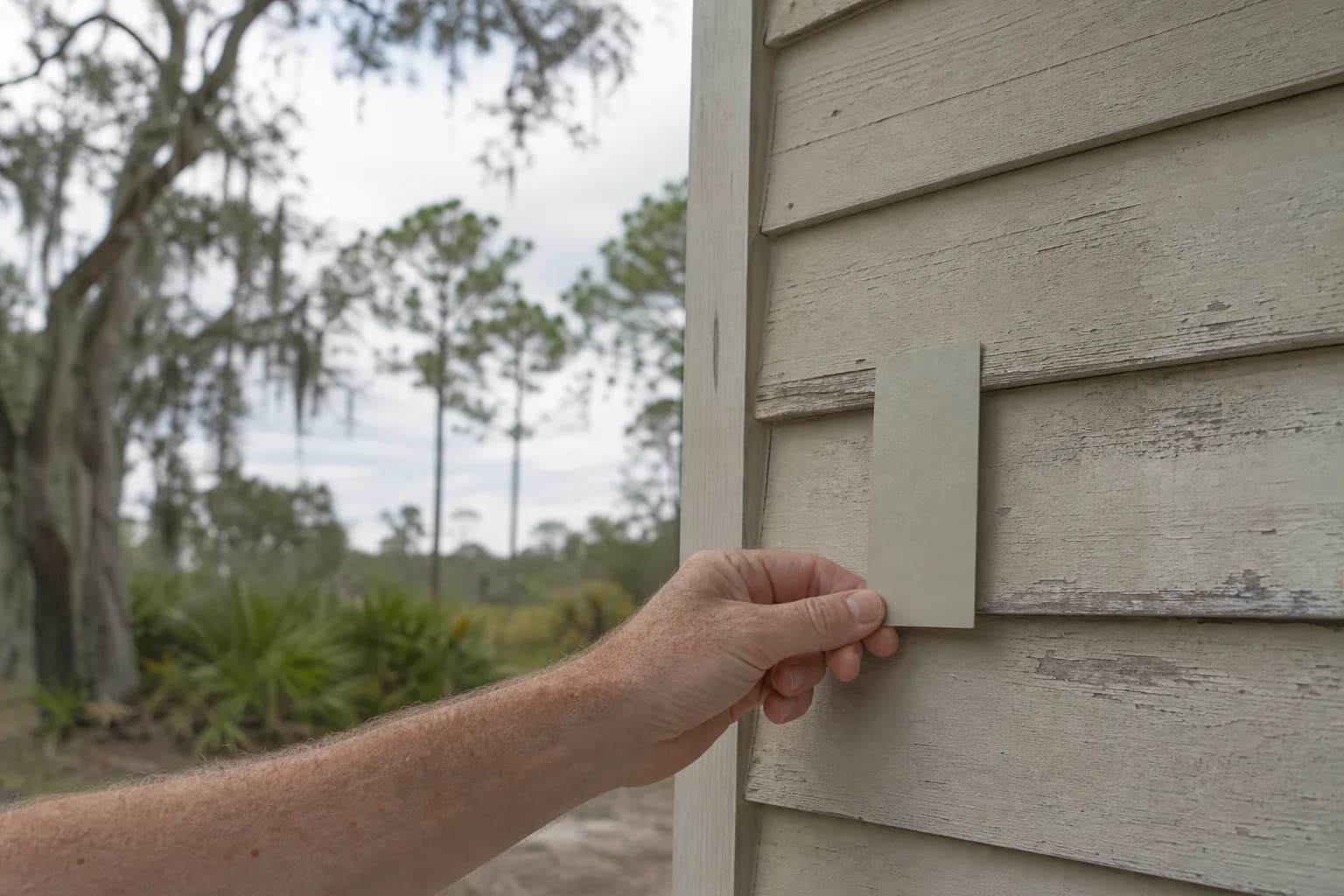
You fix the rotted trim board, prime it, and brush on paint straight from the original can — and the repair lights up like a flag, brighter and newer than the wall around it. The can was right; the wall was the problem. Years of Gulf sun pulled the paint lighter than the day it went on, so the "matching" color no longer matches anything. Matching existing exterior paint color on a repair isn't about finding the original name — it's about matching the weathered wall in front of you, and knowing when a tight blend works versus when the only clean answer is to repaint the whole side.
We do this on coastal homes constantly: a single replaced board, a patched stucco crack, a section of siding swapped after a storm. Here's how we get the color right, and how we keep a repair from reading as a patch.
Why your paint won't match — even from the same can
Answer first: the paint on your wall isn't the color it started as, so matching the original color won't match the current wall. This is the whole puzzle, and once you see it the rest of the job makes sense.
Exterior paint weathers. Our sun is intense, our salt air is hard on a finish, and over a few years both fade the pigment and chalk the surface — pulling the color lighter and slightly grayer than the chip it came from. Open the original can or reorder the exact formula and it'll match what you bought. It won't match what's faded on the wall now. The fresher the leftover paint, the worse the mismatch, because it's the un-aged version of a color that's spent years aging in place.
It gets one layer trickier on a coastal house: the walls don't fade evenly. The south and west sides bake; the shaded north side barely moves. So "the existing color" is really several weathered versions of one color, and which wall you're repairing changes the target. We break down which side of a house fades first and why — it's exactly why a board matched on the shady side can look wrong on the sunny one.
How to match the color: from a record, or from a scan
There are two honest paths to a matched color, and which one you're on depends on whether the original color was ever written down.
If you have a record, you're ahead. A named formula off an old can, the paint store's purchase history under your name or address, or a note from the last paint job gives you the exact starting color — far better than reverse-engineering it off a sun-beaten wall. You'll still adjust it to the faded wall, but you're tuning a known color instead of guessing one.
If you don't have a record, you scan. A paint store's spectrophotometer reads a color sample and builds a formula to match it, and it's genuinely accurate — but only as good as the chip you hand it. Scan faded, chalky paint off the sunny wall and you get a faithful match to the faded color, which may then look odd next to a less-weathered wall. The trick is where you take the sample: pull a clean piece from a spot the sun never reached — behind a shutter, up under the eave, off the back of a downspout, inside a removed outlet cover. That hidden chip is closest to the true original color, and it gives the scanner something honest to read.
| Your situation | Best way to match | Watch out for |
|---|---|---|
| You have leftover paint or a formula | Start from the named formula, adjust to the faded wall | Don't brush it on straight — it'll read too fresh |
| No record, but a hidden unfaded spot exists | Scan a clean sample from behind a shutter or under the eave | A scan of faded paint matches the faded color, not the original |
| No record, only weathered surfaces | Scan the wall, then sample-test and tweak on the real wall | Expect to dial it lighter/grayer to hit the aged wall |
| Repairing the sunny vs. the shady wall | Match to the specific wall you're fixing | One house can be several shades apart side to side |
Either path ends the same way: you brush the candidate color onto the actual wall, beside the existing finish, and judge it in real daylight at more than one time of day. Coastal light is bright and a little cool, and it shifts a color against your roof and trim — so a match that looks dead-on indoors under store light can miss outside. The way that light bends a color is its own subject; we get into it in how coastal light changes exterior paint colors.
Find the original color first
Check leftover cans, the paint store's purchase history under your name or address, or a note from the last job. A named formula is a far better starting point than scanning a weathered wall, because the wall has already drifted from where it started.Scan an unfaded sample for a real match
If there's no record, pull a clean sample from a hidden, unweathered spot — behind a shutter, under the eave, off a downspout — and have the store run it through their spectrophotometer. The scanner reads a true color, but only from a sample the sun hasn't bleached.Adjust the match to the faded wall
A formula matched to a fresh chip will look too saturated next to a sun-beaten wall. Brush the matched color onto the actual wall, in daylight, beside the existing finish, and have it tweaked lighter or grayer until it disappears against the weathered paint — not against the chip.Decide: blend the wall or repaint the elevation
Even a perfect match telegraphs as a fresh rectangle on a faded wall because the new paint is glossier and cleaner. Feather the repair out to a natural stopping line — a corner, a trim board, a change of plane — or, on a badly faded wall, repaint the full elevation corner to corner.
Blend the wall, or repaint the whole elevation?
Even a flawless color match can still show — because the color isn't the only difference between new and old paint. The fresh coat is glossier, cleaner, and reflects light differently than the chalked finish around it. So matching the color is half the job; managing the edge and the sheen is the other half. The decision comes down to how faded the wall is and how big the repair is.
Blend a section when the wall is fairly even and not badly faded, and the repair is small. The move is to feather the new paint out to a natural stopping line — an inside or outside corner, a trim board, a window, a change of plane — so there's never a hard edge sitting in the open middle of a wall. Stop a blend at a corner and the eye reads two planes; stop it mid-wall and the eye finds the seam. On a tight, lightly weathered wall, a feathered blend to a corner disappears.
Repaint the full elevation when the wall has clearly faded, when the repair is large or lands dead-center, or when any blend would have to stop in the middle of a sun-beaten south or west wall. A fresh patch against years of weathering will always read as a patch there. Painting wall-to-wall, corner to corner, resets the whole plane to one even color and sheen — and on a faded house it's usually the cheaper outcome in the end, because a failed blend just means painting it twice.
This same logic carries over to specific surfaces with their own quirks. For prefinished fiber cement, the factory finish adds a wrinkle we cover in color matching prefinished Hardie board; when the repair involves swapping actual boards, the blend starts with the carpentry in blending new siding boards with old. The color call in this post sits on top of both.
See the color on your own wall first
Before you commit to matching the existing shade — or decide a faded house has earned a fresh color across the board — it helps to see it in place. Our free AI Color Visualizer lets you upload a photo of your home and preview real paint colors on your actual walls, in your home's light, against your real roof and trim. It's the fastest way to judge whether you're disappearing a repair into the existing color or taking the whole exterior somewhere new before a drop of paint is bought.
The bottom line on matching a repair
Matching existing exterior paint color comes down to one shift: match the weathered wall you have, not the color it started as. Find the original formula if you can, scan a clean unfaded chip if you can't, then adjust the match to the faded wall in daylight. Blend small repairs out to a natural break, and repaint the full elevation when a wall has faded or a patch would strand in the open. Get the color and the edge and sheen right, and the repair vanishes.
Got a repair that's lighting up against weathered siding, or a faded wall you're not sure how to handle? That's exactly what we sort at a free in-home estimate. Our exterior painting crew has matched and blended Gulf Coast exteriors since 2013 — one accountable crew from your free estimate through the final inspection, backed by our 3-year workmanship warranty. Preview a color with our color visualizer, then reach out and we'll match it on the wall. We accept payment by Cash, Check, or Credit Card.