
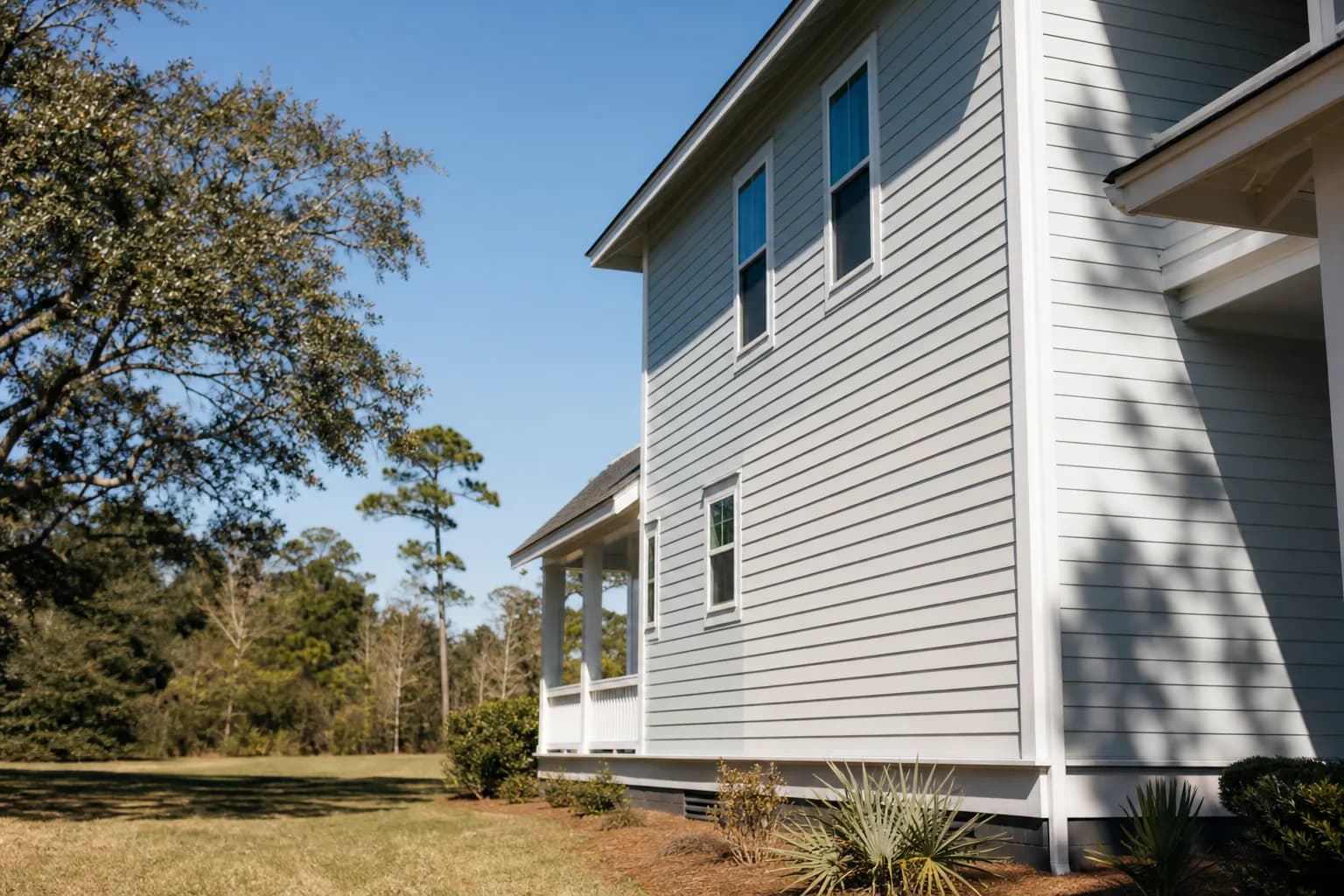
You hold a paint chip up to your house, fall for it, paint the whole exterior — and somehow the color that looked rich and perfect on the little card reads pale and washed-out across the sunny side of your home. You didn't get the wrong paint. You judged it in the wrong light. Understanding how light affects exterior paint color is the single best thing you can do before committing your whole house to a shade, and on the Gulf Coast, where the sun is relentless, it matters more than almost anywhere.
Here's why colors shift outdoors, why our coastal light is especially good at washing them out, and how to test so the color you pick is the color you actually get.
Why does bright coastal light change exterior paint color?
The reason comes down to one thing: outside, there's vastly more light, and it's a different kind of light than indoors. A paint chip on your kitchen counter is lit by maybe a few hundred units of soft, warm, indoor light. The same color on a sunny exterior wall is flooded with direct sunlight many times brighter — and cooler and bluer in tone. All that brightness pours into the color and overwhelms its depth, so it reads several shades lighter and flatter than the chip ever hinted.
On the Gulf Coast, that effect is turned up. Our sun is high, hard, and intense most of the year, and the sky stays bright. That means more of the washing-out, and it means a color that looked like a confident mid-tone on a swatch can land as a timid near-pastel once it's up on a full wall in July. The light is doing exactly what light does — there's just a lot more of it here.
This is the same physics that makes interior colors shift from room to room, just dialed way up by the sheer amount of outdoor light. If you've noticed a paint looking different on your north wall than your south wall inside, our post on how natural light changes paint color, north vs. south explains that indoor version of the effect.
Go a step bolder than the swatch
Because coastal sun lightens and flattens color, the most common exterior color regret on the Gulf Coast is going too pale. A soft greige that looks tasteful on the chip can wash out to near-white on a sunny wall; a moody blue can fade to a wishy-washy gray. The fix is to lean a step bolder than feels safe on the little card — choose a shade with a touch more depth or saturation than you think you want, and let the sun bring it back to where you pictured it.
That doesn't mean reaching for the darkest color on the rack. Deep exterior colors carry their own trade-off in our heat — they absorb more sun and can fade and stress a wall faster — which we cover in what to know about dark exterior colors and heat on the Gulf Coast. The sweet spot is bolder than the swatch but chosen with the climate in mind. And whatever the body color, your fixed elements still set the rules: your roof, brick, and stone aren't changing, so the paint has to live with them — see choosing an exterior color around your fixed elements.
How to test exterior paint colors the right way
You don't have to guess. Testing exterior colors properly takes a few days and it's the cheapest insurance there is against repainting a whole house in a color you regret.
Narrow it down on a photo of your home first
Start with our free AI Color Visualizer — upload a photo of your house and preview real colors on it to cut a long list down to two or three real contenders before you buy a drop of paint.Paint large samples on the actual house
Make your samples at least two feet square and paint them right on the wall, not on a board you hold up. Only color on the real surface, at full scale, tells the truth.Put samples on more than one wall
Test on a sunny south or west side and a shadier north side. The same paint reads lighter in hard sun and a touch deeper and truer in shade — you want to see both.Look at them in every light of the day
Check your samples in morning light, harsh midday sun, golden late afternoon, and on an overcast day. An exterior color can shift dramatically from dawn to dusk, so judge it across the whole arc, not one moment.Live with it a few days before you commit
Give your eye time. A color you love at first glance can wear differently after you've seen it in every light — far better to learn that on a two-foot patch than on the whole house.
See it on your own house before you commit
The fastest way to start is to see real colors on your real home. Our free AI Color Visualizer lets you upload a photo of your house and preview paint colors right on it — a no-risk way to compare options side by side and rule out the ones that clearly don't work before you ever open a can. Use it as your first filter, then confirm your favorite with physical samples on the wall in full sun.
When you're ready, that's exactly the kind of call we help homeowners make every day. Our color consultation walks you through choosing a shade that holds up in our specific light, and our exterior painting crew puts it on with the prep that makes coastal color last. For the full regional picture, our guide to exterior house painting in Mobile and Baldwin County pulls it all together.
Thinking about a new exterior color but not sure how it'll read once the Gulf sun hits it? Preview it on your home, then book a free in-home estimate — we'll help you land on a color you'll still love at high noon in July, and have a written quote to you within a day.