
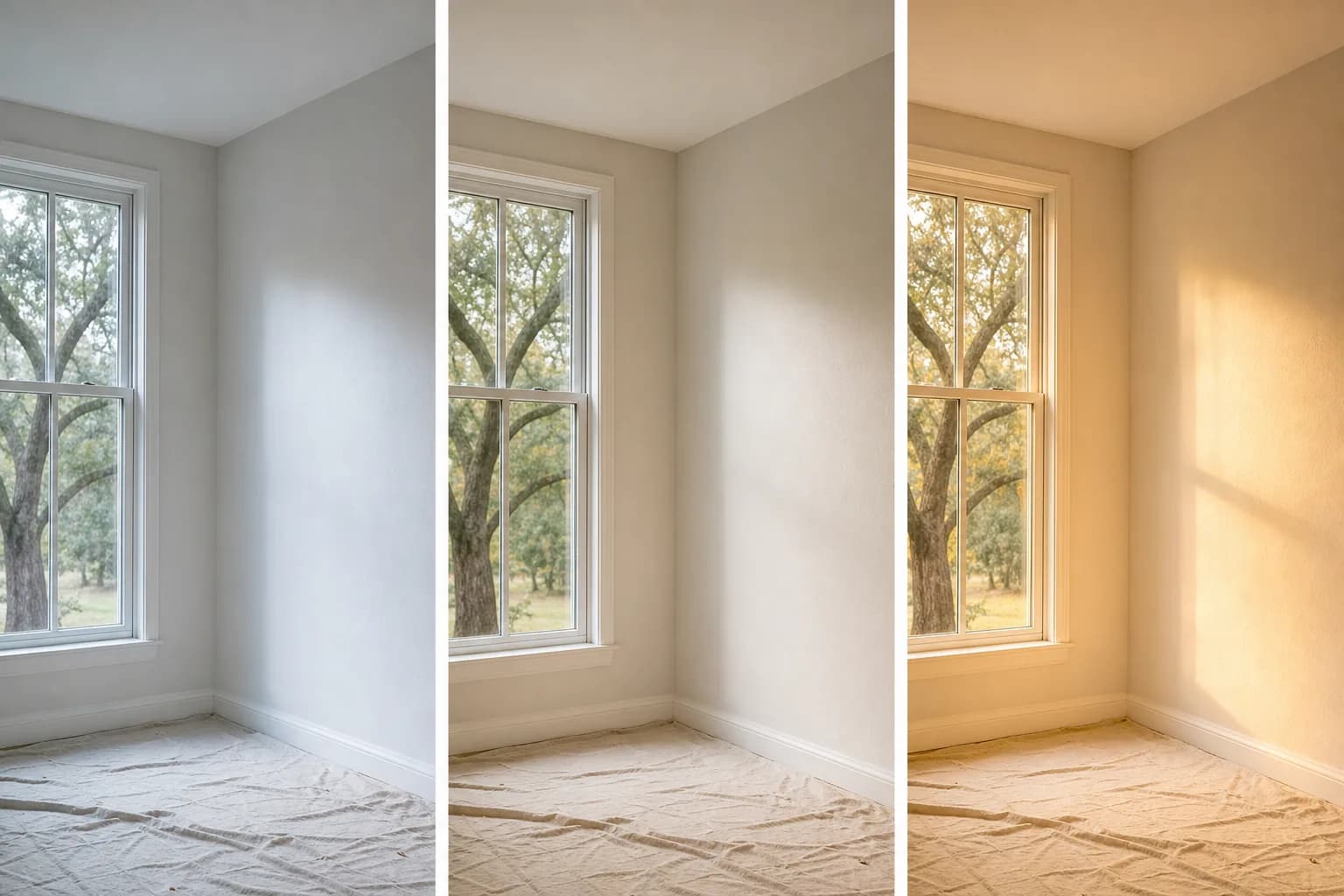
Pick up a paint chip in the store and you're seeing it under flat fluorescent light — about the least useful light it will ever sit in. Carry that chip to a north-facing bedroom and it cools off and grays down. Move it to a south-facing kitchen at noon and it brightens and warms. Hold it up at sunset and it goes golden. The paint never changed. The light did, all day, every day. Understanding how light affects paint color is the difference between a shade that looks right in your room and one that fights you the moment the furniture moves back in.
This isn't about which colors to pick — that depends on your room and your taste, and we cover it in our companion guide to the best paint colors for north- vs south-facing rooms. This is about the why: the mechanism underneath it. Once you understand how directional light and a color's hidden undertones interact, you stop being surprised by your walls and start predicting them.
Color is reflected light — change the light, change the color
Start with the one idea everything else hangs on: the color of a wall is simply the slice of light that surface reflects back to your eye. A "blue" wall absorbs most of the spectrum and bounces blue. So the color you actually perceive is a partnership between the pigment and whatever light is hitting it. Swap the light source and you swap part of that partnership — the wall looks different even though not a drop of paint has moved.
Daylight is not one fixed thing, either. It carries a color temperature that shifts through the day: warm and reddish at sunrise, cooler and more neutral by midday, warm and orange again at dusk. An overcast Gulf Coast sky cools and softens it; a clear afternoon makes it harsh and bright. Your paint sits there absorbing all of that and reflecting back whatever's left. That's why the same color genuinely looks like several colors over a day. It's not your eyes playing tricks — it's physics doing exactly what it should.
How does north light differ from south light on a color?
Room orientation is the single biggest lever on how light treats your color, because it decides what kind of daylight the room gets and for how long. North and south are the two extremes.
North-facing rooms get cool, indirect, steady light. A north window never sees direct sun, so it pulls in soft, even, slightly blue light all day. That coolness drags colors toward gray and blue and exposes any cool undertone hiding in the paint. A crisp gray that looked sharp on the chip can turn flat and chilly on a north wall.
South-facing rooms get warm, direct, abundant light. South windows catch the sun for most of the day, so the light is bright and warm and there's a lot of it. That floods a color with warmth, brightens it, and pushes its warm undertones forward — sometimes more than you bargained for. A warm beige can edge toward gold by afternoon.
East and west rooms live in between, but they swing the most because they only get direct sun for part of the day. East light is golden and warm in the morning, then goes cool and quiet by afternoon. West light is weak and dim in the morning, then turns hot and orange at sunset. A color in an east or west room is essentially two different colors depending on when you walk in.
| Room faces | Light through the day | What it does to color |
|---|---|---|
| North | Cool, indirect, steady — never direct sun | Cools and grays the color; exposes cool undertones |
| South | Warm, direct, strong most of the day | Brightens and warms; pushes warm undertones forward |
| East | Warm and golden AM, cool and dim PM | Big morning-to-afternoon shift; flattering early |
| West | Dim AM, hot and orange at sunset | Weak early, then intense warm glow late in the day |
How light pulls a color's undertone to the surface
Here's the part that catches people off guard. Most paint colors aren't pure — they have an undertone, a subtle secondary color mixed underneath the one you think you're buying. The green buried in a gray. The yellow in an off-white. The pink in a "neutral" beige. Under flat store light that undertone stays hidden, which is exactly why the chip fooled you.
Directional daylight is what drags the undertone into the open. Cool north light tends to amplify cool undertones — that's how a gray reveals its green or blue and starts looking like something you didn't choose. Warm south and west light flatters warm undertones and can overheat them. This is why a single "greige" can look like a clean neutral in one room and a muddy green-gray in the room across the hall. It's the same paint; the light is just developing a different photo.
Two more things bounce extra light onto your walls and shift the color further: the surfaces around them and the paint's own sheen. A dark hardwood floor or a big green lawn outside the window throws its color up onto the walls. And a glossier sheen reflects more light and reads lighter and shinier, while a flat sheen drinks light and reads deeper. If you want to get fluent in reading undertones before you shop, our guide to understanding paint undertones — warm, cool, and neutral goes step by step.
Gulf Coast light has its own personality
Our light isn't neutral, either. The Gulf Coast sun is long, high, and intense, and the sky is often bright and a little hazy. The practical upshot indoors: south- and west-facing rooms here run warmer and brighter than the same rooms would in a cooler, cloudier climate, and on a clear afternoon the glare can wash a pale color out until it reads almost white. That's good news for bold and cool colors — there's enough light to carry them — but it means pale, low-contrast shades can disappear in a sun-drenched room. It's a real effect worth designing around, not a reason to fear color. The same intense sun reshapes your siding colors outdoors, which we cover in how coastal light changes exterior paint colors. The takeaway is the same one that runs through this whole subject: judge the color in your room, in your light.
How to account for light when you choose a color
You don't have to predict all of this in your head. The process is the same whether your room faces north, south, east, or west: read the light, find the undertone, then test the color where it's going to live.
Identify which way the room faces
Stand at the main window. North light is cool and steady, south is warm and bright all day, east is golden early then cool, west is weak early then hot at sunset. The direction tells you how the light will bend your color.Find the paint's undertone
Hold the chip next to a pure white card. Whatever color appears against true white — a hint of green, blue, pink, or yellow — is the undertone daylight will reveal on the wall.Preview the shade on a photo of your room
Snap a photo of the actual room and try the color on it with our free AI Color Visualizer to see roughly how the light in that space treats it before you buy a sample.Sample large on more than one wall
Paint a patch at least two feet square on two different walls — one that catches direct light, one that doesn't — so you see how the same color shifts within the room.Judge it morning, midday, and night
Look at the sample in early light, at noon, and after dark under your own bulbs. Commit only to a color that still works across the whole day in that room.
The fastest way to start is our free AI color visualizer — upload a photo of your room and paint real colors right onto your own walls to see how that room's light treats each one before you spend a dime on samples. It won't replace a physical sample in your space, but it kills the obvious wrong picks in minutes.
The takeaway
Paint color isn't fixed — it's a running conversation between the pigment on your wall and the light in the room, and that light changes by orientation and by the hour. North light cools a color and surfaces its cool undertones; south light warms and brightens it; east and west rooms swing through the day; and our intense Gulf Coast sun pushes everything warmer and brighter still. Learn to read the light and the undertone, and you'll choose colors that look the way you imagined instead of the way the showroom promised.
When you want a second set of eyes, that's exactly what color consultation is for — we'll talk through your room's orientation, light, and finishes so you don't repaint a shade you regret. And when you're ready to put it up, the same care goes into our interior painting work, from prep through the final inspection, backed by our 3-year workmanship warranty. Call us for a free in-home estimate when you're ready to get the color right the first time.