
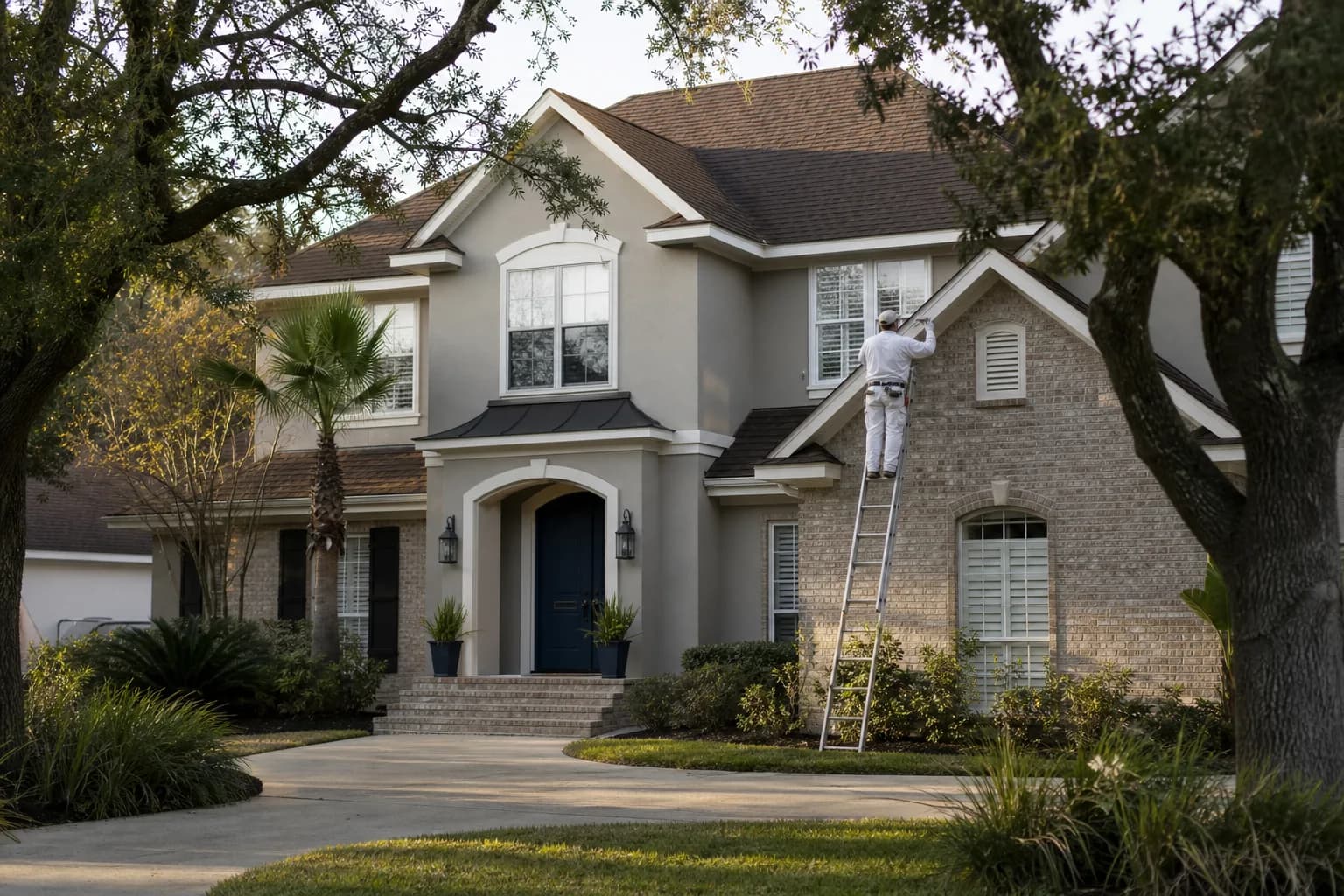
Here's the mistake that turns a fresh paint job into a regret: picking a body color you love in a vacuum, then watching it fight your roof and brick the day the ladders come down. The paint isn't the only color on your house. The roof, the brick, the stone, the stamped concrete, the stained front door — those were already there, and they're not changing. Learning how to choose an exterior paint color really means learning to coordinate one new color with everything that's staying put.
Get that right and the whole house reads as one intentional design. Get it wrong and even an expensive paint job looks "off" in a way most people can feel but can't name. This guide walks through reading your fixed elements and building a scheme around them.
Start with the fixed elements, not the paint chip
The single best habit in exterior color selection: pick your paint last, not first. Everything you're not repainting sets the palette before you choose a single color.
Make a quick inventory of your fixed elements — the colors and materials that are staying:
Inventory the fixed elements
Roof, brick or stone, stamped concrete, a stained door, metal fixtures, permanent hardscape. These set the palette before any paint.Read the roof's undertone
Decide if the roof leans warm, cool, or neutral, then plan a body color in the same temperature so they don't clash.Pull a tone from the brick
Find a color already in the brick or stone — a tan, a warm gray, a cream in the mortar — and echo it in the body or trim.Lock a three-color scheme
Choose a body, a trim, and one accent that all coordinate with the fixed elements and hold a consistent temperature.Test large samples on the wall
Paint big swatches on the real exterior and view them morning, midday, and evening before committing.
The reason this order works is simple: paint comes in thousands of colors, but your roof comes in one. The flexible thing should bend to the fixed thing, never the other way around. So you read the roof and brick first, then go find a paint that joins them.
How do you coordinate your exterior color with the roof?
Your roof is the biggest fixed surface on the house, so it carries the most weight in the scheme. The trick isn't to match it — it's to match its temperature. Every roof leans warm, cool, or neutral, and your body color should lean the same way.
| Your roof | Reads as | Body colors that coordinate |
|---|---|---|
| Brown, tan, or weathered-wood shingle | Warm | Greige, warm tan, soft cream, sage, warm gray-green |
| Charcoal or true gray | Cool / neutral | Cool grays, blue-gray, crisp whites, slate |
| Black | Neutral (versatile) | Almost anything — warm or cool whites, grays, deep colors |
| Red, terracotta, or clay tile | Strongly warm | Warm creams, soft ochres, muted greens; avoid cool grays |
| Green or blue metal | Cool, saturated | Soft neutrals that let the roof lead; avoid competing colors |
A warm brown roof under a cool blue-gray body is the most common clash we see — both colors are fine alone, but together they pull in opposite directions and the house never settles. When in doubt, hold a fan deck up against the actual roof in daylight and trust your eye: the right pairing relaxes, the wrong one buzzes.
Coordinating exterior color with brick and stone
Brick is the other heavyweight, and the rule with brick is coordinate, don't match. Don't try to find a paint that equals your brick — pull a color that already lives inside it. Look closely and most brick is a blend: reds with tan, gray with cream, browns with a hint of pink in the mortar. Choose a body or trim color that echoes one of those existing tones and the paint feels like it belongs without looking like a copy.
Stone works the same way, just with a wider built-in range. A multi-tone stone column already contains your whole palette — a soft warm body, a creamy trim, maybe a deeper accent — so let the stone hand you the colors instead of fighting it. And remember mortar counts: a white mortar line cools the whole wall, while a tan or gray mortar warms it.
Build the three-color rule around your fixed elements
A clean exterior usually runs on three paint colors: a body, a trim, and one accent (often the front door or shutters). Your fixed elements act like extra members of that palette — so you're really coordinating five-plus colors, not three. Keep the temperature consistent across all of it. If your roof and brick read warm, a stark cool-white trim can feel clinical; a warm white sits right at home. For the full breakdown of how body, trim, and accent should relate, see our companion guide on the body, trim, and accent three-color rule.
The accent is where you get to have fun, because one bold color against well-coordinated neutrals lands as confident, not chaotic. A deep navy or forest-green door against a greige body and a warm-brown roof is a Gulf-Coast classic for a reason. Need ideas? Our front-door color ideas for Gulf Coast homes post has palettes that play well with brick and shingle.
Test colors in real light before you commit
The chip lies. Exterior light is far brighter than any room, and it shifts all day — and on the Gulf Coast our intense sun and bright sky pull colors cooler and lighter than they look on a sample card under store lighting. A greige that looked warm indoors can read flat gray on a sunlit wall. So test big, and test on the actual house. Paint two-foot swatches on different walls, then look at them in morning, midday, and evening light before you decide. How that light moves across your specific elevation is its own subject — our guide on how coastal light changes exterior paint colors goes deeper.
The fastest way to preview a scheme before you buy a single sample is our free AI color visualizer — upload a photo of your home and paint different colors right onto your exterior, roof and brick and all, to see how they coordinate on your own walls. It's the easiest way to catch a clash before it's on the house.
When you're ready to put real color to your home, our exterior painting service handles the prep and the finish that make a coordinated scheme last in our climate, and our color consultation can sit down and build the palette with you so you never repaint a color you regret. For the bigger picture on painting the outside of a coastal home, start with our exterior house painting guide for Mobile & Baldwin County. Call us for a free estimate when you're ready to get the colors right the first time.