
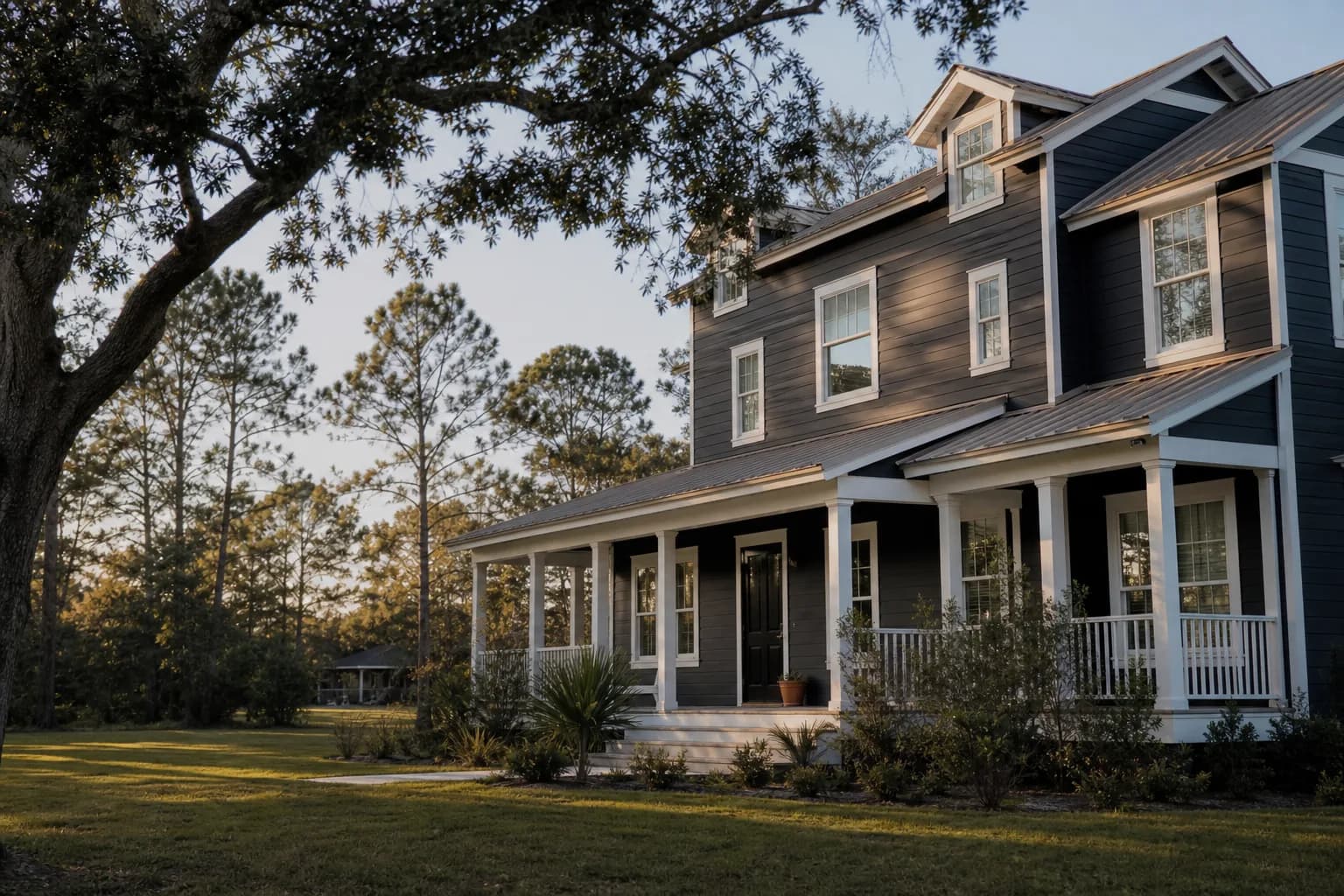
Dark exteriors look incredible on the right house. We get asked for them constantly, and the look can absolutely work here. But dark paint on the Gulf Coast comes with physics most color cards never mention: a dark wall in our sun gets hot, and that heat decides whether the color ages gracefully or cooks, fades, and in some cases warps the very material it's painted on. Understanding dark exterior paint colors and heat is what separates a dark house that still looks sharp in five years from one that's chalky and rippled on the sunny side.
We paint exteriors all over Mobile and Baldwin County, and we say yes to dark all the time — just smartly. Here's how the heat actually works, where dark is a great call, where it's a risk, and how to get the look without paying for it later.
Why dark colors get hot: LRV in plain terms
Answer first: dark colors absorb sunlight and turn it into heat, and a single number predicts how much. That number is LRV — light-reflectance value, a 0-to-100 scale of how much light a color bounces back.
A bright white sits up near the top of the scale; it reflects most of the light that hits it and stays relatively cool. A true black or deep charcoal sits near the bottom; it absorbs nearly all that light and converts it to heat at the surface. Every color falls somewhere in between, and the lower the LRV, the hotter the wall runs in the same sun. Dark exterior colors, by definition, have low LRVs — that's what makes them read as dark, and it's exactly why they heat up.
On our coast that matters more than almost anywhere. The sun is intense across most of the year, and a low-LRV wall facing the afternoon can get genuinely hot to the touch. That heat is the root cause behind the two real problems with dark exteriors here: faster fade, and stress on heat-sensitive materials.
Do dark colors fade faster here?
Generally, yes — and for two reasons that stack on the coast.
First, pigment. Deep, saturated colors rely on stronger pigments, and UV light bleaches those faster than the mild pigments in whites and light neutrals. A strong navy, forest green, or barn red will usually show fade before a soft greige on the same wall.
Second, heat. A hot, low-LRV wall ages its paint film faster, so the higher surface temperature on a dark wall speeds up the same UV breakdown. Pair that with the Gulf Coast's long, strong sun and you get visible fade sooner on the dark elevations than you would up north.
It also won't fade evenly. The walls that bake — south and west — fade first and fastest, while a shaded north wall in the same dark color can still look rich. That uneven fade is its own planning problem, and we break down the pattern in which side of a house fades first. The takeaway for dark color: the sunny walls are where a deep shade will show its age, so they're the walls to think hardest about.
Where dark works — and where it warps
Here's the part that actually saves homeowners grief: the same dark color behaves completely differently depending on what it's painted on.
| Surface / spot | How dark color behaves | Verdict |
|---|---|---|
| Front door, shutters, sash | Small, easily repainted, low heat-stress risk | Great — go as deep as you like |
| Fiber cement, brick, stucco siding | Heat-stable; handles low LRV well | Best substrates for a dark whole house |
| Properly primed wood siding/trim | Handles dark; just expect faster fade on sunny walls | Works with quality paint + prep |
| Cellular PVC trim (long runs) | Moves more with heat; dark adds heat | Risky on long runs — favor lighter, fasten for movement |
| Vinyl siding (non-vinyl-safe color) | Can heat past tolerance and warp permanently | Avoid — use only a rated vinyl-safe color |
Two materials demand respect. Vinyl siding is the big one: a dark, non-vinyl-safe color in full sun can push a panel past its heat tolerance until it softens and warps — and that warp is permanent. If your home is vinyl and you want to go deeper, you have to choose from a rated vinyl-safe collection, which we explain in vinyl-safe paint colors and why dark colors warp siding. Cellular PVC trim is the other: it expands more with heat than wood, so very dark paint on long PVC runs can open up seams unless it's fastened and gapped for the movement.
By contrast, fiber cement, brick, and stucco take dark colors well because they don't soften with heat the way plastic-based materials do — they're the substrates we'll most confidently paint a deep charcoal or near-black. Properly primed wood handles dark too; you just plan for faster fade on the sunny elevations.
How to get the dark look without the downside
You don't have to give up the dark look — you just place it intelligently. The way we steer a dark scheme on the coast:
- Go deepest on the small stuff. Front doors, shutters, sash, and trim are the lowest-risk places to use your darkest color. They're small, easy to repaint, and rarely a heat problem — so that's where to be bold.
- Match dark walls to heat-stable materials. If you want a whole-house dark, fiber cement, brick, and stucco are the substrates that take it best. Save the deepest colors off large vinyl walls entirely.
- Use only vinyl-safe colors on vinyl. Non-negotiable. If the home is vinyl and you want depth, the color has to come from a rated vinyl-safe collection.
- Spend on the paint. A quality exterior paint with fade- and heat-resistant pigments won't beat physics, but it buys real years before a dark color shows its age.
Real Sherwin-Williams dark colors we color-match in-house — like Tricorn Black (SW 6258), Iron Ore (SW 7069), Urbane Bronze (SW 7048), or a deep Naval (SW 6244) — look fantastic in the right place on the right material. The job is putting them where the heat won't fight them. Coastal light also shifts how a dark color reads once it's up on a whole wall, which is its own consideration — we cover that in how coastal light changes exterior paint colors.
See it on your own house first
A dark color is the hardest kind to judge from a two-inch chip, because depth and undertone change dramatically once they cover a full wall in bright coastal light. Before you commit, our free AI Color Visualizer lets you upload a photo of your home and preview real dark colors on your actual siding — see it on your own walls, against your roof and trim, before you buy a drop of paint. And because dark schemes are easy to get wrong, our color consultation helps you land a deep color that looks sharp and survives the coast, so you don't repaint a color you regret.
The bottom line on dark colors and Gulf heat
Dark exterior paint colors can look stunning on a Gulf Coast home — the trick is respecting the heat. Low-LRV colors absorb more sun, run hotter, fade faster on the sunny walls, and on vinyl or long PVC runs they can warp the material itself. Use dark where it's safe and smart: deep on doors, shutters, and trim; on heat-stable fiber cement, brick, or stucco for big walls; vinyl-safe only on vinyl; and always backed by quality paint and a preview on your own home.
Thinking about taking your exterior darker? That's exactly the conversation we have at a free in-home estimate — we check your siding, your sun exposure, and the color you're after, then tell you straight where dark will work and where it won't. Preview a shade with our color visualizer, learn more about our exterior painting work, and reach out for a written quote within 24 hours. We're a family-owned crew that's painted Gulf Coast exteriors since 2013, backed by our 3-year workmanship warranty, and we accept payment by Cash, Check, or Credit Card.