
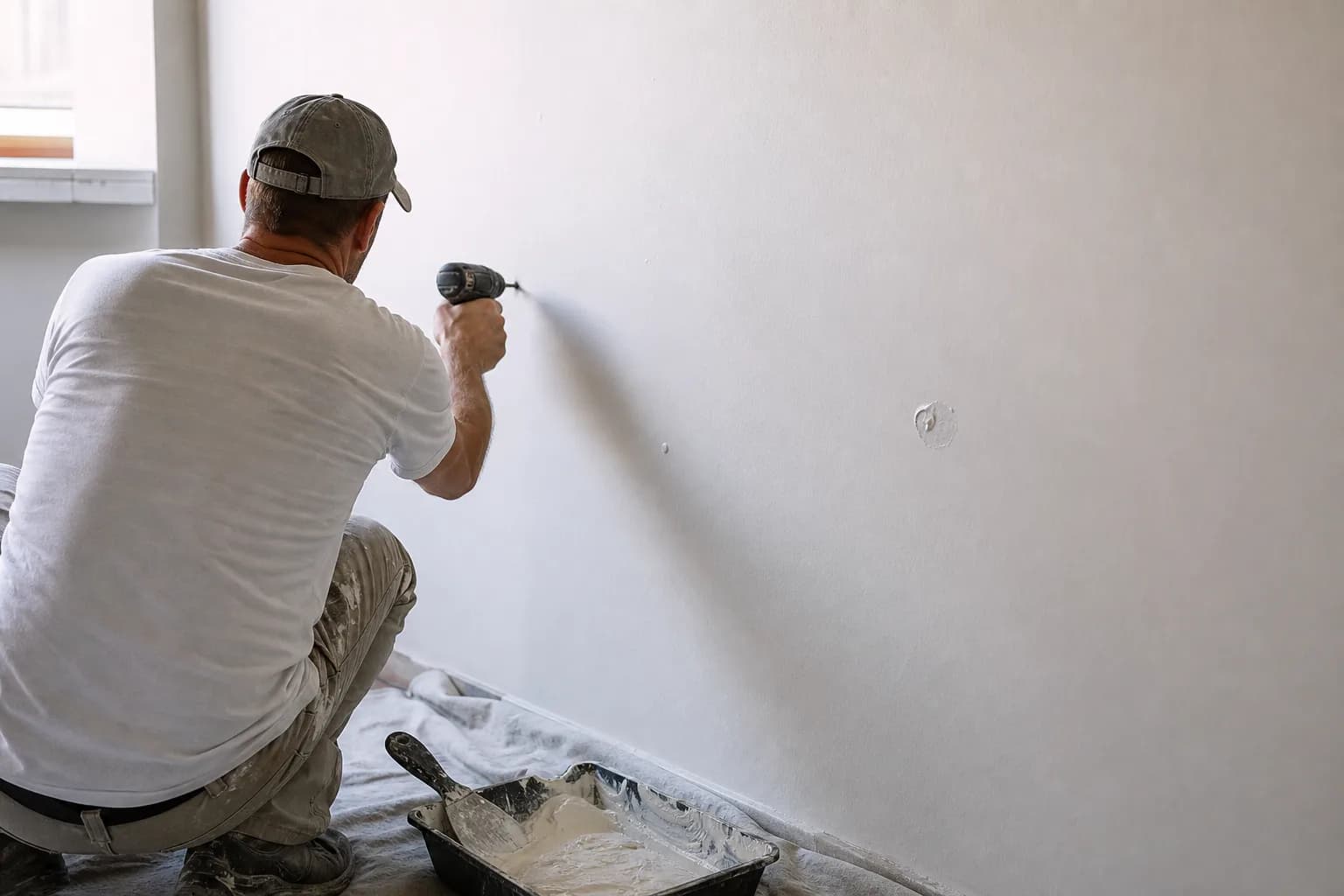
You painted the room a year ago and it looked perfect. Now there's a little dome on the wall by the closet, a crack ringing it like a tiny crater, and one more starting up on the ceiling. Those are nail pops, and the frustrating part is that the obvious fix — smear some spackle over it, dab on paint — almost guarantees they come back. To fix nail pops in your ceiling and walls for good, you have to deal with why they happen, not just the bump you can see.
Why do nail pops keep coming back?
A nail pop isn't really a paint problem or even a hole problem. It's a fastening problem. Your drywall is held to the studs and joists behind it by nails or screws. Over time the framing moves — wood expands and contracts with the humidity swings we get on the Gulf Coast, and every house settles as it ages. That movement slowly works a fastener loose, and as it backs out it pushes a small dome of drywall and dried compound off the surface. The crack you see is the compound failing around the bump.
So when you just refill the dome, the panel underneath is still loose. The next humid stretch or the next season of settling pushes it right back out. The fix has to lock the drywall back down to the framing first. Everything after that is ordinary patching.
How to fix nail pops for good, step by step
The whole repair is straightforward once you know the order. The key moves are re-securing the panel with a screw and feathering the patch wide enough that it disappears under paint.
Find and mark every pop
Shine a work light flat across the surface to catch every raised dome in raking light, and pencil-mark each one so none get missed.Re-secure the panel with a screw
Drive a drywall screw an inch or two beside each pop, into the same stud or joist, sinking it just below the surface to pull the panel tight.Remove or reset the popped fastener
Back out the old nail, or drive it flush below the surface, so nothing is left proud to push the patch off again.Dimple and fill
Tap each fastener head into a slight dimple, then lay the first coat of joint compound over both holes to fill them flush.Second coat, feather wide
Once dry, spread a wider, smoother coat that fills any shrinkage and feathers the edges out past the repair so there's no ridge.Sand flush
Sand the dried compound level with the surface under raking light until the spot feels like glass with no edge to catch the light.Texture, prime, then paint
Match any surrounding texture, spot-prime so the patch absorbs color evenly, then paint so the repair vanishes.
Two coats of compound matter because the first one shrinks as it dries. Skip the second and you'll see a faint sunken spot once the light hits it. And the priming step is the one most people skip — bare compound drinks up paint differently than the wall around it, so an unprimed patch flashes as a dull halo even when it's perfectly flat.
Walls vs. ceilings — and when to call a crew
The method is the same on a ceiling, but the work is harder: you're overhead, the compound wants to sag, and ceilings are more often textured. Many ceilings around here are knockdown or popcorn, which means the patch has to be texture-matched or it'll stand out as a smooth island. That blending is its own small skill, and it's covered in our broader drywall repair and texture matching guide.
A pop or two is a fair weekend job for a handy homeowner. But when they've spread across a room or a whole ceiling, or the surface is textured, it's usually worth folding the fix into a repaint. Every patch still has to be floated, sanded, matched, and primed to vanish — the same finishing work we cover in drywall crack repair that won't come back and in matching knockdown and orange-peel texture. We treat nail pops as routine prep on our drywall repair and painting jobs so the finished wall reads as one clean surface, not a constellation of old repairs.
Fix them once and move on
Nail pops feel like a nagging mystery, but they're not. They come back when the loose panel never gets re-secured — and they stay gone when it does. Re-fasten with a screw, reset the old nail, patch in two coats, sand flush, match the texture, prime, and paint. Do it in that order and the spot disappears for good. If you've got more than a few, or a textured ceiling you'd rather not fight, reach out for a free in-home estimate and we'll handle them as part of getting your walls and ceilings back to flat, even, and ready for paint.