
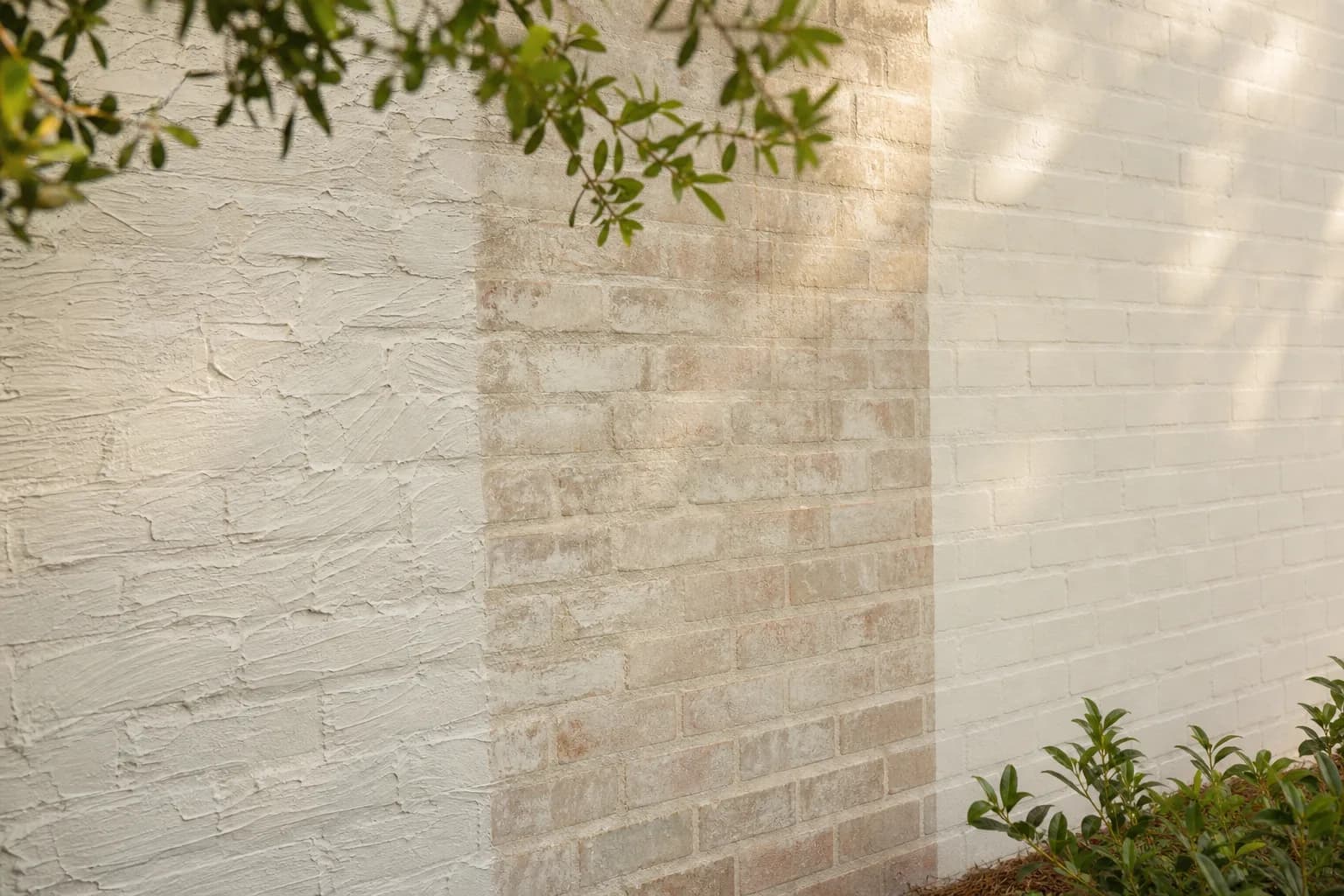
Three houses on the same coastal street can all start with the same orange-red brick and end up looking nothing alike. One has the rough, mortar-streaked texture of an old European farmhouse. One has a soft, washed, weathered tone. One is a crisp, solid white. Same brick, three completely different finishes — German smear, limewash, and paint — and they aren't interchangeable. They behave differently, they cost differently, and one of them is far harder to undo than the others.
If you're weighing German smear vs limewash vs paint for your brick, here's how a painter who works in this humidity thinks about all three — starting with the one that surprises people most.
German smear: texture you trowel on
Answer first: German smear (also called a mortar wash) is a thick mortar troweled over the brick and partially wiped back, so it changes the brick's texture, not just its color. That's the key thing that sets it apart from the other two. Limewash and paint coat the surface; German smear sculpts it.
The look is rough, irregular, and Old-World — mortar caught in the joints and dragged across the brick faces, with as much or as little of the original brick showing through as you choose. On the right home it's gorgeous and full of character. The catch is permanence: because it's a mortar product that bonds hard into the brick, German smear is very difficult to remove once it cures. It's the biggest commitment of the three, which is why the technique and the test patch matter so much.
Here's how the work actually goes:
Clean and dampen the brick
We wash the brick to remove dirt, chalk, and mildew, then dampen it so the mortar grabs and cures evenly instead of flashing dry.Mix the mortar wash
We mix a workable white or tinted mortar slurry to a thick, spreadable consistency — heavier for more coverage, thinner for a lighter touch.Trowel the mortar over the brick
We work the mortar over the brick face and into the joints in small sections so it stays workable before it sets.Wipe back to reveal texture
While it's still workable, we wipe and scrape back to expose as much or as little brick as you want — this is where the Old-World texture is created.Let it cure and assess
Each section cures, then we step back and match the next one, because the finish is permanent once it sets.
That section-by-section, hand-wiped process is exactly why German smear is the most labor-intensive of the three — and why the result is so personal to your wall.
Limewash: color and patina, breathable
Limewash is the lightweight of the trio. It's a thin, mineral-based coating that soaks into porous brick and changes its color and tone without adding real texture. You can lay it on heavy for near-solid coverage or wash it back so the brick shows through translucently.
Its two big strengths on the coast: it's highly breathable, so it lets a humid brick wall release moisture, and it ages gracefully, softening into a patina over the years rather than failing. Many homeowners refresh it periodically because the evolving, weathered look is the whole point. If limewash is the direction you're leaning, we go deeper on it in our dedicated guide to limewash brick versus paint on the Gulf Coast.
Painted brick: solid, uniform, permanent color
Paint is the choice for precision. A quality masonry paint gives you one even, fully-opaque color edge to edge — a clean modern white, a moody charcoal, exactly the shade on the chip with no variation. It's also the most durable for uniform color, holding for years when it's done right.
The two things to know: it must be a breathable masonry paint over sound, prepped brick (sealing damp brick under a non-breathable film is how you trap moisture), and like German smear, it's permanent — once brick is painted, it stays painted. For the fuller weigh-in on going this route, including whether to coat the brick at all, see our pros and cons of painting a brick house on the coast. And if your main worry is the humidity, our guide on how to paint brick without trapping moisture covers doing it the right way.
German smear vs limewash vs paint: side by side
Here's the three-way at a glance, with the Gulf-Coast climate in mind.
| Factor | German smear | Limewash | Paint |
|---|---|---|---|
| What it changes | Texture + color (mortar troweled on) | Color + tone (thin mineral wash) | Color only (opaque film) |
| Look | Rough, Old-World, irregular | Soft, weathered, translucent | Solid, uniform, modern |
| Permanence | Very permanent — hard to remove | Weathers off gradually over years | Permanent once painted |
| Breathability | Mineral-based, fairly breathable | Highly breathable | Use a breathable masonry paint |
| Labor | Highest — troweled + hand-wiped | Lowest — thin, fast coats | Moderate — prep + two coats |
| Best on | Raw, healthy brick wanting texture | Raw, porous, healthy brick | Raw or previously painted, sound brick |
None of these is "best" in a vacuum. German smear is for the homeowner who wants permanent texture and Old-World character. Limewash is for the one who wants breathable, evolving softness. Paint is for the one who wants an exact, lasting, uniform color.
Which brick finish costs the most?
People want a clean cost ranking, and the rough rule is: limewash tends to be the most budget-friendly (thin, fast coats), German smear the most labor-intensive (troweled and hand-wiped section by section), and paint somewhere in between or above depending on prep and product. But the honest deciding factor on any of them is the condition of your brick — bad mortar, moisture, or already-painted brick changes the work and the cost more than the finish style does.
That's also why we don't recommend a finish over the phone. The right call depends on whether your brick is raw or painted, how it's holding up, and the look you're after — and on the coast, the moisture question is never optional. For everything that goes into a coastal masonry finish that lasts, our exterior painting service page and our full coastal exterior house painting guide for Mobile and Baldwin County cover the whole picture.
See it before you commit to permanent
Two of these three finishes are permanent, so guessing is expensive. Color and texture read completely differently on a full brick facade in Gulf sun than on a sample. Before you commit, snap a photo of your home and preview real colors on it with our free AI Color Visualizer, and ask us about a small test area on the actual wall.
When you're ready, reach out for a free in-home estimate. We'll look at your real brick, tell you straight which finish fits it, and get you a written quote within 24 hours. We're a family-owned crew that has finished Gulf Coast masonry since 2013, backed by a 3-year workmanship warranty and a 4.8-star Google rating. Pay by Cash, Check, or Credit Card.