
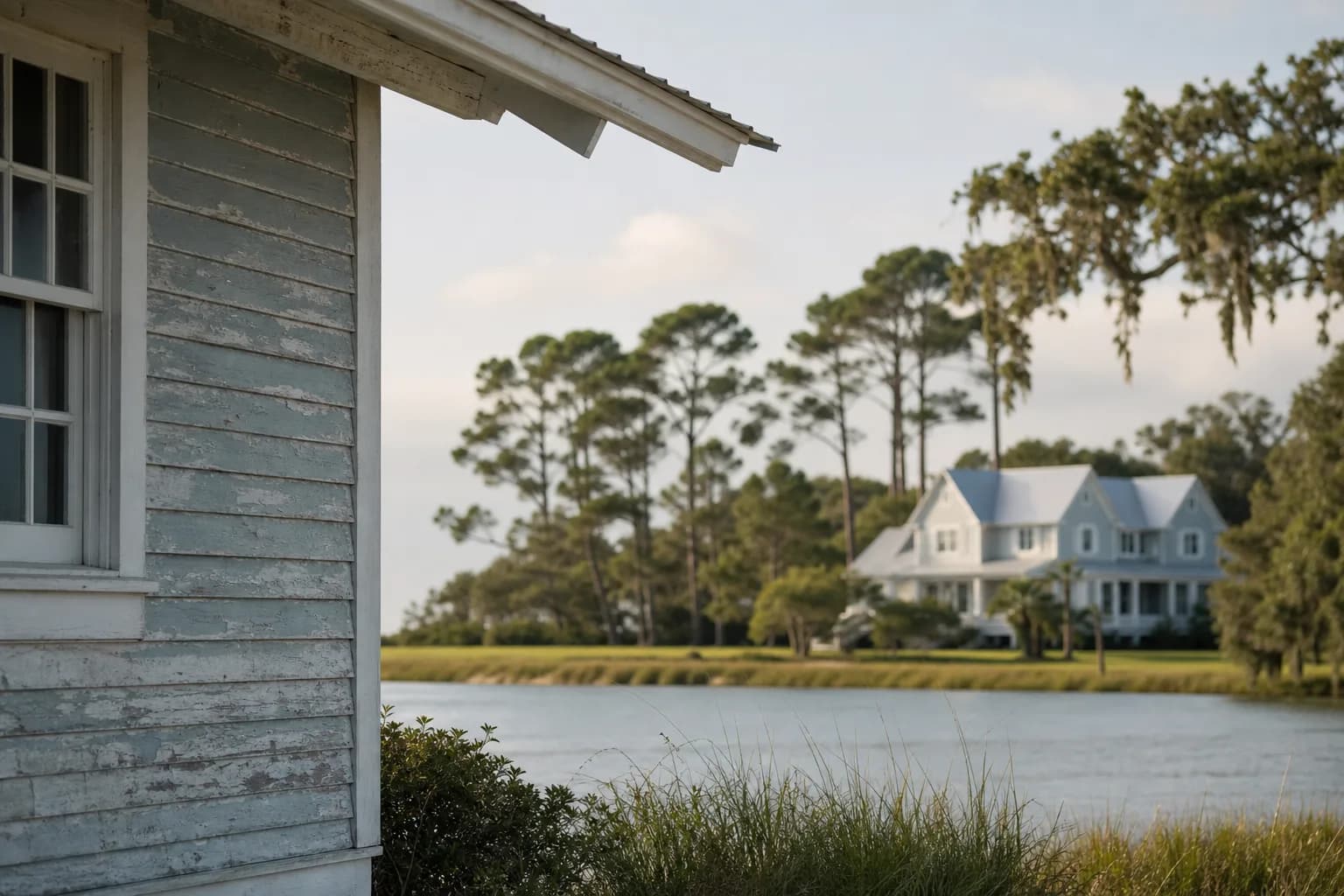
Park two identical homes the same distance apart and the paint tells you where each one lives. The house three blocks off Mobile Bay is chalking on its south wall at year five; the one twenty miles inland in the pines still looks fresh. Same paint, same crew — the only variable is the air. That's the heart of the coastal-versus-inland question: how long exterior paint lasts depends less on the brand on the can than on how much salt and sun the wall has to fight. Below is the realistic lifespan from the open Gulf to deep inland, and the system that stretches it.
This is the lifespan picture across the region. If you want the Mobile-specific numbers and the prep that protects them, see our exterior paint lifespan in Mobile vs. inland guide; for the chemistry of why the salt does it, our breakdown of how salt air and humidity shorten paint life goes deep.
How long does exterior paint last from the Gulf to inland?
Exterior paint has a working life, and on the Gulf Coast that life is a sliding scale set by distance from salt water. There's no single number — there's a gradient, and your home sits somewhere on it.
| Where the home sits | Typical exterior paint life | Why |
|---|---|---|
| Beachfront / open Gulf (Gulf Shores, Orange Beach, Perdido) | ~4–6 years | Constant salt spray, full sun, wind-driven rain — the harshest exposure |
| Bay-front & bluff (Spanish Fort, Daphne, Fairhope, Point Clear) | ~5–7 years | Salt-laden bay air and strong sun, a step gentler than open Gulf |
| Coastal-adjacent / a few miles inland | ~6–8 years | Less constant salt, still heat and humidity |
| Deep inland Baldwin & Mobile County | ~7–10 years | Minimal salt; sun and humidity remain the main load |
The pattern is consistent: the closer to salt water, the shorter the finish's life. A beachfront home in Orange Beach or Perdido Key takes the full brunt of salt spray and sun, so even a good coat is realistically near the short end. The bay-front and bluff towns on Mobile Bay — Spanish Fort, Daphne, Fairhope, Montrose, Point Clear — sit on salt-laden air but are spared the open-Gulf spray, so they land a notch longer. Move into inland Baldwin and northern Mobile County — Bay Minette, Loxley, Robertsdale, the US-31 corridor — and the salt thins out while the heat and humidity stay, stretching the same work toward the inland end of the range. Wherever you are, our exterior painting service is built around that local reality.
What drives the coastal-vs-inland gap
Three forces age exterior paint, and the coast turns all three up at once while inland runs one or two at a time.
Salt. This is the swing factor between coastal and inland. Salt is hygroscopic — it pulls moisture out of humid air and holds it against your siding, keeping the surface damp under the paint film and breaking the bond from below. The more salt that settles on a wall, the faster the finish lets go. It's the single biggest reason a bay-front home repaints before an inland one.
Sun. Our UV load is intense everywhere on the Gulf Coast, coastal or inland. Direct sun breaks down the binders that hold paint together, first as fading and chalking, then as a finish that's lost its seal. This is why the south- and west-facing walls of any home — beach or pine forest — fail first while the shaded north side still looks fine.
Humidity. Heavy, year-round moisture is the quiet partner. It slows the cure when the paint goes on so the film bonds weaker, then keeps the substrate damp afterward, feeding mildew and working with salt to lift the coating. Inland homes feel humidity too, but paired with less salt it does less damage.
The system that stretches paint life anywhere on the coast
Here's the part that matters most: location sets the range, but the system decides where in that range you land — and a good system can buy you years even on a bay-front wall. It's never one thing. It's prep, product, sheen, and color working together.
- Prep is the foundation. A washed, scraped, sound, and primed surface holds a finish far longer than paint laid over chalk and salt. Prep is roughly 80% of a paint job that lasts, which is why two homes on the same street can be years apart in how long their paint holds. It's covered in depth across our coastal guides, so we won't repeat the full sequence here — just know it's the lever that moves your home toward the long end of every range above.
- A coating built for the coast. A quality, flexible, breathable exterior paint rated for sun and moisture outlasts a bargain product — but only over good prep. Premium paint protects prep; it can't rescue skipped prep. We dig into that trade-off in does expensive paint actually last longer.
- The right sheen and color. A sheen that sheds water and a lighter, sun-reflecting color on the exposed walls both add years on the coast, especially on the south and west sides.
Two of those carry extra weight near salt water. The wash isn't cosmetic — salt and chalk left on the wall keep fresh paint from ever bonding, so a coastal job that skips it is compromised before it starts. And when our humidity has gotten into the wood, that soft wood needs carpentry repair before paint, because no coating holds a surface together.
Reading the signs and stretching the years
You don't have to count years to know you're due — the paint will tell you. Chalking when you wipe the wall, color noticeably faded on the sunny side, hairline cracks in the caulk, or any bare or peeling spot all mean the finish has stopped protecting the wood. Catching it then is a clean repaint; waiting until bare wood shows usually adds repair to the bill. Our guide on how often to repaint a house exterior on the Gulf Coast covers the timing in detail.
Between repaints, simple upkeep stretches the lifespan on either side of the gradient: rinse salt and pollen off the walls a couple of times a year, keep gutters clear so water isn't running down the siding, trim shrubs back so walls can dry, and touch up small failures before they spread. None of it stops the salt and sun — it just slows their work.
So how long does exterior paint last, coastal vs inland? Roughly four to six years on the open Gulf, five to seven on the bay, and seven to ten well inland — with sun-beaten walls shorter and a smart system longer. If you want to know exactly where your home falls, the easiest next step is to have someone who knows this climate look at your actual siding, sun exposure, and surfaces. We'll come out for a free in-home estimate, tell you honestly whether you're due, and put a written quote in your hands within 24 hours. Family-owned and serving the Gulf Coast since 2013, with one accountable crew from your estimate to the final inspection, a manager sign-off before final payment, our 3-year workmanship warranty, and a 4.8-star rating from homeowners across the region.