
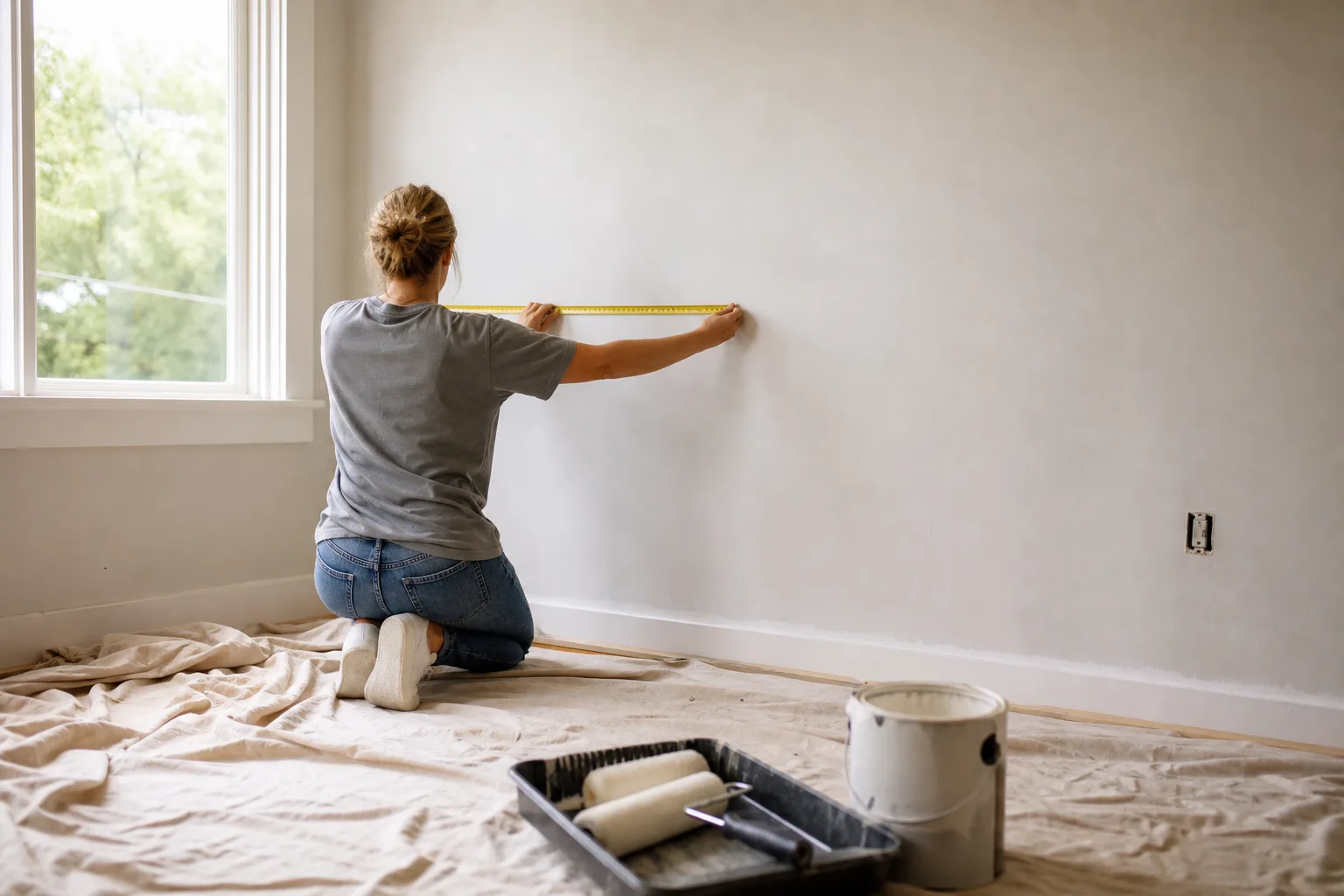
You're standing in the paint aisle doing mental math, and the honest answer is you're guessing. Buy too little and you're back at the store mid-job, hoping the new can matches. Buy too much and you've got half-empty gallons cluttering the garage. The good news: figuring out how much paint you need for a room is simple arithmetic, and once you've done it once you'll never guess again.
Here's the whole method — measure the walls, knock out the openings, divide by how far a gallon goes, and multiply by your coats. We'll walk it step by step, run a real example for a standard bedroom, and flag the spots where most people get the number wrong. If you'd rather skip the math entirely, that's part of what we handle in our interior house painting guide and every free estimate we give.
How much paint do you need for a room, in short?
For a quick gut-check: most standard rooms take about two gallons for two coats on the walls. A small bathroom or a closet might be one gallon; a large open living-and-dining space can run three or four. But "most rooms" isn't your room, so the worthwhile version is the quick measurement below — it takes five minutes and gets you to the right number instead of a guess.
The only inputs you need are your wall area, how far your paint covers, and how many coats you're doing. That's it.
How to calculate paint for a room, step by step
The math hinges on one number — your total wall area in square feet — and then two adjustments. Walk it in order:
Measure the wall area
Measure the length of each wall, add them up to get the room's perimeter, then multiply that perimeter by the wall height. That product is your total wall area in square feet.Subtract big openings
Subtract about 20 square feet for each standard door and 15 for each average window. Skip the small windows — leaving a little extra area in just gives you margin.Divide by coverage per gallon
Divide your adjusted wall area by 350 square feet per gallon for one coat. Use 200 to 250 instead for fresh drywall, rough surfaces, or a big color change.Multiply by the number of coats
Multiply that one-coat figure by your number of coats — almost always two — to get total gallons for the walls.Round up and add a buffer
Round up to the nearest gallon or quart and keep a little extra for touch-ups. Estimate trim and ceilings separately.
That's the entire formula: (perimeter × height − openings) ÷ coverage × coats, rounded up. Everything else is just knowing which coverage number to use.
Coverage per gallon depends on the surface
A gallon of interior paint covers roughly 350 square feet in one coat — but only on a smooth, previously painted wall. Anything thirstier eats into that. Match your surface to the right number before you divide:
| Surface | Coverage per gallon (1 coat) | Why |
|---|---|---|
| Smooth, previously painted wall | ~350 sq ft | Sealed surface, paint spreads thin and even |
| Fresh or patched drywall | ~200–250 sq ft | Bare gypsum and joint compound soak up the first coat |
| Textured (knockdown, orange peel) | ~250–300 sq ft | More surface area in the texture to cover |
| Dramatic color change | ~250–300 sq ft | Needs heavier coats to fully hide the old color |
When in doubt, use the lower number. Running a hair short mid-wall is far more annoying than having a little left over, and the coverage printed on your specific can always beats a rule of thumb.
A worked example: a standard 12 × 12 bedroom
Let's put real numbers to it. Say you've got a square bedroom, 12 feet on each side, with 8-foot ceilings, one door, and one window.
Perimeter
12 + 12 + 12 + 12 = 48 feet around the room.Wall area
48 feet of perimeter × 8-foot walls = 384 square feet of wall.Subtract openings
Take off about 20 for the door and 15 for the window: 384 − 35 ≈ 350 square feet to paint.One coat
350 ÷ 350 per gallon = about 1 gallon for a single coat.Two coats
1 gallon × 2 coats = 2 gallons for the walls.
So this bedroom needs about two gallons for a standard two-coat repaint on previously painted walls. If it were fresh drywall, you'd divide by 250 instead of 350 — that bumps the first coat closer to a gallon and a half, so you'd buy three gallons to be safe. Same room, different surface, different answer. That's exactly why the coverage number matters more than the room size.
Don't forget coats, ceilings, and a little extra
Three things trip people up after the wall math:
- Coats. Plan on two. One coat rarely lays down even or durable, especially over a color change, which is why pros budget two by default. We dig into that in how many coats interior walls need.
- Ceilings and trim are separate. They're usually different products and sheens. Figure the ceiling by its floor area and the trim by its rough length — don't fold them into the wall total.
- Buy a buffer. Round up and keep a little extra. Touch-ups are part of owning a painted room, and a can from the same batch is the cleanest fix. When you finish, store the leftover paint the right way so it's usable later.
When the math gets fuzzy, get a real number
This method nails a standard rectangular room. Where it gets murky is the real-world stuff — vaulted ceilings, stairwells, lots of windows, a deep color change, or a whole house at once, where small estimating errors stack up across rooms. That's also where it starts feeding into a bigger budget question, which we cover in the cost to paint a house interior on the coastal Alabama.
If you'd rather not measure walls and price gallons, that's the easy part of what we do. See how we approach interior painting, and when you're ready, book a free estimate — we'll measure it, spec the paint, and hand you a written quote within 24 hours.