
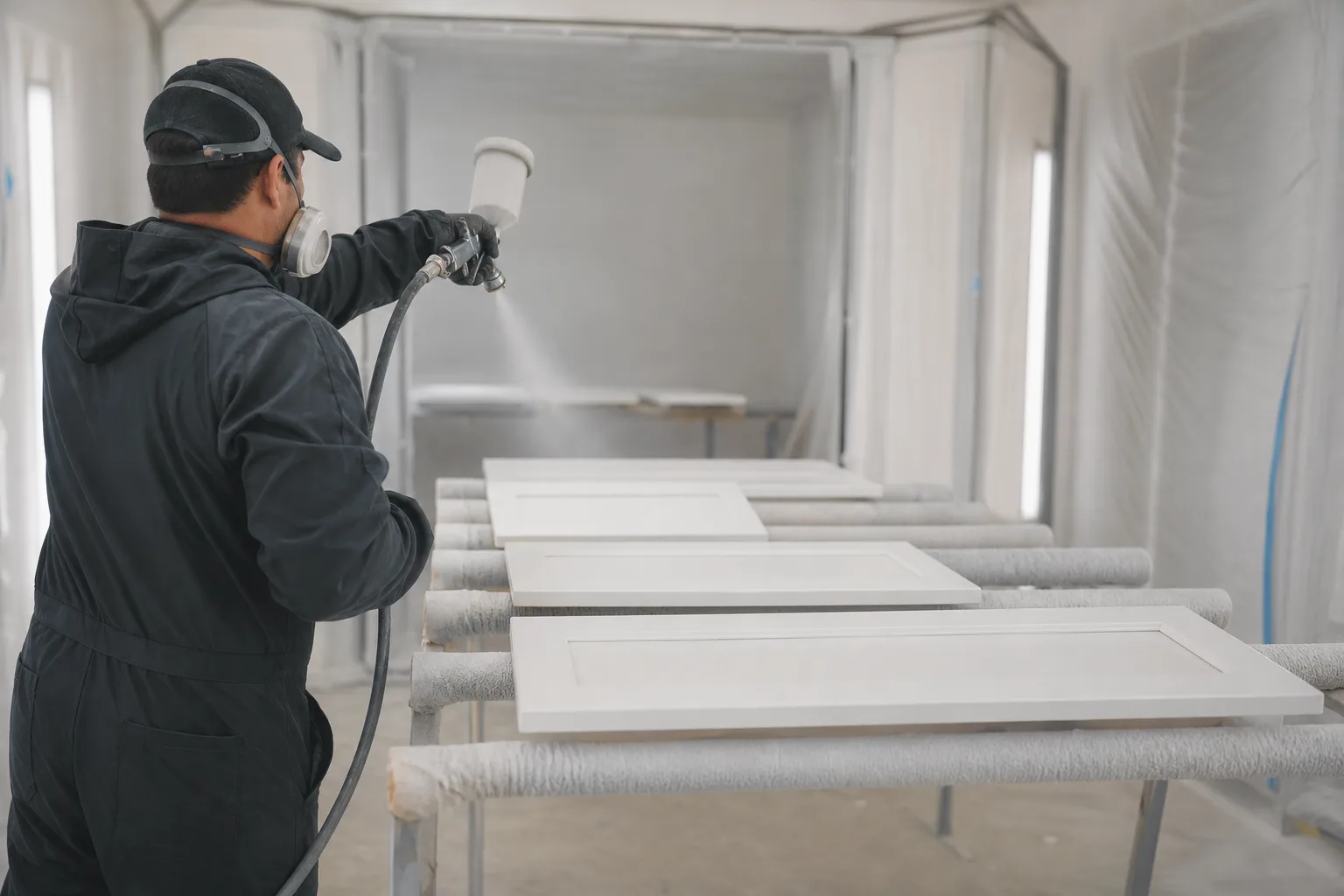
Any quality cabinet paint tells you to apply it in clean, dry conditions — and the average Gulf Coast kitchen is neither. There's dust in the air, the humidity rarely lets up, and a finish curing in those conditions never hardens the way it should. A kitchen can't be turned into a clean room, so we don't try. We take the doors and drawers where the clean room already lives — our own off-site shop — and spray and cure them in climate-controlled drying & preparation booths. That's how your cabinets get a dust-free, humidity-controlled cure without your home ever becoming a paint shop.
Here's what those booths actually are, the two things they protect, and why finishing the doors at our facility is the difference between a finish that looks factory-smooth and one that's gritty and slow to harden.
What is a cabinet drying & preparation booth, exactly?
It's a clean, climate-controlled space at our shop — sealed off, with the temperature and humidity held steady and the air kept clean — built for one job: spraying and curing cabinet doors and drawers. We remove the doors and drawer fronts from your kitchen, label every piece, and bring them to those booths to be prepped, sprayed, and cured. The cabinet boxes bolted to your walls stay home and get sanded and painted right in the kitchen.
That split is what makes the whole job least-invasive. The fine, messy spray work happens at the facility, where the air is controlled and your floors and counters are nowhere nearby. Your kitchen stays livable while we work, and your doors never sit out in a driveway baking in the Gulf sun. The booth gives the finish factory-grade conditions; doing it off-site keeps your home clean and usable the whole time.
What it protects #1: the finish
A cabinet finish is most vulnerable in the hours it's drying, and two things attack it then — dust and humidity. The booth shuts both down.
Dust. A speck of airborne dust that lands in wet paint dries into a hard little bump, and a whole coat of them turns a smooth door gritty. You can feel it the first time you run a hand across it. By spraying and curing inside a clean, contained booth at the shop, we keep dust out of the wet film, so each coat dries glassy-smooth.
Humidity. This is the big one on the Gulf Coast. When the air is heavy with moisture, a finish dries slowly and unevenly and never fully hardens — it can stay soft, blush, or cure blotchy. A humidity-controlled booth keeps the air steady so the finish cures the way the product is engineered to: hard, even, and tough. That's the cure your doors simply can't get drying in a driveway or a garage, and it's exactly what stands up to years of daily kitchen life — wiping, splashes, door slams — without chipping at the edges.
This is also why sprayed cabinets done in a controlled space look so much better than a brushed job. Spraying lays down a thin, even film with no brush marks, and curing it dust-free keeps that surface flawless. We go deeper on that in our guide on why sprayed cabinets look factory-smooth, and there's more on the whole refinishing process across our cabinet painting articles.
What it protects #2: your home
Spraying is what makes cabinets look factory-finished, but spraying produces a fine paint mist — and that mist has to go somewhere. Spray in the open inside a house and it drifts, settling a haze on floors, counters, and anything nearby. We sidestep that entirely by taking the doors and drawers to the booths at our shop, so the spraying and all of its overspray happen at the facility, never in your kitchen. The only in-home work is the box prep — sanding and brushing the bases bolted to your walls — which is tidy and contained. No fine-paint film lands on your counters, because the spray never enters your home.
That's the core of our least-invasive process: the messy half of the job leaves with the doors, and your house stays livable. You keep using the kitchen while your cabinetry is being finished somewhere it can be done right.
How the booth fits into the cabinet job
The booth is the controlled environment the door-and-drawer finishing happens inside — at our shop, while the box work happens in your kitchen. Here's how a cabinet job moves from your home to the booth and back.
Remove and label the doors and drawers
We take off every door and drawer front in your kitchen, label each one so it returns to its exact spot, and bring them to our off-site shop — the cabinet boxes stay on the wall to be finished in the home.Prep and prime in the booth
At the shop we clean, degrease, sand, and prime the doors and drawers inside our climate-controlled drying & preparation booths, so the finish has a sound, contaminant-free surface to bond to.Spray each coat in clean, controlled air
We spray the finish coats inside the booths, where filtered, humidity-controlled air keeps dust out of the wet paint and lets each coat lay down thin and even with no brush marks.Cure in stable humidity, then reinstall
We let each coat cure fully in the booth's controlled humidity so the finish hardens factory-even, then bring the doors and drawers back and rehang them, resetting the hardware once everything has cured.
For the full sequence beyond the booth, our cabinet painting service page walks through how a project comes together start to finish.
Why the controlled cure is what makes it last
It's tempting to think the paint brand is what decides how long a cabinet finish holds up. It isn't — not by itself. The same can of paint cures hard and tough in clean, humidity-controlled air, and cures soft, gritty, and weak in a dusty, humid garage or driveway. The environment the finish dries in is doing as much work as the product. That's the whole reason the booths at our shop exist: to give every coat the conditions it needs to reach full hardness.
A fully cured, dust-free finish is what shrugs off the wiping, the splashes, and the daily open-and-close that a kitchen dishes out for years. A coat that cured in bad conditions starts giving up at the edges far sooner — which is also why the durability of a cabinet finish on the humid Gulf Coast comes down so much to how it was cured. We cover that in how long a cabinet paint job lasts on the Gulf Coast.
The bottom line on the drying booth
Our climate-controlled drying & preparation booths do two things that decide whether a cabinet job looks and lasts the way it should. They protect the finish — a dust-free, humidity-controlled cure that comes out factory-smooth and hardens fully — and they protect your home, because the doors and drawers are sprayed at our shop instead of in your kitchen, keeping the overspray out entirely. It's the least-invasive way to do it: your parts get the controlled cure they need at the facility, and your home stays livable the whole time. If you want to see how it would work in your kitchen, the full process lives in our kitchen cabinet painting guide for Mobile and Baldwin County, and you can ballpark the budget first with our cabinet painting cost estimator. When you're ready, book a free in-home estimate — family-owned since 2013, backed by a 3-year workmanship warranty — and we'll put a written quote in your hands within 24 hours.