
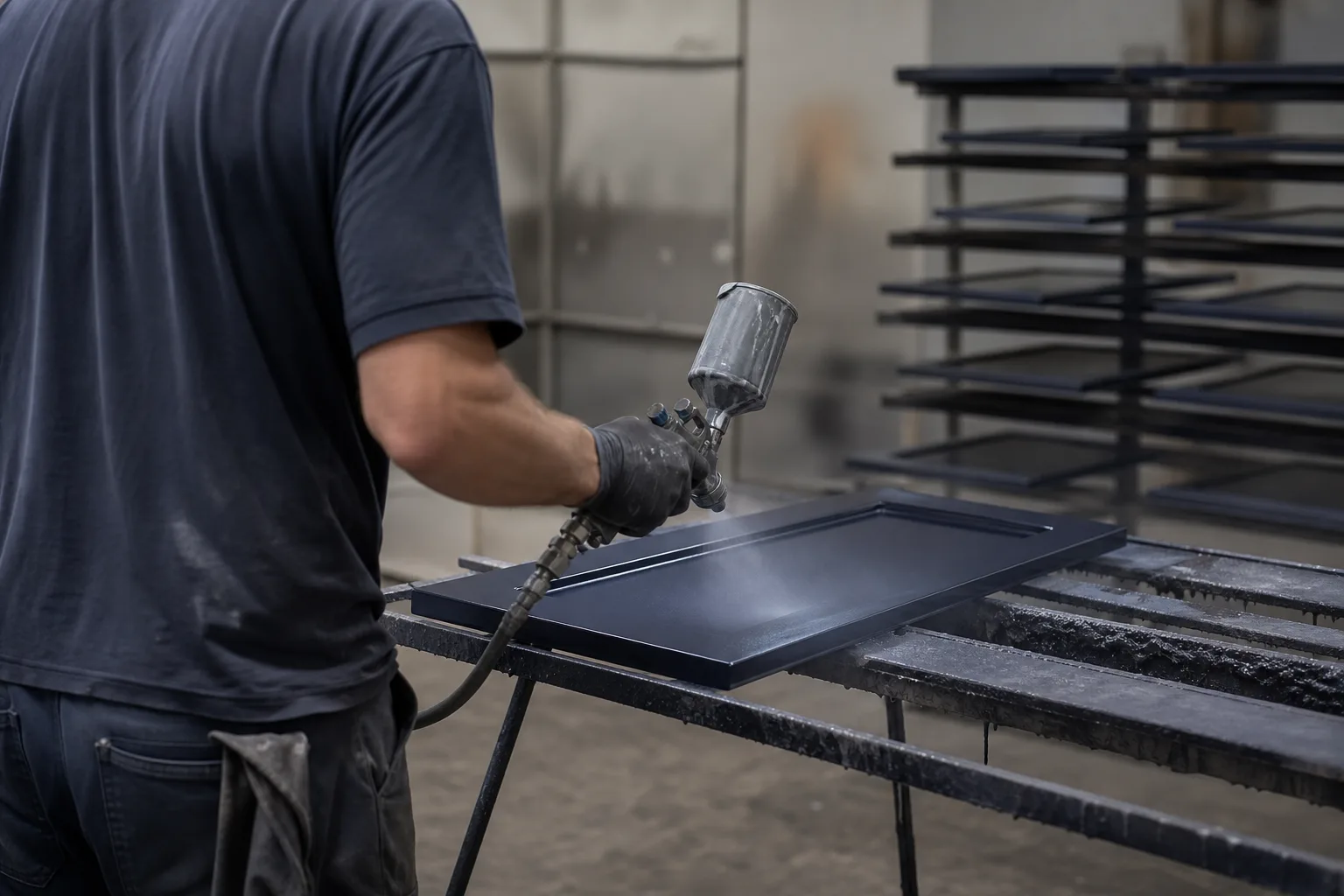
Run your hand across a brand-new kitchen cabinet and you feel nothing — no ridges, no brush lines, just a hard, glass-smooth surface that looks like it was poured on. Then look at a repaint someone did with a brush and a quart from the hardware store, and you can read every stroke in the afternoon light. Same color, completely different result. The reason for that gap is almost entirely how the paint went on.
If you've ever wondered why spray painting kitchen cabinets gives that factory finish and a brush never quite does, here's the honest breakdown — what spraying does that brushing can't, where brushing still has a place, and the part most people miss: the finish is only as good as the cure that protects it.
The short answer: spraying lays one continuous film
A direct answer first. Sprayed cabinets look smoother because spraying atomizes the paint into a fine mist that settles into a single, even, ultra-thin film. There's nothing dragging across the surface, so there are no brush marks, no lap lines where wet meets dry, and no roller stipple to catch the light. A brush, by definition, leaves the texture of its bristles behind.
Build that up over several thin sprayed coats — sanded smooth between each one — and you get a hard, level surface that reads as one piece. That layered, sanded, sprayed build is the thing a brush physically cannot reproduce on a flat door panel.
Brush vs spray, head to head
Both have a job. The mistake is using the wrong one for a full kitchen.
| Brushing | Spraying | |
|---|---|---|
| Surface texture | Visible brush strokes, especially on flat panels | Smooth, even, no strokes — a glass finish |
| Coat thickness | Thicker, less even; can stay soft | Thin, uniform coats that cure hard |
| Sheen consistency | Can look patchy in raking light | Uniform sheen across every door |
| Where doors meet frames | Thick paint can gum and stick | Thin film keeps clean edges |
| Best use | Small touch-ups and tight repairs | Full cabinet jobs and doors/drawers |
This is why the answer to "do professionals spray or brush?" is spray for the finish coats. A skilled hand might cut in a tight spot with a brush, but the doors and drawer fronts — the surfaces you see and touch every day — get sprayed. Brushing a whole kitchen tends to leave strokes, an uneven sheen, and paint thick enough to stay tacky where a door closes against the frame.
Why does prep decide the whole thing?
Here's the catch with spraying: it hides nothing. A brush can drag a little filler over a small flaw, but a thin sprayed coat shows every dent, every raised bit of grain, and every spot of leftover kitchen grease. So the smooth finish you're after is really built before any color goes on.
Strip the hardware and clean off the kitchen grease
Remove doors, drawers, and hardware, label everything, and degrease every surface. Kitchen oils are invisible until paint won't stick to them, so this step decides whether the finish lasts.Sand and fill for a dead-flat surface
Scuff-sand all surfaces for grip, fill dents and grain where a glass finish is wanted, and sand again. Spraying shows every flaw underneath, so the prep has to be flat.Prime and spray thin, even coats
Spray a bonding primer, then build the color in multiple thin coats with a light sanding between them. Thin sprayed coats are what create the smooth, hard, even film.Cure in a controlled space before reassembly
Let the finish cure in a dust-free, humidity-controlled environment before rehanging. A protected cure is what keeps the smooth result smooth once the kitchen is back in use.
That last step is where a lot of finishes get ruined. You can spray a perfect coat and still wreck it if a single fan kicks up dust, or if Gulf-Coast humidity keeps the enamel from setting up the way it should.
The cure is what protects the finish
This is the part homeowners rarely hear about, and it's the difference between a finish that looks factory-made and one that looks almost there. A freshly sprayed surface is wet and vulnerable. Dust landing on it shows up as grit. Too much humidity slows the cure and can leave the film soft. So controlling the air around the drying cabinets matters as much as the spraying itself.
That's why we take the doors and drawer fronts off and spray and cure them in the climate-controlled drying and preparation booths at our own facility — the least-invasive way to get a controlled cure. The cabinet boxes, bolted to the wall, are sanded and painted right in your kitchen, so your home stays livable the whole time. That booth at our shop does two jobs at once: it keeps dust and humidity off the wet finish so it cures hard, dust-free, and even, and it keeps the spraying and overspray out of your house entirely. Your doors never sit out in the Gulf Coast sun and humidity the way they do when a crew sprays in the driveway. The result is a smooth, factory-grade finish that holds up, protected from the moment it's sprayed until it's fully cured.
What this costs, and whether it's worth it
A sprayed cabinet finish gives you a kitchen that looks new for a fraction of replacement. Our cabinet painting projects generally run from about $3,500 to $9,000, depending on how many doors and drawers you have, the condition and material of the boxes, and the finish you choose. To sketch your own number before you call, try our cabinet painting cost estimator — and if you're torn on whether to refinish at all, our cabinet painting team can walk you through whether to paint or replace.
The math usually favors refinishing when the boxes are solid and the layout works: you're paying for a transformed look, not new cabinetry. To see a color on your own kitchen before you commit, our free AI Color Visualizer lets you preview real paint colors on a photo of your cabinets.
The bottom line on brush vs spray
Sprayed cabinets look factory-smooth because spraying lays one continuous, flaw-free film that a brush can't match — and because the right prep and a protected cure keep that finish flawless. Brush the touch-ups; spray the kitchen. For the full picture, see our complete cabinet painting service and our deeper kitchen cabinet painting guide for Mobile and Baldwin County. You can also read the cabinet painting process step by step or how to pick the best paint and enamel for kitchen cabinets.
Pro 1 Painters is family-owned since 2013 with a 4.8-star Google rating and a 3-year workmanship warranty on our work. Ready for a smooth, like-new kitchen? Call us for a free in-home estimate and a written quote within 24 hours. Pay by Cash, Check, or Credit Card.