
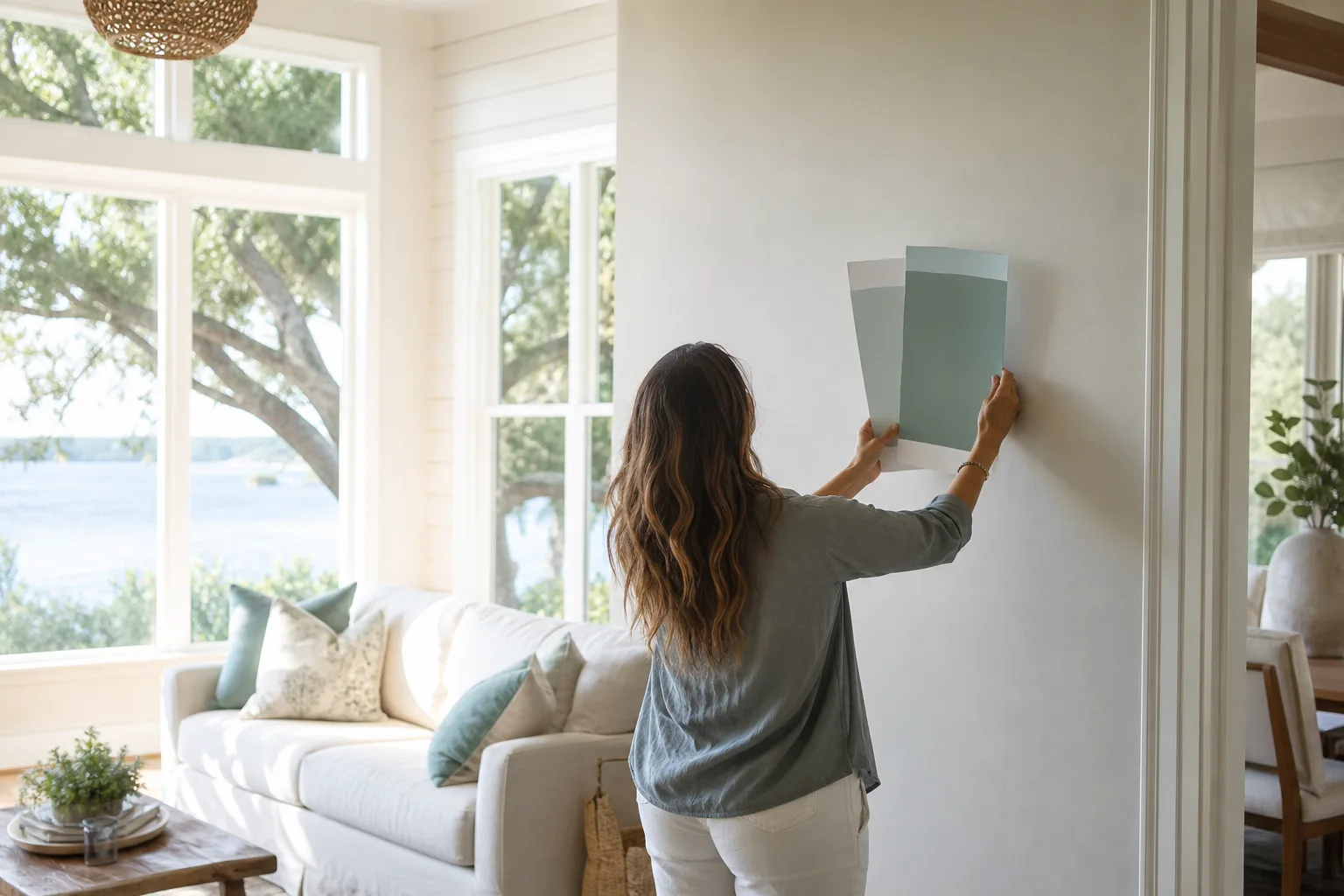
You painted the living room the gray your neighbor swore by, and in your house it turned faintly green by four in the afternoon. That's not a mistake — it's coastal light doing what it does. The bright, slightly warm sun we get on the Gulf Coast bounces off the water and the sky and changes how every color reads on the wall.
Choosing coastal interior paint colors for an Alabama home isn't about copying a beach-house photo. It's about picking colors that work with your light, your floors, and the way you move from room to room. Get that right and the whole house feels calm and connected. Get it wrong and you're repainting in a year. Here's how we help homeowners across Mobile and Baldwin County land on a palette they actually keep.
How does Gulf Coast light change how a paint color reads?
The first thing to understand about coastal interior paint colors is that the light is the real decision-maker. Our sun is bright and carries a little warmth, and it shifts hard from morning to evening. A color that looks perfect at 9 a.m. can look like a different paint entirely at sunset.
Window direction is the lever you have:
- South-facing rooms get the most light, and it's warm and strong. Cooler or more neutral colors stay balanced here; very warm colors can go yellow and heavy.
- West-facing rooms catch intense, golden late-day sun. Watch warm colors closely — they amplify.
- North-facing rooms get soft, cool, even light all day. Warmer colors keep them from feeling gray and flat.
- East-facing rooms are bright and cool in the morning, dimmer later. Warm-neutral tones hold up well across the day.
This is the same principle behind choosing the right colors for north- vs. south-facing rooms — the direction your windows face should steer the undertone, not just the color name on the can.
Build coastal interior paint colors into a palette, not a theme
The best coastal interior paint colors suggest the water and the light without shouting "beach house." Think about the colors that are actually around us on the Gulf Coast: soft sandy neutrals, weathered driftwood grays, the pale blue-green of the bay on a calm morning, crisp cloud white. Used in the right doses, those read as coastal and stay timeless.
A palette that works almost everywhere on the coast:
- A main neutral — a soft white, warm greige, or pale sand for most of the walls.
- A trim white — clean and a touch crisper than the walls, for trim, doors, and built-ins.
- One or two accents — a muted blue-green, soft blue, or deeper sandy tone for smaller spaces and details.
The mistake we fix most often is too many colors fighting each other. You don't need a different color in every room. You need one calm foundation and a couple of accents you place on purpose.
The fastest way to narrow a long list is to see the colors on your own room. Our free AI Color Visualizer lets you upload a photo of your space and preview real paint colors on your actual walls — see it before you commit, then take your top two or three to samples. When you want a trained eye on the final call, our color consultation matches the palette to your light, your floors, and your furniture so you're not guessing.
Make the whole house flow, room to room
A palette only works if it flows. In the open floor plans common in newer Baldwin County homes, the kitchen, dining, and living areas all see each other — so they can't each have an unrelated color. The fix is to let one main color carry the open space and use your accents in the rooms that close off: a study, a powder room, a bedroom.
Here's the simple structure we build most coastal homes around:
Lock the main neutral first
Choose the soft white, greige, or sand that will cover most of the walls and set the tone for the whole house. Everything else gets chosen to work with it.Pick a trim white that pairs
Set one trim white for trim, doors, and built-ins so the architecture stays crisp and consistent from room to room.Add one or two accents in doses
Use a muted blue-green or deeper sand in the spaces that close off — a bathroom, a study, the back of a bookshelf — so accents feel intentional, not random.Adjust sheen, not color, per room
Keep the color family tight and vary the finish: matte or eggshell on most walls, satin or semi-gloss in wet and high-traffic rooms.Carry the palette down the halls
Paint connecting spaces in the main neutral so the eye moves smoothly between rooms instead of hitting a hard color change at every doorway.
This is the heart of a whole-home color flow for open floor plans: connection through a shared foundation, variety through accents and sheen. For the bigger picture on planning an interior repaint — prep, sheen, sequence — our interior house painting guide for Mobile and Baldwin County walks through the whole project.
Sheen and humidity: the quiet half of color
Two homeowners can choose the exact same color and end up with rooms that look nothing alike, because sheen changes how a color reads and how it holds up. On the humid Gulf Coast, that's not a minor detail.
| Room | Recommended sheen | Why it fits the coast |
|---|---|---|
| Living, bedrooms, dining | Matte or eggshell | Hides wall flaws and reads soft; easy to touch up |
| Kitchen | Eggshell or satin | Wipes clean from cooking grease and splatter |
| Bathrooms & laundry | Satin or semi-gloss | Stands up to steam, humidity, and scrubbing |
| Trim, doors, cabinets | Semi-gloss | Durable, crisp, and easy to wipe down |
Choosing your sheen at the same time as your color is what keeps the result looking the way you pictured it. A flat color in a steamy bathroom won't last; a high-gloss living room shows every roller mark. We settle both together so there are no surprises after the furniture goes back.
Put it all together
Choosing interior paint colors for a coastal Alabama home comes down to three moves: read your light before you fall for a color, build a tight palette of soft coastal neutrals plus one or two muted accents, and let one foundation color flow through the open spaces while sheen and accents do the varying. Do that and your home feels like the coast — calm, bright, connected — without looking like a stage set.
When you're ready, preview your favorites on your own walls with our color visualizer, then book a free in-home estimate. We're a family-owned crew that's painted Gulf Coast interiors since 2013, one accountable crew runs your job from the free estimate through the final inspection, and every project is backed by our 3-year workmanship warranty. Let's pick colors you'll still love next summer.