
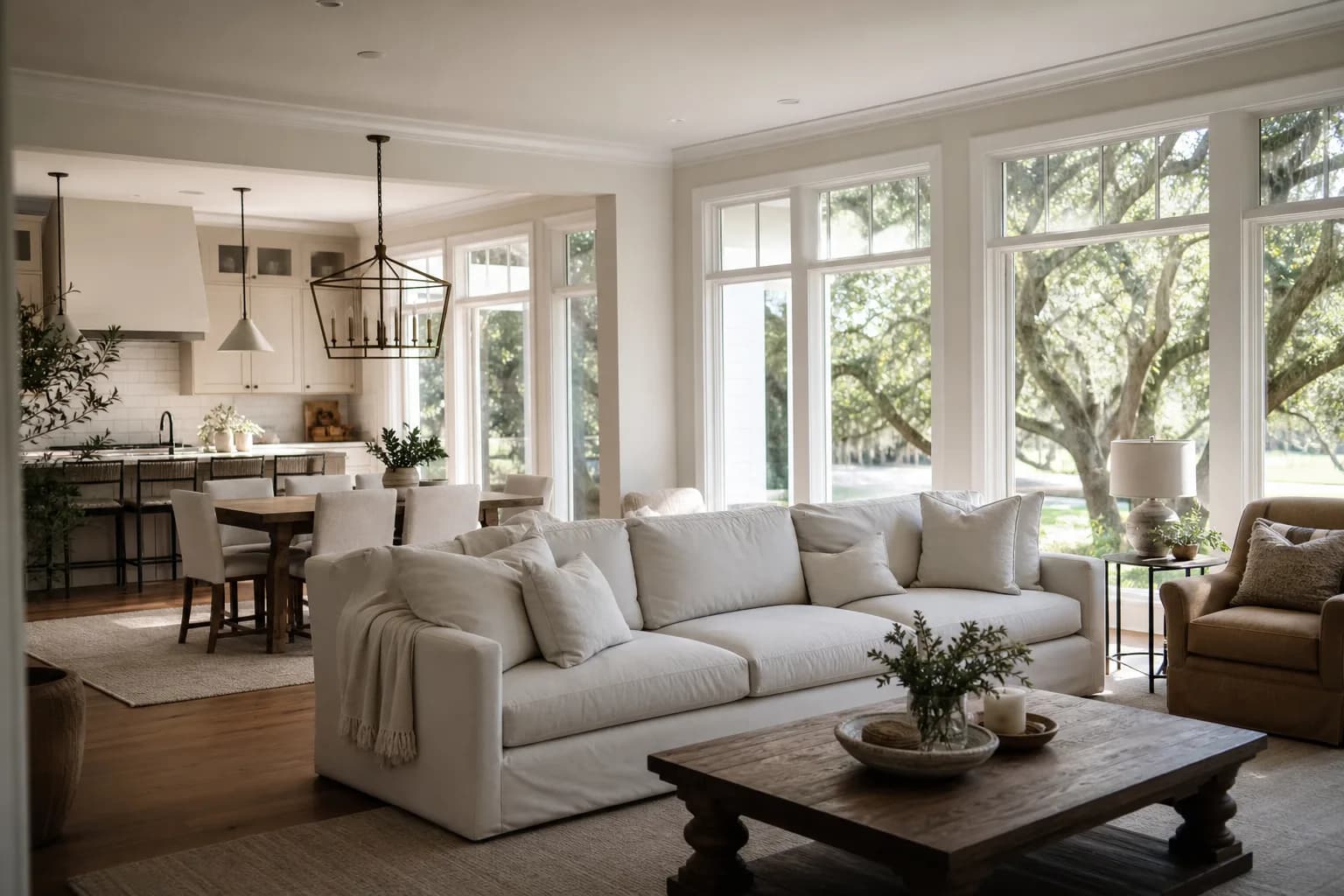
Stand in the kitchen of most homes built in the last twenty years and you can see three rooms at once — the island, the dining table, the couch, sometimes the stairs and a hallway too. That's the gift of an open floor plan, and it's also the trap when it comes to paint. Pick colors room by room the way people used to, and an open plan turns into a patchwork: a sage kitchen bumping into a beige living room bumping into a gray hall, all visible in one glance, none of them talking to each other.
A whole-home color palette fixes that. Instead of choosing colors one room at a time, you choose a small connected family of colors for the whole house, then place them so the open sightlines read as one calm space and the closed rooms get their own moment without breaking the flow. Done right, you stop noticing where one color ends and the next begins — the house just feels finished. Here's how we build that flow for the open-plan homes all over Mobile and the Eastern Shore.
Start with the sightlines, not the rooms
Answer-first: in an open floor plan, choose your main wall color for everything you can see at once — kitchen, living, dining — then build the rest of the palette around it, because those connected surfaces have to agree.
The old approach was to walk into each room and ask "what color should this be?" In an open plan that question is backwards. Walk to the center of the main living space and look around. Whatever you can see without turning your head — that's one visual zone, and it wants one wall color. Fighting that with three different colors across a single open space is what makes a house feel chopped up.
So your first decision isn't "what color is the kitchen." It's "what color carries the whole open core." Pick that anchor first. Then the dining nook, the breakfast area, the wall behind the TV all inherit it, and the eye glides instead of stopping at every corner. Rooms that actually close off with a door — bedrooms, an office, a powder room — are where you get to introduce a second or third color.
How do you build a connected palette around one undertone?
Answer-first: keep every color in your whole-home palette on the same undertone — all warm, all cool, or all the same gray base — so the rooms relate even when the colors differ.
This is the single biggest thing that separates a home that flows from one that feels off, and it's invisible until it's wrong. Two grays can each look great on a chip and still clash on adjacent walls because one leans blue and the other leans green. Undertone is the hidden thread. When your anchor color, your secondary colors, and even your whites all share a common undertone, you can vary the actual colors quite a bit and the house still hangs together.
A reliable way to build the palette: take your anchor color and move a step lighter or darker for adjacent spaces rather than jumping to an unrelated hue. A soft greige in the open core, a shade deeper in a study, a clean tint of the same family in the bedrooms. They're different rooms, clearly — but they're obviously the same house.
| Palette role | How many | How to choose it |
|---|---|---|
| Anchor wall color | 1 | Carries the open core — the connected kitchen/living/dining |
| Supporting wall colors | 1–2 | For closed rooms; same undertone, a step lighter or darker |
| Trim color | 1 | One consistent white or off-white throughout the whole house |
| Ceiling color | 1 | One consistent ceiling color, often a soft white, everywhere |
| Accent (optional) | 0–1 | A single bolder note for a front door, island, or one feature wall |
For most homes that's a four- to five-color palette: one anchor, one or two supporting wall colors, a trim color, and a ceiling color. Open plans lean toward the lower end because so much is visible at once. If you want a deeper dive on getting undertones right in our specific light, our guide on how to choose interior paint colors for a coastal Alabama home goes further, and our coastal interior color palettes that actually work gives you tested starting points.
Use trim and ceiling as the connectors
Answer-first: run one consistent trim color and one consistent ceiling color through the entire house — they're the quiet constants that let your wall colors change without the home feeling broken up.
Here's the move most people miss. You don't make a house flow only by matching wall colors — you make it flow by keeping the frame constant. Run the same white trim around every window, door, and baseboard, and run the same ceiling color overhead in every room. Now the eye always has a steady reference. Against that constant frame, the walls can shift from the anchor color in the great room to a deeper version in the den and the transition reads as intentional, not accidental.
In an open floor plan this is especially powerful, because the trim literally travels with you — the same baseboard runs from the kitchen into the living room into the hall. Keep it one color and it stitches the whole level together. Switch trim colors room to room in an open plan and you'll feel the seams even if you can't name why.
See the palette on your own walls before you commit
Answer-first: test your palette in your own home and light before buying gallons — Gulf Coast sun shifts a color dramatically from morning to evening, and a flowing plan only works if every color holds across that range.
A color that looks perfect on a store chip can go green at 4 p.m. in a west-facing room. That's not a flaw in the color; it's the light. The only way to trust a whole-home palette is to see it where it'll actually live. Paint large sample patches on a few walls — one in the open core, one in a closed room — and look at them morning, midday, and evening before you commit to anything.
Faster than that: our free AI Color Visualizer lets you upload a photo of your own room and preview real paint colors on your actual walls. For an open plan, it's the quickest way to see how an anchor color reads across the connected kitchen, living, and dining before you ever open a can — so you can confirm the flow, not just imagine it. If you're leaning toward a single color for everything, our take on choosing one wall color for the whole house is worth a read too.
When to bring in color help
Answer-first: a whole-home palette is one of the higher-stakes color decisions there is, so it's worth getting a second set of trained eyes before you commit the whole house to it.
Picking one room is forgiving. Picking the palette that flows through an entire open floor plan is not — get the undertone wrong and you feel it everywhere, every day. That's exactly the kind of thing our color consultation is for: we help you land a connected palette you won't second-guess, then our crew puts it on the walls. It's all part of the same interior painting work, handled by one accountable crew from your free estimate through the final inspection, backed by our 3-year workmanship warranty.
We're family-owned, we've been painting Gulf Coast homes since 2013, and we've color-matched a lot of open floor plans across Mobile and Baldwin County. Ready to make your whole home flow? Book a free in-home estimate — written quote within 24 hours, and you can pay by Cash, Check, or Credit Card.