
There's a lot to love about an older home — the tall trim, the solid doors, the character a builder-grade house never gets. But under decades of paint on a home built before 1978, there's a good chance the original coats contain lead. Painted over and left alone, that's usually fine. The moment someone sands or scrapes it carelessly, it becomes fine lead dust drifting through the rooms where your kids play.
That's why lead-safe interior painting on a pre-1978 home isn't the same job as repainting a new build. Done right, by a crew certified for it, you get fresh walls and a home that's safer than before — the old surface sealed down, the dust contained and cleaned up. Here's why the 1978 line matters, what a lead-safe job looks like, and how it protects your family. For the broader repaint picture, see our interior house painting guide; this piece is specifically about older homes and lead.
Why 1978 is the dividing line
Answer-first: lead-based paint was banned for residential use in the United States in 1978, so any home built before then may have lead paint somewhere under the current finish — and the older the home, the more likely it is. You can't tell by looking; testing is the only way to be certain. So the safe default is to treat pre-1978 paint as lead-containing and handle it with that in mind.
This matters more here than people expect. Around Mobile and across the Eastern Shore, there are plenty of homes from the 1970s and earlier — older in-town neighborhoods, historic streets, and homes that have stayed in the same family for generations. If yours is one of them, lead is worth assuming. (Many of these same homes have original plaster instead of drywall, which has its own quirks — we cover that in painting plaster walls in older coastal homes.)
What makes painting "lead-safe"
Lead-safe painting is a specific set of practices for disturbing old painted surfaces without spreading lead dust. The core ideas are simple: contain the area, minimize the dust you create, and clean up thoroughly. Compare it with how a standard repaint is often done:
| Step | Ordinary repaint | Lead-safe repaint (pre-1978) |
|---|---|---|
| Prep | Dry sanding, open scraping | Wet methods and HEPA-equipped tools — no dry sanding |
| Containment | Drop cloths, maybe | Sealed plastic, airflow shut off, area posted |
| Cleanup | Sweep and vacuum | HEPA-vacuum plus wet-wipe; debris bagged and disposed of |
| Who does it | Any painter | An EPA RRP Lead-Safe Certified crew |
The headline difference is dust control. A standard prep kicks particles into the air; a lead-safe prep keeps them down with moisture and HEPA filtration, then captures whatever settles. That's the whole game.
How an EPA Lead-Safe Certified crew handles your repaint
Pro 1 Painters is an EPA RRP Lead-Safe Certified renovator, which means we're trained to disturb painted surfaces in pre-1978 homes the right way. On a lead-safe interior job, here's the sequence we follow:
Identify pre-1978 surfaces and assume lead
We treat any home built before 1978 as if the existing paint contains lead and identify exactly which surfaces — walls, trim, doors, windows — we'll be disturbing before we start.Seal off and contain the work area
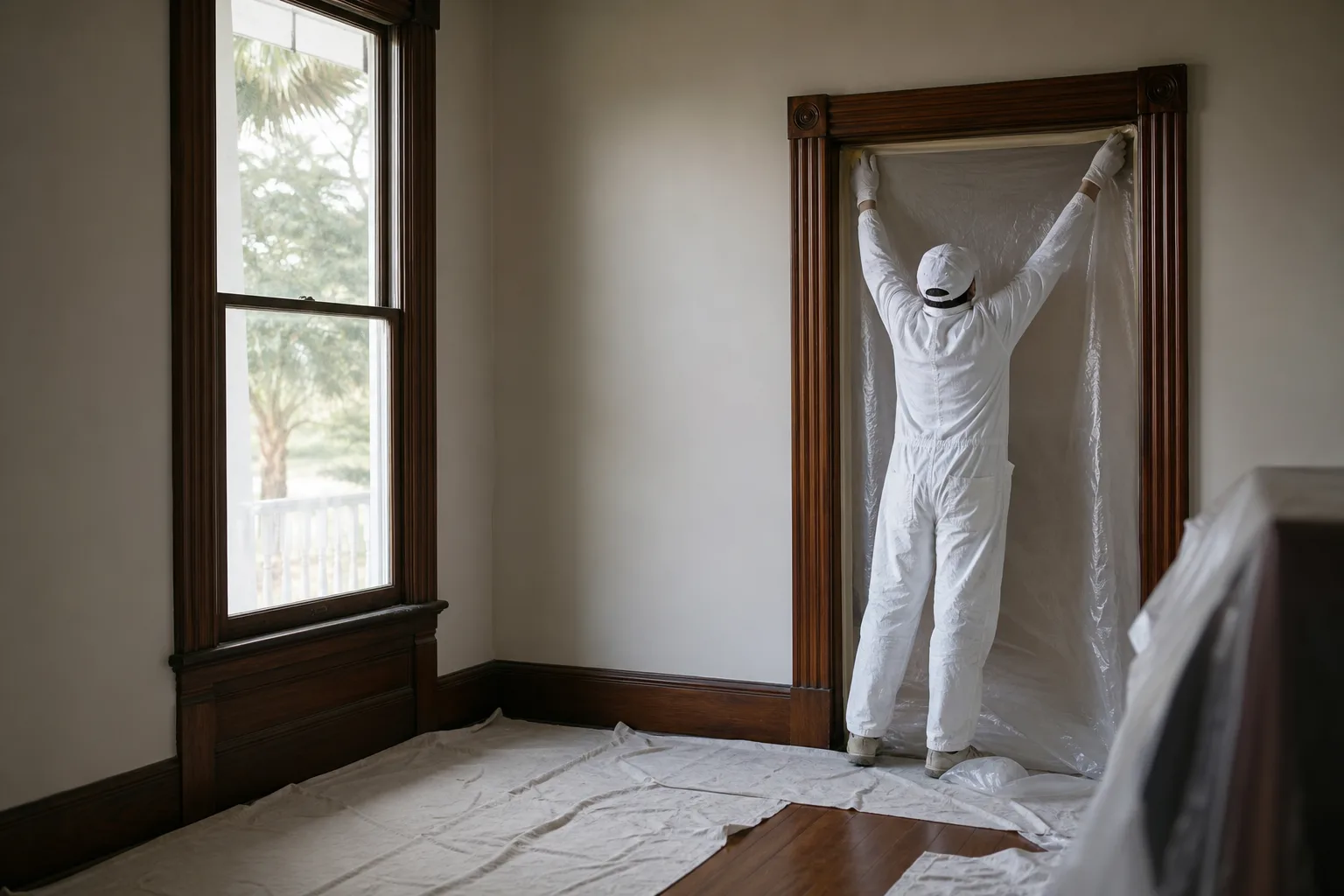
We close the room off with plastic sheeting, cover floors and any furniture that stays, shut down airflow into the rest of the house, and post the area so dust can't travel.Use dust-minimizing prep, never dry sanding
We prep with lead-safe methods — wet sanding or scraping and HEPA-equipped tools instead of dry sanding or open scraping — so we don't put lead dust into the air.Prime, paint, and lock the surface down
We prime bare and disturbed spots and apply fresh coats that encapsulate the old surface, sealing the original paint safely under a sound new finish.HEPA-clean and verify the area is clean
We HEPA-vacuum and wet-wipe the entire contained area, dispose of debris properly, and confirm the space is clean before the containment comes down and a manager signs off.
That last step is where lead-safe work really separates from a normal repaint: the area isn't done when the paint dries — it's done when it's been HEPA-cleaned, wiped, and checked.
Which surfaces matter most in an older home
Lead paint isn't spread evenly through a house, and the spots that worry us most are the ones that rub, slam, and shed. A few to watch in a pre-1978 home:
- Windows and sashes — the single biggest concern. A double-hung window grinds paint against paint every time it opens, so old window paint tends to powder into dust on the sill and floor below.
- Doors and door frames — they get handled and bumped constantly, and the friction at the latch and hinge edges wears paint loose.
- Trim, baseboards, and stair rails — high-touch, often layered with decades of coats, and right at kid height.
- Walls with chipping or flaking paint — any surface already shedding is releasing whatever's underneath.
When we scope an older home at the free estimate, these are the surfaces we flag first, because they're where lead-safe prep earns its keep. A wall in good shape may just need cleaning and a fresh coat; a chalky old window needs the full containment-and-HEPA treatment.
Does painting over lead paint make it safe?
Mostly, yes — with one condition. Sealing sound old paint under fresh coats, called encapsulation, does lock the surface down, and it's a legitimate, effective approach. The risk was never the new coat of paint. The risk is the sanding and scraping that come before it. So encapsulation is safe when the prep underneath it is done by a lead-safe crew with proper containment and cleanup — and risky when it's done by dry-sanding the old surface first and hoping a fresh coat hides the rest.
This is exactly why the certification matters for an older home. The paint job at the end looks the same either way; what protects your family is everything that happens before the first finish coat.
A safer home, not just a fresher one
Older Gulf Coast homes are worth repainting well — and on a pre-1978 home, "well" means lead-safe. With containment, dust-minimizing prep, and a thorough HEPA cleanup, a repaint leaves you with more than new color: the old surface sealed down and the lead dust kept out of the rooms your family uses.
If your home dates to the 1970s or earlier — and especially if you've got young kids — that's the careful version worth having. While you're thinking about a family-friendly repaint, it's also worth choosing low-VOC or zero-VOC interior paint to cut fumes on top of the lead precautions. See how we approach interior painting for older homes, and when you're ready, book a free estimate and we'll plan a lead-safe job for your house.