
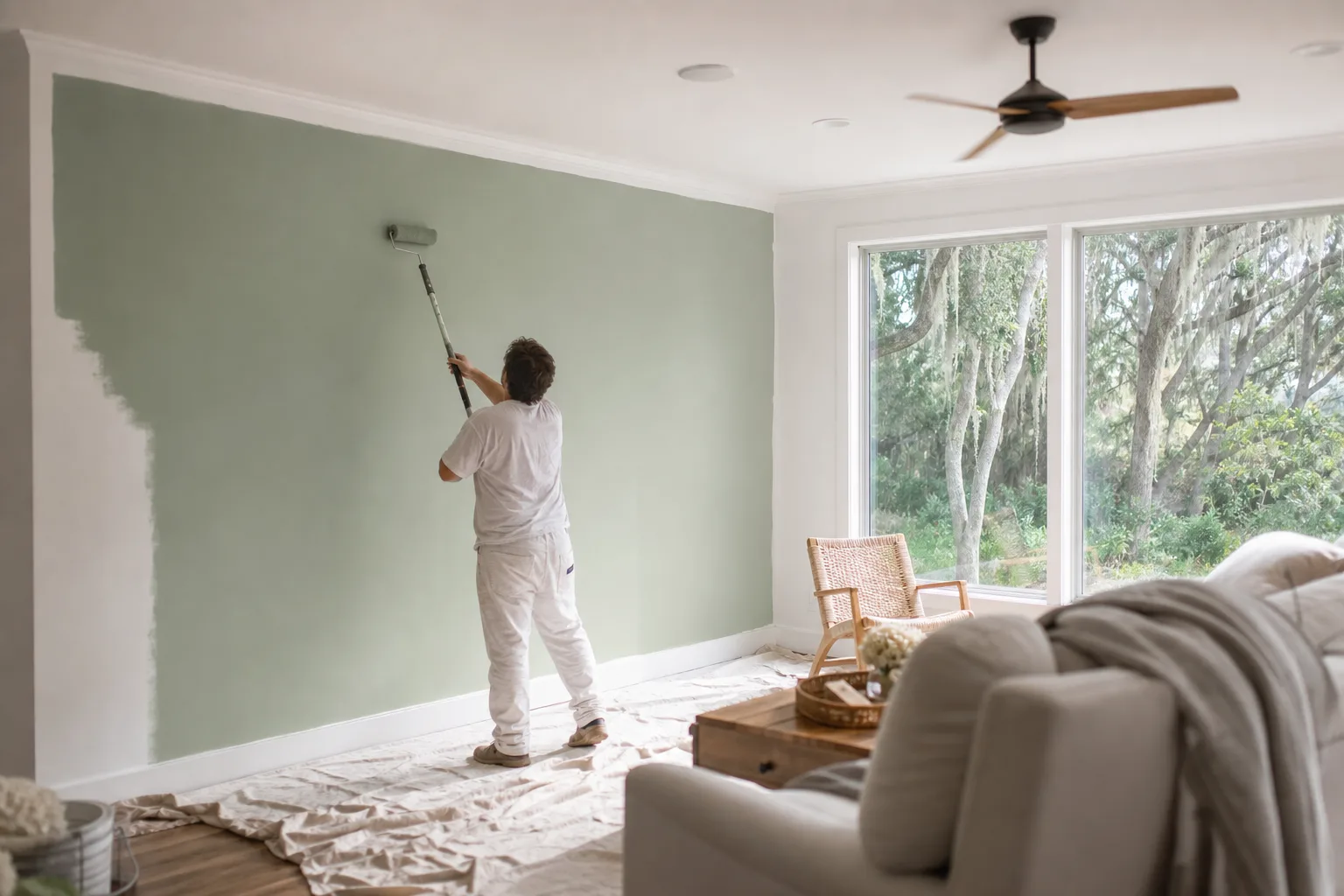
You're standing in the paint aisle, or scrolling a color app at the kitchen table, and you notice some cans cost a few dollars more and say "zero-VOC" on the label. If you've got a toddler, a dog that sleeps in every room, or anyone in the house who reacts to strong smells, the question is fair: is the low-fume paint actually worth it, or is it just a sticker?
Short answer: for the rooms people live in, low-VOC and zero-VOC interior paint is usually worth it — and the modern versions perform just as well as standard paint. But the right call depends on the room and who's breathing the air. Here's what the labels mean, how much they really cut the fumes, whether they hold up, and how to decide. For the bigger picture on a whole-home repaint, our interior house painting guide covers prep, sheens, and planning; this piece is just about the low-fume question.
What low-VOC and zero-VOC paint actually are
Answer-first: the wet-paint smell comes from VOCs — volatile organic compounds, the solvents that carry the paint and then evaporate as it dries and "off-gasses." Low-VOC paint contains far less of that solvent than a traditional paint, and zero-VOC paint has effectively none in the base. Less solvent means less smell, less off-gassing, and air that clears in hours instead of days.
Here's how the common terms compare:
| Term | What it means | Best for |
|---|---|---|
| Zero-VOC | Effectively no VOCs in the base paint | Nurseries, bedrooms, anyone sensitive — the least off-gassing |
| Low-VOC | A small, regulated amount of solvent | Most living spaces; a big cut in fumes at a friendly price |
| Standard paint | Higher VOC content, stronger smell | Rooms you can ventilate for days, or unoccupied projects |
| "Non-toxic" / "natural" | Marketing terms — read the actual VOC number | Verify on the label; the VOC figure is what matters |
One honest note: a zero-VOC base can pick up a little VOC when it's tinted a deep color, and primers and additives can add a faint smell too. So "zero" rarely means literally odorless — it means a mild, short-lived smell rather than heavy fumes that hang around.
Do they really cut the fumes — and who benefits most?
Yes, noticeably. The difference is most obvious in the first day or two after painting, when a standard paint is still off-gassing and a zero-VOC room has already cleared. That matters most for:
- Babies, young kids, and nurseries — little lungs, and rooms you want back in use right away.
- Pregnant household members and anyone with asthma or allergies — fewer fumes to react to.
- Pets — birds especially are sensitive, but dogs and cats sleep close to freshly painted walls too.
- Anyone who simply can't move out for a few days while a room airs out.
If you're painting a kids' room or repainting with the family still in the house, low-fume paint is a real comfort, not a luxury. (We dig into the logistics of that in painting with kids and pets in the house safely, and into clearing a room fast in how to air out a room after painting.)
But do low-VOC paints actually perform?
This is the question that stops people, and it deserves a straight answer: the early low-VOC paints, years ago, earned a reputation for thin coverage and weak durability. Today's premium low-VOC and zero-VOC lines have closed that gap. The good ones cover in the same number of coats, scrub clean, resist fading, and stand up to everyday handling just like a standard paint.
A couple of things that keep performance high regardless of the VOC number:
- Buy a quality line, not the cheapest can. The performance gap today is between good paint and bad paint — not between low-VOC and standard.
- Prep the same way. Clean, patched, primed surfaces are what make any paint last. A low-VOC paint over poor prep fails for the same reason a standard one would.
- Match sheen to the room. A washable finish in a kitchen or kids' room handles wear; that choice matters more than the VOC level for how the paint holds up.
In other words, the low-VOC decision is about the air in your home. It isn't a trade-off against a paint that lasts — as long as you pick a good product and prep right.
So — is it worth it?
For the rooms you live in and sleep in, and for any home with kids, pets, or someone sensitive to fumes, low-VOC or zero-VOC interior paint is usually worth the small extra cost. You get to move back in fast, breathe easier, and — with a quality line — give up nothing in durability or color. For a rarely-used space you can leave open for days, a standard paint may be perfectly fine.
The simplest way to decide is room by room. At your free estimate we'll talk through who uses each space and how fast you need it back, recommend the right product, and put it in the written quote. Take a look at how we approach interior painting, or book a free estimate and we'll build a low-fume plan that fits your home.