
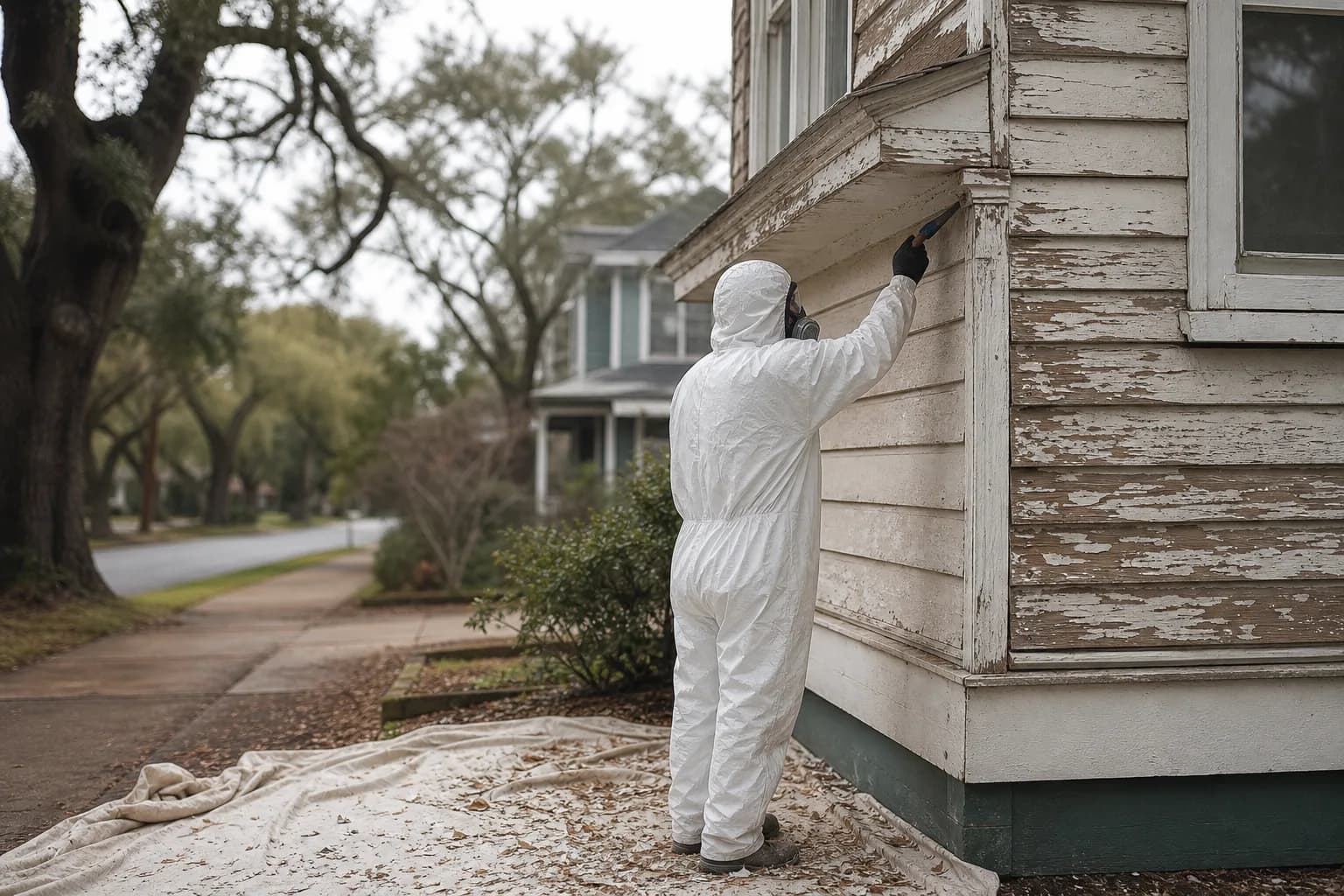
Drive through Oakleigh, Old Dauphin Way, or the De Tonti Square blocks and you're looking at some of the oldest housing stock on the Gulf Coast — homes that have been repainted a dozen times over a century. That's a lot of the city: Mobile's median home was built around 1973, before the 1978 ban on lead house paint. Under those layers, there's a real chance the original coats contain lead. Left alone, that's usually fine. The moment a crew dry-sands or scrapes it carelessly, it becomes fine lead dust in the rooms your family lives in and the soil your kids play on.
That's why lead-safe painting in Mobile, AL isn't the same job as repainting a new subdivision build out in west Mobile or Saraland. Done right, by a certified crew, you get fresh walls and siding and a home that's safer than before — the old surface sealed down, the dust contained and cleaned up. Here's why the 1978 line matters so much in this city, what lead-safe prep looks like inside and out, and how it protects your family. For the broader picture on Mobile's oldest homes, see our guide to painting historic homes in Mobile's National Register districts.
Why 1978 matters more in Mobile than most cities
Lead-based paint was banned for residential use in the United States in 1978, so any home built before then may have lead somewhere under the current finish — and the older the home, the more likely it is. What makes Mobile different is how much of the housing predates that line. The city's median year built sits around 1973, which means a huge share of homes here are old enough to assume lead is present. In the historic districts it's older still.
You can't tell by looking; testing is the only way to be certain. So across Mobile's pre-1978 neighborhoods, the safe default is to treat the existing paint as lead-containing and handle any repaint with that in mind. This is also why so many of these homes pair lead concerns with other older-home quirks — original plaster walls instead of drywall, single-pane wood windows, layered trim. We get into the plaster side in our piece on painting plaster walls in older Mobile homes.
What makes paint prep "lead-safe"
Answer-first: lead-safe prep is a specific set of practices for disturbing old painted surfaces without spreading lead dust — contain the area, minimize the dust you create, and clean up thoroughly. It's the prep that changes, not the finish coats. Here's how it compares to how a standard repaint is often done:
| Step | Ordinary repaint | Lead-safe repaint (pre-1978) |
|---|---|---|
| Prep | Dry sanding, open scraping, aggressive power-washing | Wet scraping and sanding with HEPA-equipped tools — no dry sanding |
| Containment | A few drop cloths, maybe | Sealed plastic inside; ground sheeting under exterior work |
| Cleanup | Sweep and a shop vac | HEPA-vacuum and wet-wipe inside; chips bagged and disposed of outside |
| Who does it | Any painter | An EPA RRP Lead-Safe Certified crew |
The headline difference is dust control. A standard prep kicks particles into the air and onto the ground; a lead-safe prep keeps them down with moisture and HEPA filtration, then captures whatever settles. That's the whole game, and it applies just as much to a peeling exterior repaint as it does to interior trim.
How Pro 1 handles a lead-safe repaint in Mobile
Pro 1 Painters is an EPA RRP Lead-Safe Certified renovator, so we're trained to disturb painted surfaces in pre-1978 homes the right way. On an older Mobile home — interior, exterior, or both — here's the sequence we follow:
Treat the home as lead-containing and scope it
On any Mobile home built before 1978 we assume the paint contains lead and walk the inside and outside at your free estimate, flagging the surfaces we'll disturb — siding, eaves, windows, trim, doors, and walls.Contain the area before any prep
Inside, we seal off rooms with plastic and shut down airflow. Outside, we lay ground sheeting under the work zone to catch chips and dust so nothing ends up in the soil or the rest of the house.Prep with wet, dust-minimizing methods
We use wet scraping and sanding with HEPA-equipped tools instead of dry sanding or open power-sanding, which keeps lead dust out of the air on both interior and exterior surfaces.Prime and encapsulate the old surface
We spot-prime bare and disturbed areas and apply fresh coats that seal the original paint under a sound new finish — the encapsulation that locks the old surface down.HEPA-clean, verify, and sign off
We HEPA-vacuum and wet-wipe interior containment, collect and bag exterior debris, dispose of it properly, and a manager confirms the area is clean before the final inspection.
That last step is where lead-safe work really separates from a normal repaint: the job isn't done when the paint dries — it's done when the area has been cleaned, wiped, and checked.
The exterior is where Mobile homeowners get caught
Most people picture lead risk as an interior, sanding-the-trim problem. On Mobile's older homes, the outside is just as important — and it's where a careless crew does the most damage. Old exterior paint on wood siding, eaves, porch columns, and window casings chalks and peels in our heat and humidity, and the wrong prep scatters lead chips and dust right into the flower beds and the ground where kids and pets play.
A few exterior surfaces we watch closely on a pre-1978 Mobile home:
- Wood siding and eaves — decades of coats, often peeling on the sun-and-rain-beaten elevations, shedding chips below.
- Window casings and sills — old single-pane wood windows grind and weather, powdering paint onto the sill and ground.
- Porch columns, railings, and ceilings — high-touch, frequently layered, and right where people sit and kids play.
- Soffits and trim — easy to gouge with an aggressive scraper or sander, kicking dust into the air.
The fix isn't complicated, but it has to be deliberate: contain the ground, scrape and sand wet, and clean up the debris instead of letting it blow into the yard. Pressure-washing has its place in exterior prep, but on lead-era paint it's done carefully, not blasted, so it rinses chalk without turning sound paint into airborne chips.
Does painting over lead paint make it safe?
Mostly, yes — with one condition. Sealing sound old paint under fresh coats, called encapsulation, does lock the surface down, and it's a legitimate, effective approach. The risk was never the new coat of paint. The risk is the sanding and scraping that come before it. So encapsulation is safe when the prep underneath it is done by a lead-safe crew with proper containment and cleanup — and risky when someone dry-sands the old surface first and hopes a fresh coat hides the rest.
This is exactly why certification matters on an older Mobile home. The finished paint job looks the same either way; what protects your family is everything that happens before the first finish coat goes on.
A safer home, not just a fresher one
Mobile's older homes are worth repainting well — and on a pre-1978 home, "well" means lead-safe. With containment, wet dust-minimizing prep, and a thorough cleanup inside and out, a repaint leaves you with more than new color: the old surface sealed down and the lead dust kept out of the rooms and the yard your family uses.
If your home is in one of Mobile's older neighborhoods or historic districts — and especially if you've got young kids — that's the careful version worth having. This pairs naturally with broader lead-safe interior painting in pre-1978 homes when the work moves inside, and with planning a repaint for older homes in northern Mobile County. When you're ready, see how we approach interior painting and book a free estimate — we'll plan a lead-safe job for your house.