
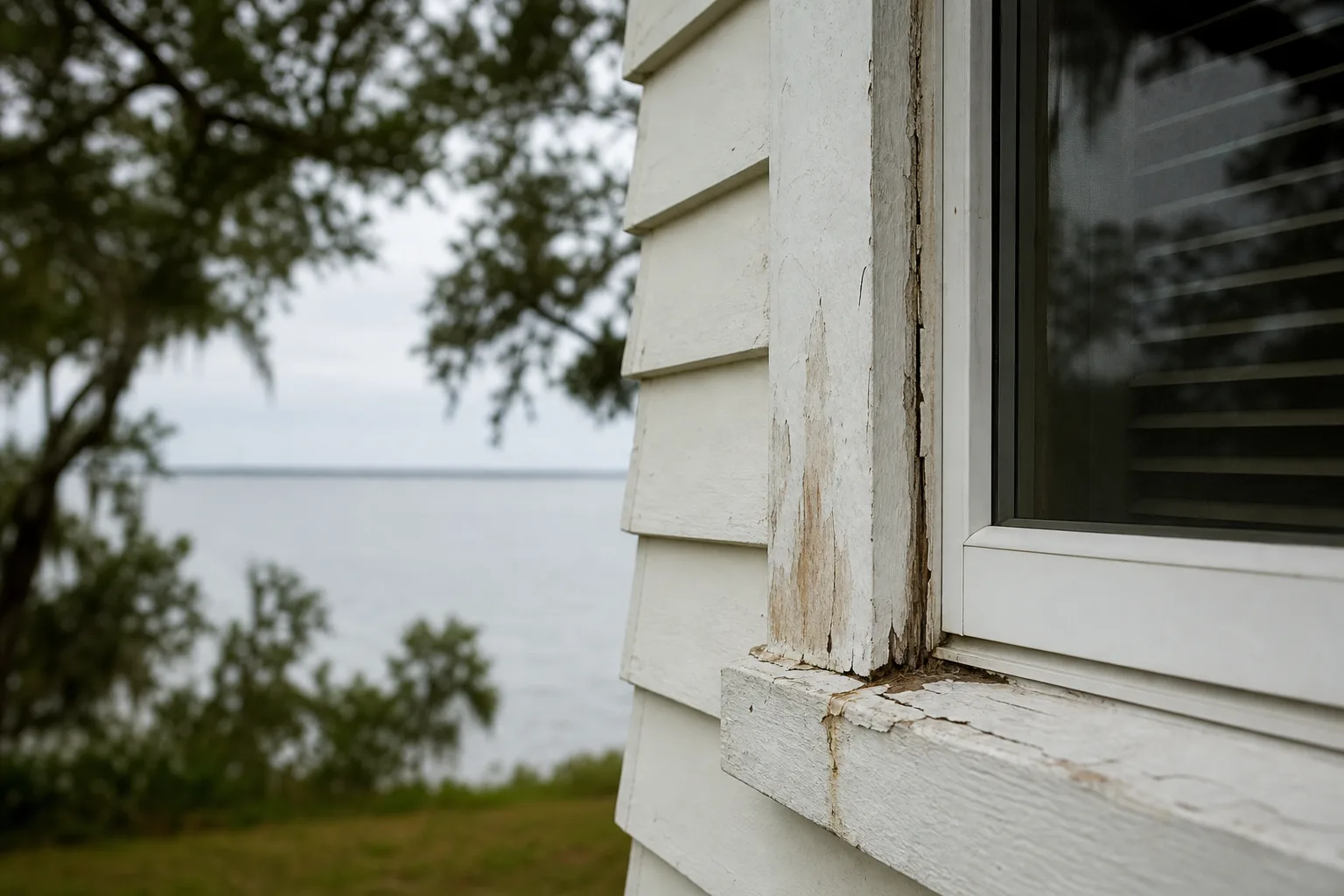
A paint film is only as good as the surface under it stays dry. That's the part homeowners almost never see, and it's the part that decides whether a Gulf Coast repaint lasts five years or fails in one. When paint blisters or peels out here, the paint isn't the problem — moisture got behind it. The real question, the one worth answering before anyone opens a can, is where that moisture behind the exterior paint is coming from.
Water reaches the back of your paint from two directions: pushed in from outside, or pushed out from inside as vapor. On the coast, both are usually happening at once. This is a field guide to every common source — so you can find yours, fix it, and repaint over a wall that actually stays dry. (If you want the mechanics of how that trapped water lifts the finish into bubbles and sheets, that's a separate read: why coastal humidity causes peeling and blistering.)
Moisture from outside: where water gets behind the wall
Most water behind coastal paint comes from outside the house, finding an opening and getting pushed in. Wind-driven rain is the engine — a Gulf storm drives rain sideways, not just down — and it exploits every gap. Here's where it gets in.
- Failed caulk joints. Caulk around trim, corners, windows, and where dissimilar materials meet is the first line of defense, and it's the first thing to go. Once a bead cracks or pulls away, rain runs straight behind the boards. Failure along seams and trim almost always traces back to caulk.
- Missing or rusted flashing. Flashing is the metal that directs water away from windows, doors, rooflines, and decks. When it's missing, installed wrong, or rusted through, water sheets behind the siding above and shows up as peeling below.
- Gutter overflow and roof leaks. A clogged or missing gutter dumps water down one stretch of wall every rain. A roof or flashing leak can travel inside the wall and surface as peeling well below where it entered.
- Ground contact and rising damp. Siding or stucco that runs too close to soil, mulch, or a patio wicks ground moisture up from below. That's why peeling so often clusters along the bottom foot of a wall — no topcoat stops water coming up from underneath.
- Sprinklers. An irrigation head that hits the wall a few times a week keeps that section perpetually damp. It's one of the most overlooked sources we find.
Moisture from inside: vapor drive
The sneakier source comes from inside your own house. It's called vapor drive, and in our climate it works in both directions depending on the season.
Warm, humid air always tries to move toward cooler, drier air, and it carries water vapor with it as it goes. In a Gulf Coast summer, hot humid outdoor air pushes toward your air-conditioned interior; on a cool night, the warm moist air inside pushes out toward the siding. Either way, that vapor migrates through the wall. When it reaches the back of an exterior paint film that can't breathe, it has nowhere to go — so it builds pressure and lifts the film into blisters.
This is why you'll see paint failure concentrated on the outside of bathroom, kitchen, and laundry walls, where a lot of moisture gets generated indoors and ventilation is often weak. The shower, the stovetop, the dryer — all of it pumps humidity into the air, and some of it ends up driving out through the wall. It's the same indoor-humidity problem that grows mildew on the inside of those rooms, which we cover in mildew-resistant paint for Gulf Coast bathrooms and laundry rooms.
| Where the paint fails | Most likely moisture source | What to check |
|---|---|---|
| Along seams, corners, and trim | Failed caulk joints | Re-caulk every open joint before repainting |
| Under or beside windows | Missing or rusted flashing, or a leak above | Inspect and repair flashing; find the leak |
| Low on the wall, near the ground | Ground contact or rising damp | Create clearance from soil, mulch, and pavement |
| Whole field on a bath/kitchen wall | Interior vapor drive | Improve indoor venting; use a breathable coating |
| One vertical stripe down the wall | Gutter overflow or a roof leak | Clear or repair the gutter; trace the roof leak |
How do you find your moisture source?
You don't need moisture meters to start narrowing it down — you need to read the wall like a detective. The location and shape of the failure usually names the culprit.
Walk the house slowly. Note exactly where paint is bubbling or peeling, and what's directly above it. Failure marching along a caulk line says the joints failed. A bloom of bubbles low on a wall says water's coming up from the ground. Peeling that only shows under a window says flashing or a leak above it. Whole-wall failure on the outside of a bathroom says vapor from inside. Check the obvious culprits while you're at it: are the gutters clear and draining away from the wall? Do sprinklers hit the siding? Is the soil or mulch piled up against the bottom of the wall? More than one source can be at work, and on an older home, usually is.
Some sources hide behind the siding entirely. A slow flashing leak or rotted sheathing doesn't announce itself until you open the wall — and that's where it stops being a paint question and becomes a repair one. When the wood behind the paint has gone soft, our carpentry crew replaces the failed boards and trim so there's sound, dry material to paint over in the first place. Painting over rotted wood is just hiding the next failure.
Fixing the source, then repainting to last
Once you've found the source, the order of operations is everything: stop the water, dry the wall, then paint. Re-caulk the open joints, repair or replace failed flashing, clear and redirect the gutters, create clearance at the ground, and fix any leak before a brush touches the wall. Then let the substrate dry out genuinely — in our humidity that can take a stretch of dry weather, longer for wood than for masonry.
The repaint itself should work with the moisture you can't fully eliminate. A quality, breathable exterior coating lets interior vapor pass through instead of trapping it behind the film — which directly defeats the vapor-drive failures. Pair that with the prep that makes any coastal job last, and you've turned a wall that was filling with water into one that sheds and breathes. Our exterior painting page covers how we approach that start to finish, and for the bigger picture on protecting a coastal home, our exterior house painting guide for Mobile and Baldwin County ties it together.
The bottom line on moisture behind exterior paint: it comes from failed caulk, missing flashing, gutter and roof leaks, ground contact, sprinklers, or vapor driving out from inside — and the pattern of the failure points you to which one. Find it, fix it, dry the wall, then repaint with a breathable coating. Skip the source and you'll repaint again next year. When you'd rather have the source diagnosed before a drop of paint goes on, reach out for a free in-home estimate and a written quote within 24 hours. We're a family-owned crew that's worked Gulf Coast exteriors since 2013.