
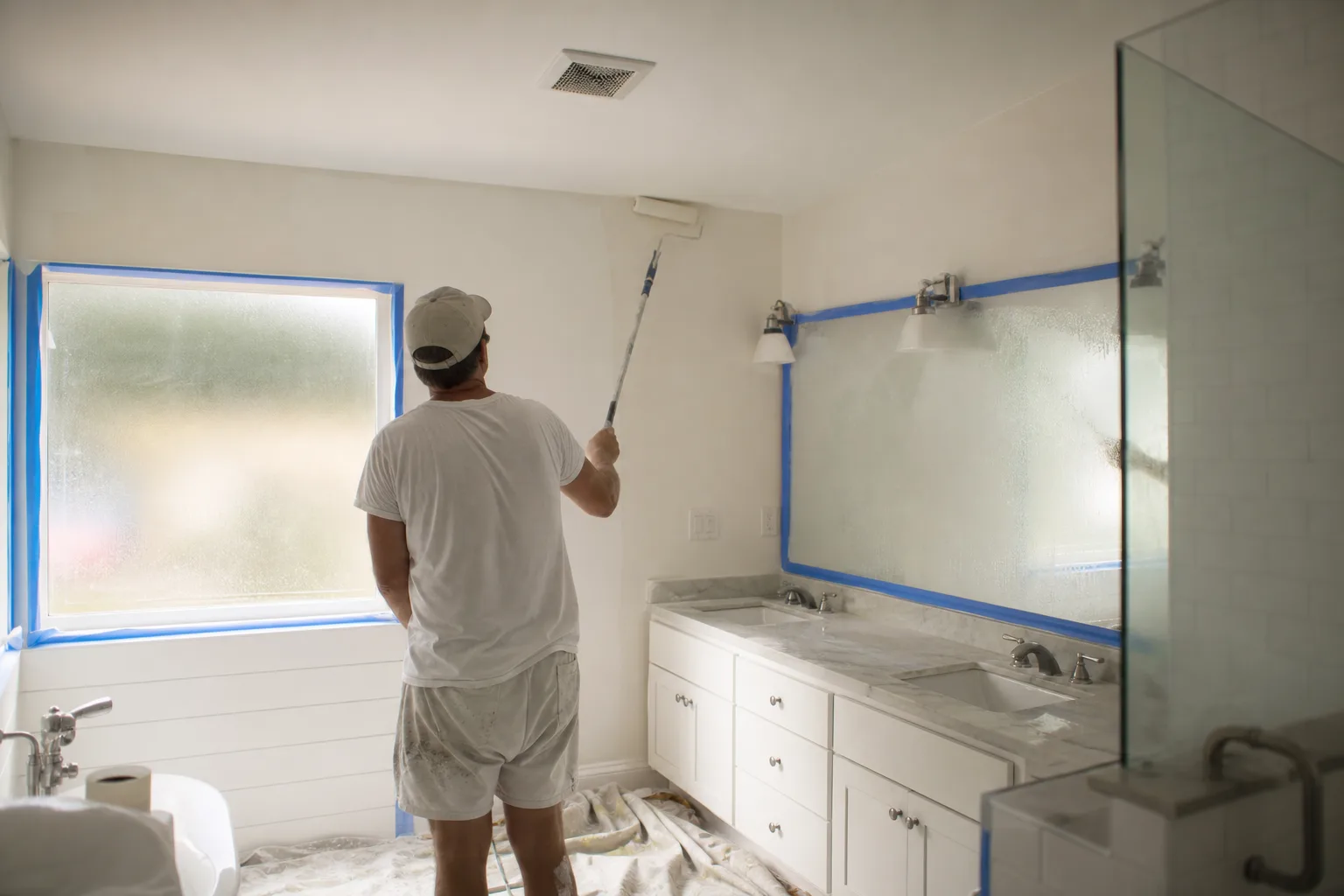
Pull back the shower curtain in a Gulf Coast home and look up at the corner of the ceiling. If a faint gray speckle is creeping in, your bathroom is doing what every wet room in this climate does first — growing mildew before the rest of the house even thinks about it. Same story in the laundry room. These rooms make their own weather, and they're exactly where the right mildew-resistant paint earns its place — but the paint is only part of the answer, and the part most people get backwards. Here's how to actually keep a humid bathroom or laundry room from speckling on the Gulf Coast.
Why do wet rooms mildew first?
Answer-first: bathrooms and laundry rooms mildew before the rest of the house because they combine three things mildew needs — moisture, warmth, and still air — in one small, often poorly vented space.
Think about what a hot shower does. It pumps warm, wet air into a closed room with a cool ceiling and walls, and that moisture condenses and clings to every surface. A running dryer does the same to a laundry room. Now layer on the Gulf Coast baseline — long humid stretches and mild winters that never really dry a house out — and the wet rooms get a head start on mildew that a dry bedroom or living room never faces.
That's why mildew shows up unevenly inside a home. The living areas can look perfect while the bathroom ceiling and the laundry wall go gray. Same house, same air conditioning, completely different micro-climate behind those doors. Once you see the wet rooms as their own environment, the fix gets obvious: you treat them differently than the rest of the house.
Airflow does more than the can — fix it first
Here's the part the paint aisle won't tell you: ventilation beats any product on the shelf in a wet room. A bathroom-and-kitchen paint is genuinely useful, but the single biggest lever in a steamy room is getting the moisture out before it can settle.
The same goes for the laundry room: a dryer vented properly to the outside, and a little air movement, keeps the warm damp air from sitting against the walls. None of this is glamorous, but it does more for mildew than any additive. The paint's job is to hold the line in a room you've already helped dry out — not to single-handedly out-argue a room that stays wet.
What mildew-resistant bathroom paint actually does
A mildew-resistant paint — including the bathroom-and-kitchen lines built for these rooms — is interior paint with a mildewcide in the dried film. The additive makes the paint surface inhospitable to the mildew that would otherwise speckle a basic flat coat in a steamy room. On a wet-room wall or ceiling, that's a real, measurable help.
What it isn't: it's not a sealant against a leak, it doesn't fix bad ventilation, and it won't kill mildew already living on the wall. It protects the paint film once the room's been dried out and the surface prepped. Used that way — as the last step, not the only step — it's exactly the right product for the rooms that stay humid.
The sheen matters as much as the paint
In a wet room, the finish you pick is half the decision. A satin or semi-gloss has a tighter, less porous film that sheds moisture and wipes clean — flat and matte hold damp and give mildew more texture to grab. Step up the sheen in the rooms that stay humid, including the ceiling over a shower, which is often where growth shows first as steam rises and condenses there.
Here's how it plays out room by room in a Gulf Coast home:
| Room / surface | Why it mildews | What we use |
|---|---|---|
| Bathroom walls | Shower steam, closed door, slow to dry | Mildew-resistant, satin or semi-gloss |
| Bathroom ceiling over shower | Rising steam condenses on the cool ceiling | Mildew-resistant, satin |
| Laundry & utility room | Dryer heat and moisture, warm still air | Mildew-resistant, satin |
| Kitchen walls near range/sink | Cooking steam and splash, grease | Bathroom-and-kitchen line, satin |
| Powder room with no fan | Small, often unvented space | Mildew-resistant, semi-gloss + add airflow |
The pattern is simple: the steamier and stiller the room, the more both the mildew-resistant product and the glossier sheen are worth it. For the full breakdown of which finish belongs where, our guides to the best paint sheen for bathrooms and humid rooms and choosing between flat, eggshell, satin, and semi-gloss go deeper. And if you want to see a wet-room color on your own walls before you commit, our free AI Color Visualizer lets you upload a photo of the bathroom and preview real paint colors on it.
When it's a repair, not a repaint
Sometimes the wall behind the speckle is past painting. If mildew has been feeding on the same bathroom or laundry wall long enough — or there's been a slow leak behind it — the drywall can be soft, swollen, or musty. At that point cleaning and repainting won't cut it; the failed board has to come out and the surface gets rebuilt before a drop of finish goes on. That's where our drywall repair and painting work comes in, and we cover the read-the-wall side of it in our drywall repair and texture-matching guide. A brown halo on the ceiling is its own warning sign — we break that down in what causes ceiling water stains and how to fix them.
If you're already seeing growth, it has to come off before a fresh coat goes on, or it bleeds right back through. We've walked through that step by step in how to remove mold and mildew from walls before painting. For the wider picture on choosing a mildew-fighting product, our guide to anti-mildew and mold-resistant paint for Gulf Coast homes covers the product side, and the exterior version for shaded siding handles the outside of the house.
The bottom line on wet-room paint
Mildew-resistant paint is a smart choice for a Gulf Coast bathroom, laundry room, or kitchen — but it's a helper, not a hero. The order that actually works: get the room drying out with real ventilation, kill and clean any existing growth, stain-block, then topcoat with a mildew-resistant paint in a satin or semi-gloss. Skip the airflow or paint over living mildew, and you'll be back at the same wall next summer.
If your bathroom ceiling keeps speckling or the laundry-room wall won't stay clean, that's a fixable problem — usually a mix of better airflow, the right product, and sometimes a real repair. Our interior painting crew handles the moisture-prone rooms start to finish: reading the wall, prep, the right paint and sheen, and a manager sign-off before final payment. Book a free estimate and we'll tell you whether your wet room needs a better paint, more airflow, a repair, or all three — and put it in a written quote within 24 hours.