
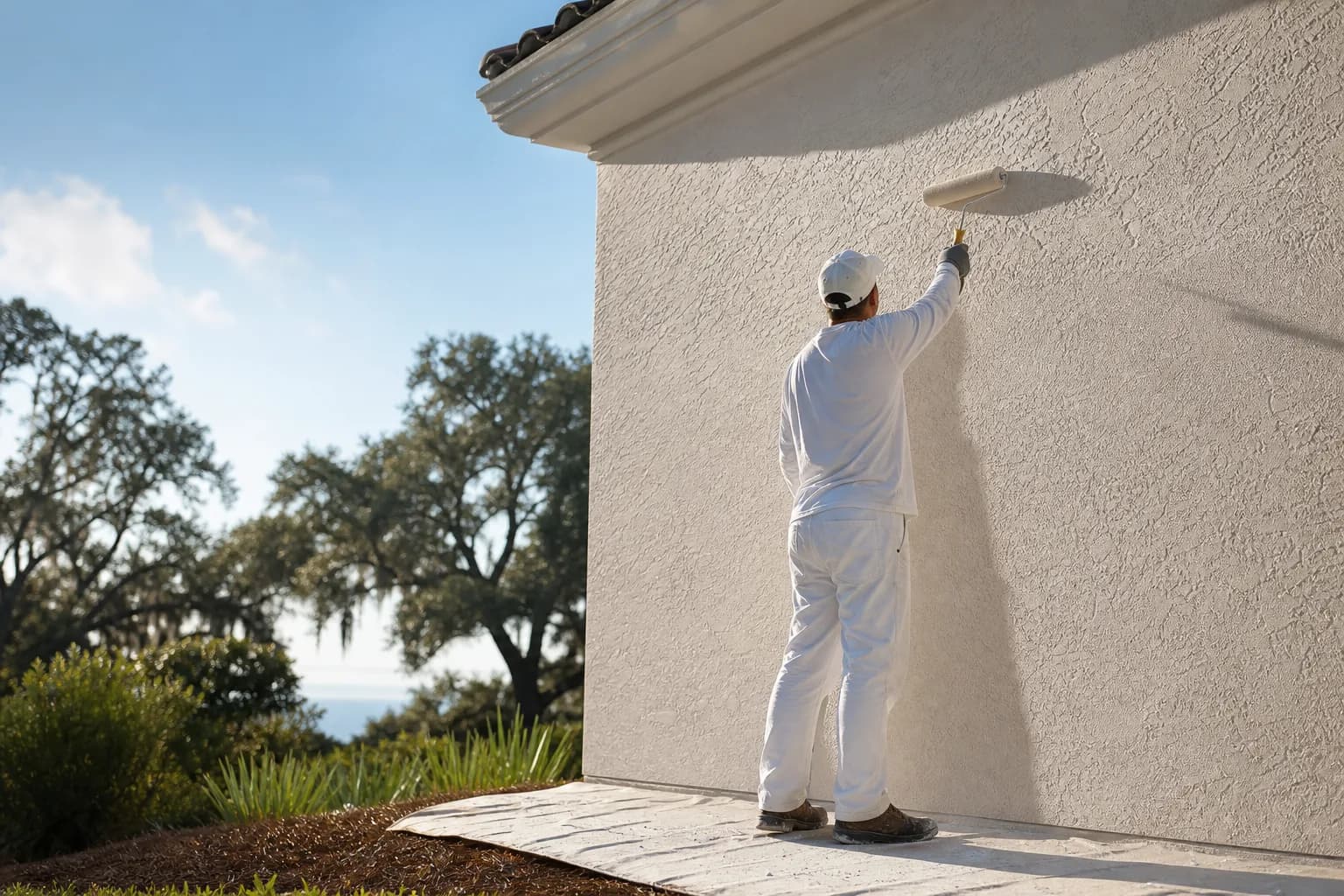
A stucco wall in our climate is doing something most homeowners never think about: it's breathing. All day it takes on humidity and wind-driven rain, and all day it lets that moisture back out as vapor. Paint the wall with the wrong product and you slam that door shut. The water still gets in — it always finds a way — but now it can't get out, so it pools behind the film until the paint blisters off in sheets and the wood behind it starts to rot.
If that's already happening on your walls, professional stucco painting that keeps the wall breathable is the fix — we find the moisture source first, then repaint.
That's the whole story of stucco failure on the Gulf Coast, and it's almost never the paint color or the brand. It's trapped moisture. Painting stucco in a humid climate is less about what shade you pick and more about choosing a coating that lets the wall dry and doing the prep that keeps water from getting behind it in the first place. Here's how to do it right.
Why does painting stucco in a humid climate trap moisture?
Stucco is porous by design. It's a cement-based skin that's meant to take on a little water and release it as vapor — that's how a properly built stucco wall stays sound. The problem starts when you coat that breathable skin with a paint that forms a tight, plastic-like film. Liquid water still pushes in through cracks, around windows, and during wind-driven rain. But the vapor that used to escape now hits the back of the paint film and stops.
In a dry climate that wall might get a chance to dry out between rains. On the Gulf Coast it rarely does. Mobile and Baldwin County see heavy annual rainfall and long stretches of high summer humidity, so there's almost always moisture trying to move through your walls. Seal it in behind the wrong paint and you get the classic failures: bubbling and blistering, paint that peels off in sheets, chalky white efflorescence where salts get carried to the surface, and — worst of all — soft, rotting framing you can't see until it's expensive.
Breathable paint vs. a sealed film
The fix is a paint that does two jobs at once: sheds liquid water from the outside, and lets vapor pass through from the inside. That's a vapor-permeable, or breathable, masonry coating — measured by its perm rating. A higher perm rating means more vapor can escape. The wrong choice is a thick, low-perm film that looks tough but seals the wall like a plastic bag.
| Coating type | How it handles moisture | Best fit for coastal stucco |
|---|---|---|
| Breathable acrylic masonry paint | Sheds rain, high vapor permeability — wall can dry | The everyday workhorse for most Gulf Coast stucco |
| Mineral / silicate masonry paint | Very breathable, bonds into the masonry | Older or unpainted stucco where max breathability matters |
| Quality elastomeric (used correctly) | Bridges hairline cracks; lower perm, so prep and drainage are critical | Crack-prone walls — only when the wall can still dry elsewhere |
| Standard non-breathable house paint | Forms a tight film that seals vapor in | Not recommended — the classic trapped-moisture failure |
Notice elastomeric in that table. It's a thick, flexible coating that's great at bridging hairline cracks, which makes it tempting on the coast — but it's lower-perm, so it has to be used thoughtfully on a wall that can still dry. There's a real "which one fits my wall" decision here, and we walk through it in detail in our breakdown of elastomeric vs. acrylic paint for Gulf Coast stucco. The short version: match the coating to the wall's condition and its ability to dry, not to whatever's cheapest on the shelf.
Prep is what keeps water out of the wall
Even the most breathable paint fails if water is pouring in faster than the wall can release it. That's why prep matters more on stucco than on almost any other exterior surface. As we tell folks all the time, prep is about 80% of a paint job that lasts — and on stucco, prep is mostly about controlling where water goes.
Let the wall dry and pick the window
Confirm the stucco is genuinely dry — new stucco cured 30 to 60 days, and an existing wall given a dry stretch after rain — and paint in a window with low humidity and no rain coming.Clean the stucco
Pressure-wash off chalk, dirt, mildew, and salt film so the new coat bonds to sound stucco instead of a dusty surface, then let it dry fully.Repair and seal cracks
Fill hairline and larger cracks with the right patch or sealant so wind-driven rain can't get behind the wall, and let every repair cure before painting.Prime bare and patched areas
Spot-prime raw stucco and repairs with a breathable masonry primer so the finish bonds evenly and the wall keeps its ability to release vapor.Apply breathable masonry paint
Roll or spray two coats of a vapor-permeable masonry paint, thick enough to shed rain but breathable enough to let interior moisture escape, drying between coats.
A few of those steps carry extra weight on the coast. Cracks are the number-one way water gets behind stucco, so painting over them without sealing is the same as inviting the problem in — repair them first, never bury them under a coat. It's the same entry path we trace in our breakdown of how wind-driven rain gets behind siding. Drying time is just as important: new stucco needs to cure for roughly 30 to 60 days before paint, and after one of our heavy rains an existing wall needs a dry stretch before anyone opens a can. Paint a damp wall and you've sealed that water inside on day one.
Don't forget drainage and detailing
Paint can't fix a water problem the building has. A lot of "the paint failed" calls we get on stucco are really drainage problems wearing a paint costume. Before — and after — you paint, check the spots where water actually gets in:
- Around windows and doors. Failed caulk and worn flashing let wind-driven rain run straight behind the stucco. Re-seal these before paint.
- Roof and gutter lines. Overflowing or missing gutters dump water down a stucco wall all season. Fix the drainage and you cut the load on the wall.
- The bottom of the wall. Stucco that runs too close to the soil or a patio wicks ground moisture up from below. That water shows up as peeling near the base no paint will stop.
- Cracks and penetrations. Anywhere a pipe, light, or fixture comes through is a potential leak. Seal them properly so the field of the wall isn't fighting hidden intrusions.
Get these right and your breathable coating is set up to win. Skip them and even the best paint is bailing out a wall that keeps filling up.
When to call a professional for coastal stucco
Stucco in a humid coastal climate is genuinely unforgiving. The margin between a job that lasts a decade and one that peels in two seasons comes down to reading the wall's condition, repairing and sealing cracks correctly, choosing a coating with the right balance of water resistance and breathability, and waiting for the right weather window. That's a lot to judge from the ground, and it's where DIY stucco jobs most often go sideways.
If your stucco is already blistering, peeling, or showing chalky efflorescence, that's a sign moisture is already trapped — and painting over it without finding the source just resets the same failure. Our exterior painting crews handle the full job: assessing the wall, repairing and sealing cracks, and applying a breathable system built for our humidity. If your walls have real damage from trapped water, our drywall repair and painting team can address the related interior staining that often comes with it. And for the bigger picture on protecting a coastal home's exterior, start with our exterior house painting guide for Mobile and Baldwin County.
The bottom line on painting stucco in a humid climate: choose a breathable paint, repair the cracks, fix the drainage, and wait for a dry wall and a dry forecast. Do that and your stucco sheds our rain while still drying out — which is the whole trick to a finish that lasts. When you want it done right, book a free in-home estimate and we'll hand you a written quote within 24 hours. Family-owned and serving the Gulf Coast since 2013.